

I've been in B2B sales for over two decades. I've closed deals over steak dinners that took three quarters to land. I've also closed deals on a Tuesday afternoon Zoom that started as a cold inbound 11 days earlier. Both of those things happened in my career. Only one of them is happening now.
What we're living through isn't a gradual compression. It's a full reset.
The traditional sales cycle—neat stages, gated discovery calls, months of nurturing—is done. Not "evolving." Not "under pressure." Done. And I'll be honest: most revenue teams, including ones I've led in the past, are still running a playbook their buyers stopped following.
Here's what I'm seeing, what the data backs up, and what I'm telling my team every single week.
The buyer already decided
Here's the number that keeps me up at night: 95% of the time, the winning vendor is already on the buyer's Day One shortlist. That's from the 6sense 2025 Buyer Experience Report—nearly 4,000 B2B buyers surveyed. Four out of five deals go to the "pre-contact favorite." The vendor the buyer picked before your SDR even got the email drafted.
Let that sink in. The deals sitting in your pipeline right now? Many of them were won or lost before your team booked the first meeting.
- 89% of B2B buyers use generative AI in purchasing decisions
- 50% of buyers now start research in AI chatbots, not Google
- 95% of winning vendors were on the buyer's Day One shortlist
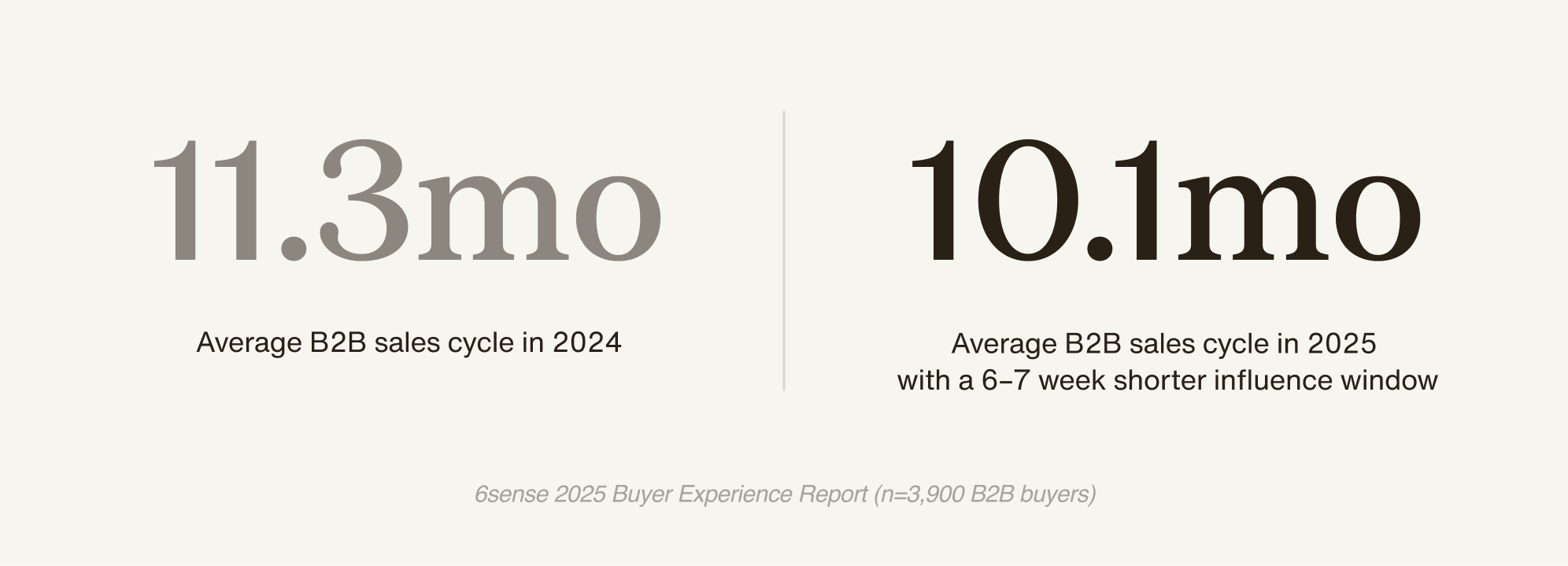
Average B2B sales cycles dropped from 11.3 months to 10.1 months between 2024 and 2025. Sounds modest, right? But here's the kicker—buyers are also contacting sellers earlier in the process (61% vs. 69%), which means your window to actually influence the outcome just shrank by six to seven weeks. That's not a rounding error. That's an entire pipeline stage evaporating.
And here's the paradox that messes with your head: buyers reach out sooner, but they've already done MORE work. They show up with AI-generated competitive matrices, peer review summaries, and a mental model of exactly what they want. The information advantage that used to justify a 45-minute discovery call? It's gone. Your buyer did it themselves on a Sunday night with ChatGPT.
Stop calling it discovery. It's an audition.
This is the shift I keep hammering with my team: your first meeting isn't an interview where you get to ask questions. It's an audition where the buyer decides if you're worth a second conversation.
When 90% of buyers have done substantial research before talking to any vendor, opening with "tell me about your company" doesn't just waste time—it signals that you haven't done yours. When your buyer spent three hours with ChatGPT preparing for this call, showing up unprepared isn't a missed opportunity. It's an insult.
The best reps I've managed don't walk into calls to learn about the prospect. They walk in to show the prospect they've already done the learning.
The old playbook was built around methodically qualifying: Does this prospect have budget? Authority? Need? Timeline? Each question was a gate. Each gate was a meeting. Each meeting was a week.
Today's buyers don't have patience for that. They've already used ChatGPT to compare you to four competitors. They've read your G2 reviews. They've watched your product walkthrough on YouTube. They know your strengths, they know your gaps, and they walked into your Zoom room to validate a hypothesis they've already formed.
If you show up with a generic deck and scripted questions, you've confirmed their hypothesis that you're interchangeable.
The crisis of sameness
This is the part that should scare every revenue leader reading this: AI has created a crisis of sameness. And it happened fast.
When every seller is using the same AI tools—same intent signals, same email generators, same personalization engines—guess what? The output all looks identical. Cold email conversion rates have actually DROPPED from 1-2% to 0.5-1.5% since mass AI adoption. Inboxes are flooded with competently mediocre messages that all sound like the same robot wrote them. Because it did.
The question buyers are asking isn't "does your product have the features?" AI already told them it does. The question is: do you actually understand MY problem well enough to be worth 30 minutes of my day?
I tell my team this all the time: if a buyer could get the same experience from a well-prompted chatbot, you haven't earned that meeting. You're furniture in their evaluation process. Don't be furniture.
What differentiates now
It's not what you know anymore. It's how well you listen. Not feature superiority—contextual intelligence. Not the strength of your product, but the depth of your preparation.
The sellers winning today put in the work before the call, not during it. I tell our team to research across five dimensions: what's happening in their industry, what their CEO is saying publicly, what their specific team is measured on, who the individual is and what they care about, and which of our customer stories maps closest to their situation. You don't show up with a list of questions. You show up with a point of view.
Proof beats demo. Every. Single. Time.
This is the hill I will die on. And it's where I see the BIGGEST gap between teams that crush quota and teams that wonder why deals stall.
A demo is a performance. Scripted, polished, running on fake data in a perfect environment. Proof is evidence. It's their actual problem, solved with their actual data, shown to them before they even asked for it.
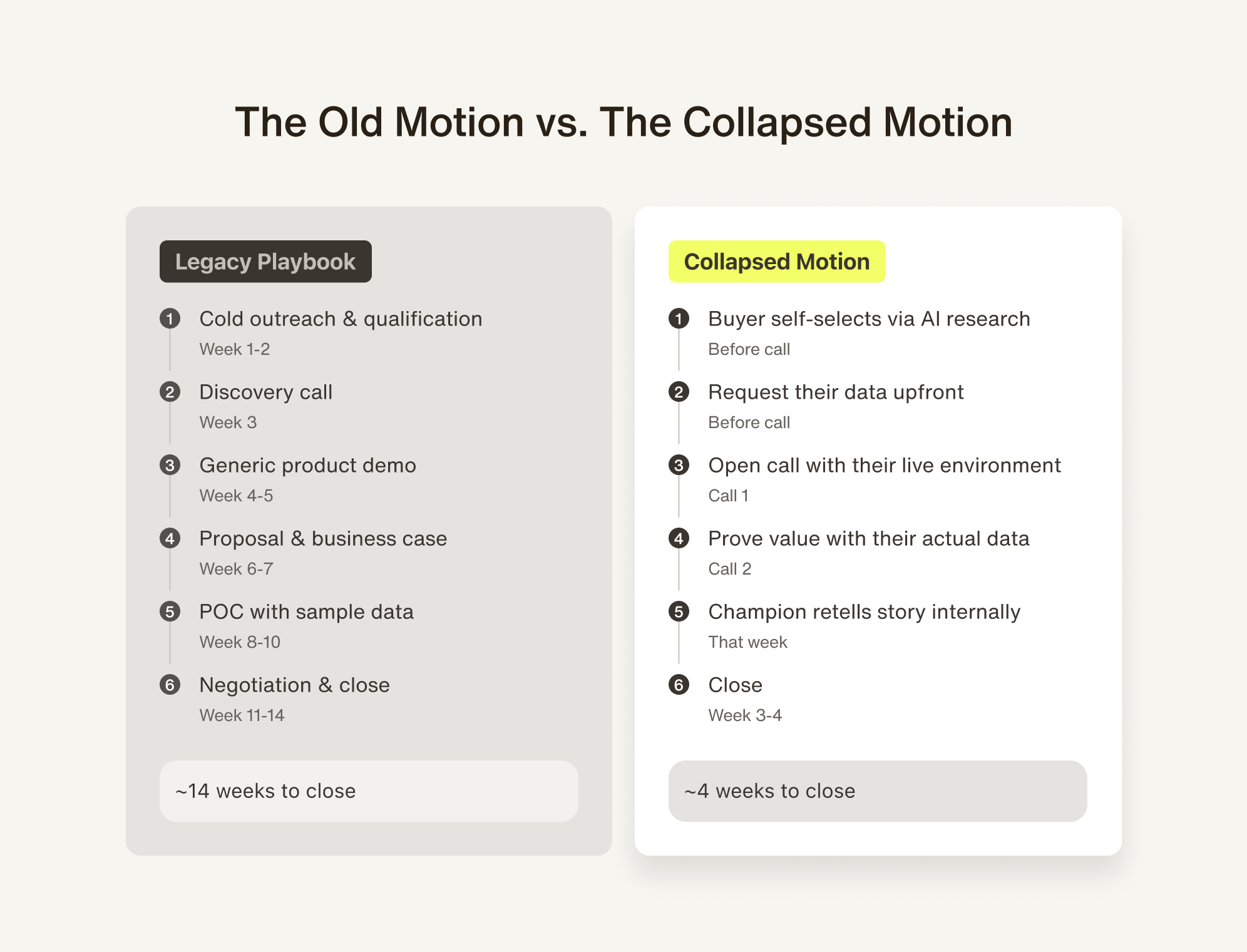
The teams getting real customer data into their systems by call two? They're closing deals that used to take months. And the psychology is dead simple: when a buyer sees their own data inside your product, they've already mentally adopted it. Everything after that is paperwork.
When I look at stalled deals in our pipeline, the first thing I check is: when did proof show up? If it was too late, too generic, or too disconnected from their specific pain—that's your answer. That's almost always the answer.
Emotion closes deals. Data defends them.
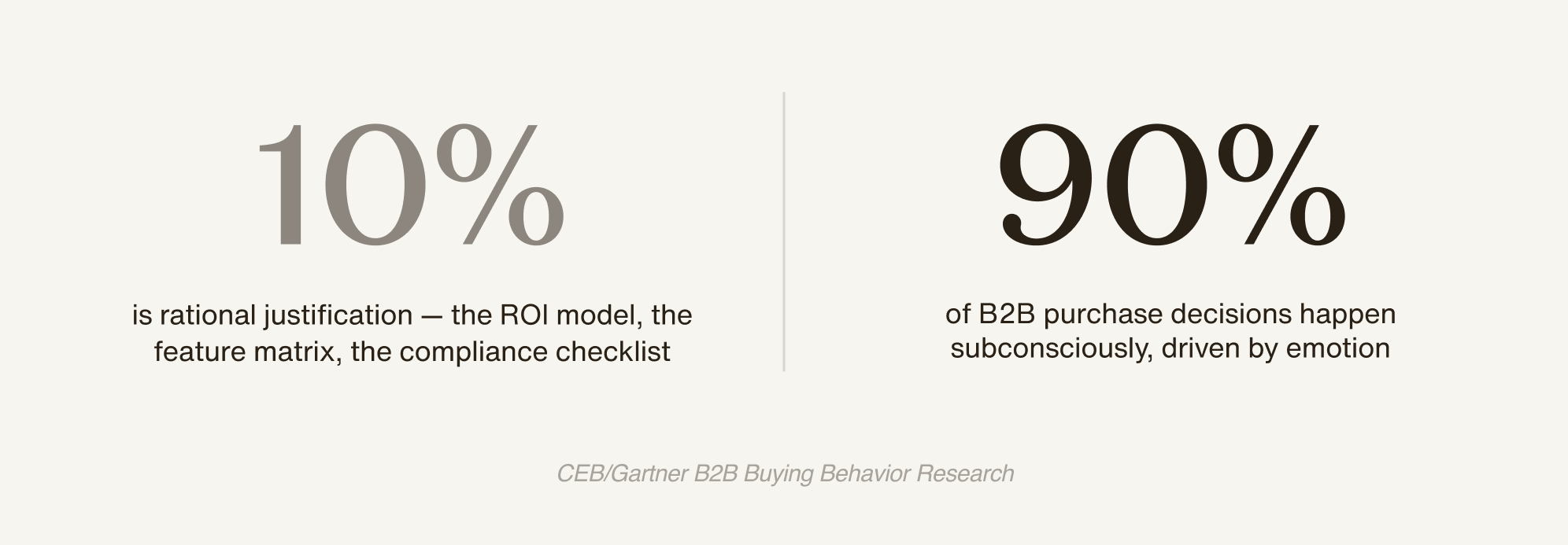
I know this sounds weird coming from a CRO, but hear me out: 90% of B2B purchase decisions happen subconsciously, driven by emotion, then justified with logic afterward. I didn't make that up—it's backed by CEB/Gartner research. And it tracks with everything I've seen in 20+ years of selling.
Data matters. I'm not saying throw out the ROI model. But data doesn't close. Data defends a decision the buyer already made because of how you made them FEEL.
Here's what blew my mind when I first saw the research: individual benefits—"Will this reduce MY stress? Make MY job easier? Help ME look good to my VP?"—have TWICE the impact of organizational benefits on purchase decisions. And over 50% of B2B buyers form strong emotional connections with their vendors. That's higher than most consumer brands. In B2B! Wild.
Your ROI calculator doesn't close the deal. It gives your champion permission to say yes to a decision they already made in their gut.
This is why I'm obsessed with storytelling in our sales org. It's not a soft skill. It's THE mechanism by which buying decisions actually get made.
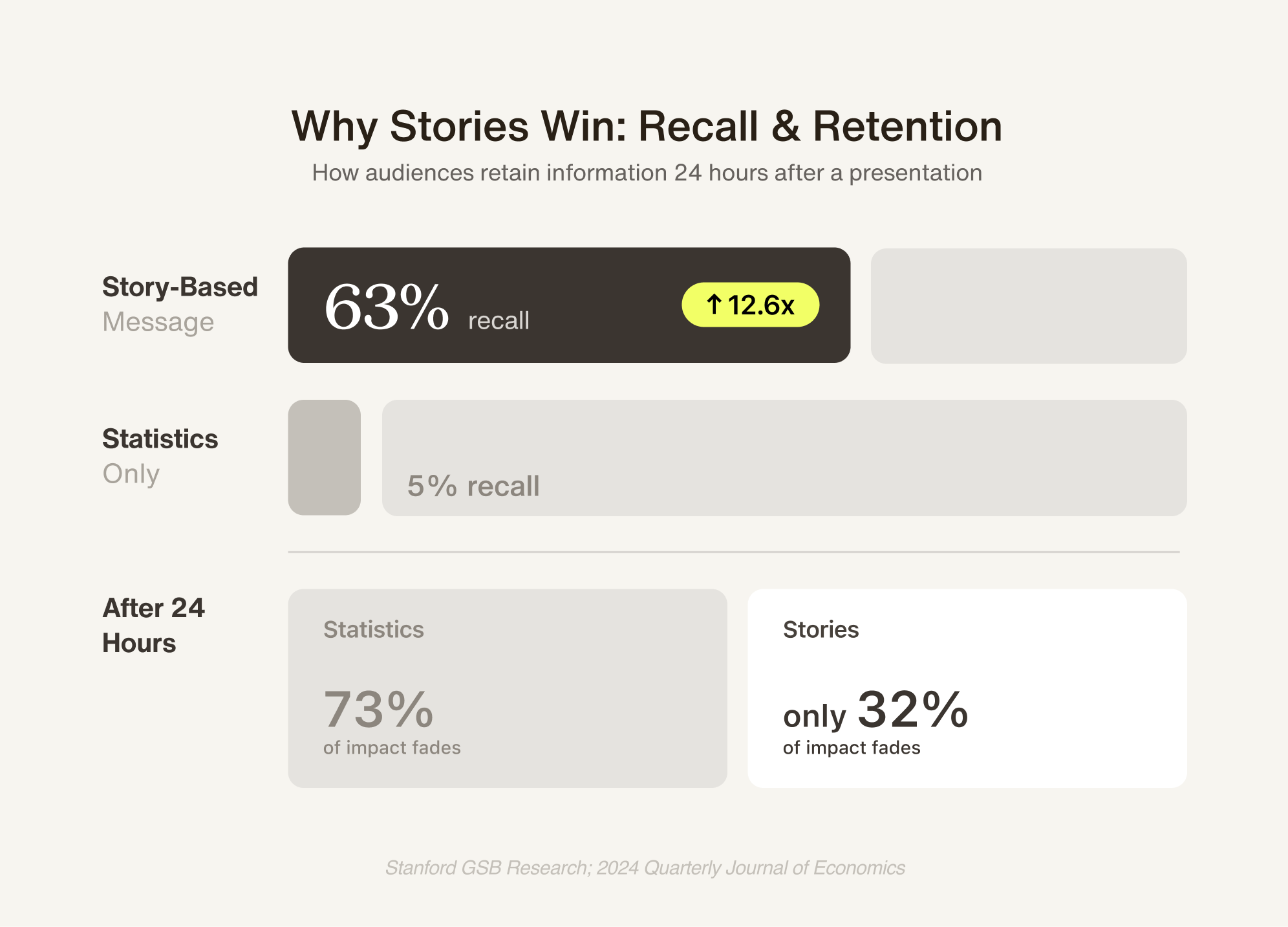
Stanford research: stories produce 63% recall versus 5% for statistics alone. After 24 hours, 73% of statistical impact fades versus only 32% for stories. When you tell a buyer about a care coordinator who couldn't see problems until customers complained—and now spots issues before anyone notices—that lands 12x harder than "we have 500 enterprise customers." It's not even close.
The neuroscience backs this up in a big way: stories trigger neural coupling between speaker and listener. They release cortisol (focus), oxytocin (trust), and dopamine (motivation). You're not just presenting. You're literally syncing brains. That's the superpower that no AI tool can replicate.
Your champion can't sell what they can't remember
I wish someone had grabbed me by the shoulders early in my career and said this: the person on your Zoom is almost never the person who signs the check. Your real job—the thing that separates closers from presenters—is arming that person with something they can carry into every internal meeting you'll never be invited to.
Nobody walks into their VP's office and recites a feature matrix. Nobody. But they WILL walk in and say, "Let me tell you what happened at a company just like ours." That's the story doing the selling when you're not in the room. That's the whole game.
I think of stories as portable value. A feature list dies in someone's inbox. A good story gets retold in Slack threads, in executive reviews, in budget conversations you'll never see. The technical details travel inside the narrative, not alongside it.
So the real question after every call isn't "did I nail the pitch?" It's: did I give my champion something they can repeat from memory at their Monday standup? If not, you gave them a deck. Not an argument.
How I coach my reps to structure a customer story
- Name a real person: Not "a Fortune 500 customer." Give them a name, a title, a role your buyer recognizes as their own. Specificity creates identification.
- Describe their bad Tuesday: What did their daily grind look like before? The manual workarounds, the 2am alerts, the spreadsheet chaos. Make the buyer nod and think: "that's me."
- Explain why they were stuck: What kept them from fixing it on their own? Legacy tech, organizational inertia, lack of visibility? This is where your buyer stops listening politely and starts leaning in.
- Show the shift: Not a product walkthrough. Describe how that person's actual workday changed. What do they do differently on a Wednesday morning now?
- Land the number: Now the metric has emotional weight. When you say "40% reduction in handle time," the buyer already has a face attached to it. The ROI isn't abstract anymore.
The rule I enforce: never open with what our product does. Open with what someone like them was struggling with. Tie every capability to a real person facing a real constraint. And close with how that person's Tuesday afternoon is different now—not with a screenshot of our dashboard.
What I'm telling my team right now
I'll keep this real. Here's what I tell our revenue team every week—the stuff I repeat until they can say it back to me:
- The first call is a thesis defense: Show up with a hypothesis about their problem. Back it with research. If you're asking "tell me about your company" in 2026, we have a problem.
- Collapse the motion: Get their data into our system before call two. The competitor who shows proof first usually wins.
- Burn the deck: Your slides are a crutch. What buyers haven't seen? Someone who genuinely understands their pressure and can describe a real path through it.
- Equip the champion: Every story should be designed for retelling. If your champion can't repeat your narrative from memory, you gave them a feature list.
When deals stall, check the proof. Where did proof show up in the cycle? Too late? Too generic? Too disconnected from their specific pain? Nine times out of ten, that's your answer.
The bottom line
This is the biggest shift in B2B sales since the internet made information free. AI didn't just compress the cycle—it restructured the entire power dynamic between buyers and sellers.
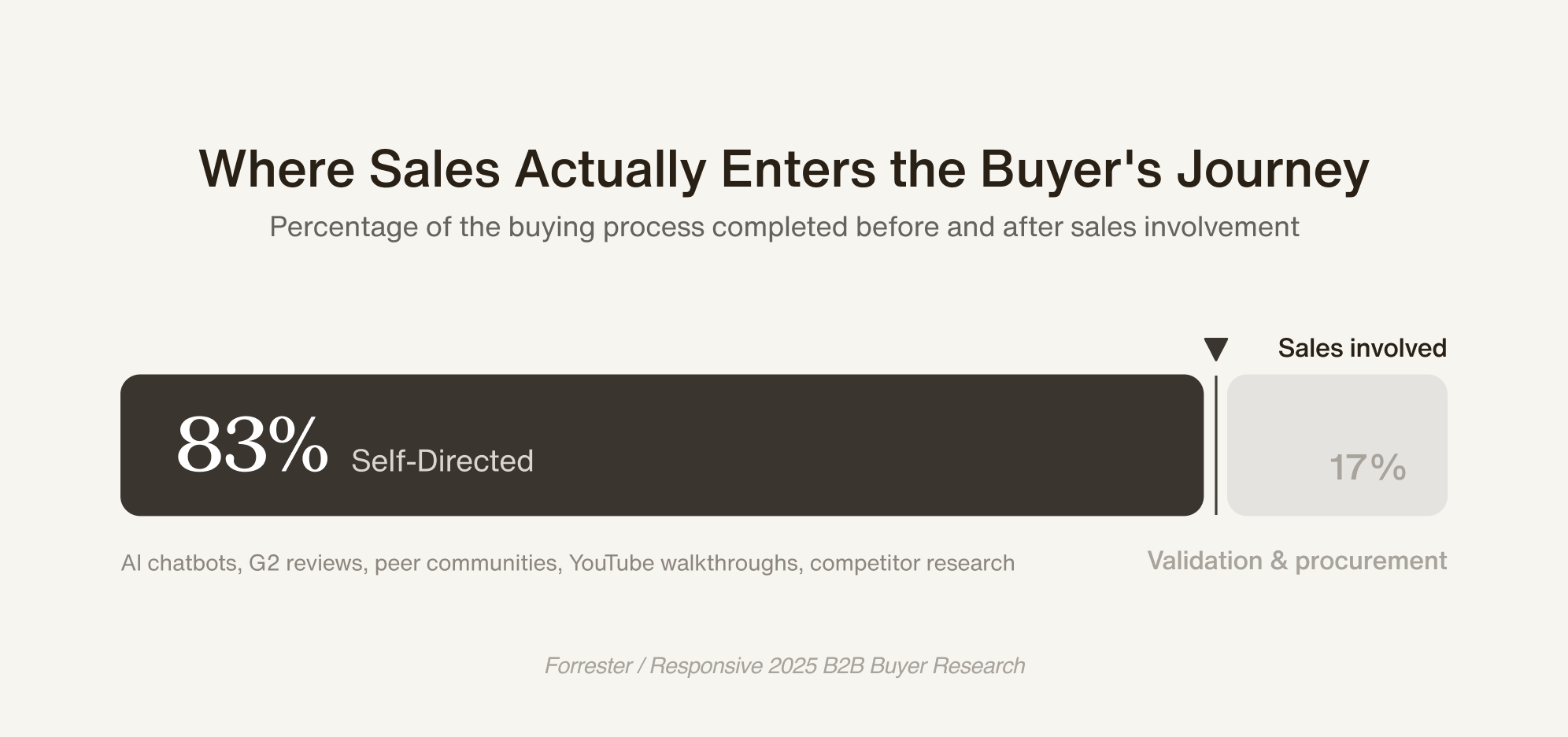
Buyers show up informed, opinionated, and moving fast. They've already used AI to build shortlists, compare vendors, and form preferences. The 83% of the journey that happens without us? That's not a problem to fix. That's the new playing field.
The sellers who win from here aren't the ones with the best decks. They're the ones who show up prepared, lead with proof, and tell stories worth retelling.
The sales cycle didn't shrink. It already shrank. The only question left is whether your team has caught up. Let's go.