- Evaluating Cresta?
Cresta handles the conversation.
We own the relationship.
Cresta stops when the call ends. Delight.ai persists across every interaction, remembering customers, anticipating needs, and resolving issues before they become tickets.
Book a demo



Delight.ai vs Cresta :
The complete stack, not another add-on.
Beyond what Cresta offers. All native to delight.ai.

Agent Memory Platform (AMP)
Persistent profiles across every interaction, with shared context.

Trust OS
Full visibility with built-in policy and controls.
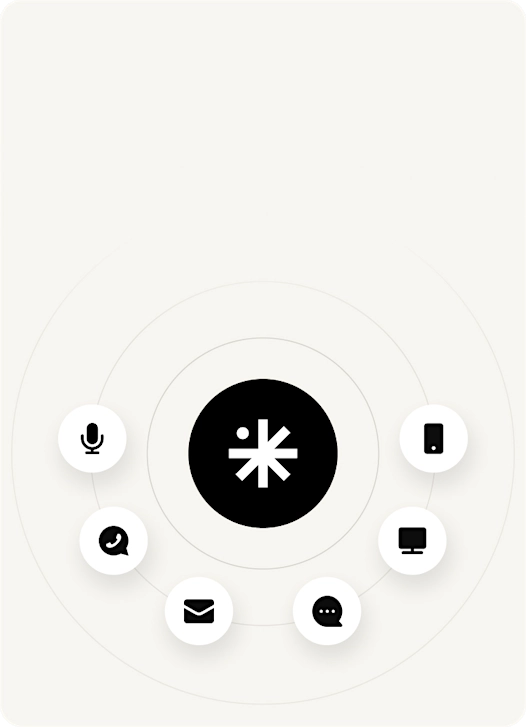
Omnipresence
All channels in one place with full context across interactions.

Sendbird Desk
Built-in helpdesk with AI-to-agent handoffs. No CCaaS required.
Where Cresta is strong.
Where we differ.
The strongest case for delight.ai is an honest one. Here is where Cresta excels and where the two were built for different jobs.

When to choose each platform

Real-time agent coaching
Real-time guidance delivered during live calls to help agents respond more effectively, stay on script, and close faster. If live agent coaching is your core need, Cresta specializes in this.

100% QA auto-scoring
Every interaction scored automatically, not sampled. Built for CC ops teams that need full coverage without manual review. Cresta offers deep investment here for quality-focused teams.

Additive to existing CCaaS
Layers onto Genesys, NICE, or Five9 without rip-and-replace. Need deep CCaaS integrations out of the box? Cresta is built for that.
Questions worth asking any AI vendor, including us.
The right questions surface the real differences between platforms.
It depends on what you need to optimize. Contact center AI is built to handle inbound interactions faster, coaching agents and scoring calls. Delight.ai is built to reduce how many of those contacts need to happen at all, through persistent memory, autonomous resolution, and proactive outreach. One optimizes the interaction. The other optimizes the relationship.
Personalization requires memory that persists across every session and channel. Most contact center AI scopes context to the active call, so each interaction starts from zero. Agent Memory Platform builds a continuous profile from every conversation, purchase, and signal, so the AI knows who the customer is and what they need before the conversation begins.
Most contact center AI is reactive. It handles interactions well when customers reach out. For You Conversations lets the AI initiate outreach at key moments, when a customer goes quiet, hits a lifecycle milestone, or is at risk of churning, without waiting for them to come to you first.
Some platforms are intelligence layers that require an existing CCaaS such as Genesys, NICE, or Five9 to operate. Sendbird Desk ships natively with delight.ai, so the helpdesk, agent workspace, ticketing, and AI come as one system. No third-party CCaaS required.
Some platforms scope governance to contact center workflows. Trust OS is built for broader oversight, giving your team full visibility into every AI decision, what it said, why, and whether it followed the SOP you defined. For regulated industries that need a complete audit trail across the customer journey, that distinction matters.
Contact center AI is typically measured on handle time, conversion rate, and quality scores within the conversation. Delight.ai is optimized for what happens after, whether customers return, upgrade, or churn. The metrics a platform is built around reflect the outcomes it was designed to drive.
Most contact center AI is built for a single channel. Omnipresence lets the AI meet customers on chat, voice, email, SMS, and messaging apps, with full context carried across every interaction. No matter where a customer reaches out, the AI already knows who they are and where they left off.
Some platforms carry the vendor's fingerprint into the customer experience. Delight.ai is fully white-label, so your brand owns the interface, voice, personality, and escalation logic end to end.
The call ends. The relationship doesn't.
See how delight.ai handles memory, engagement, and resolution in one platform.