If you're comparing Ada CX alternatives, you've probably already seen what Ada does well. It's a mature enterprise platform with strong G2 ratings, customers including Pinterest, monday.com, and Zapier, and a newly launched Unified Reasoning Engine that signals ongoing investment in AI capabilities.
But three factors tend to push customer experience (CX) leaders toward alternatives: per-resolution pricing that gets harder to predict as AI success grows, session-scoped context that resets between conversations and channels, and integration constraints that require Zendesk or Salesforce for full feature availability. Which trigger matters most to your team will shape which alternative fits best.
This guide evaluates 11 Ada CX alternatives across 8 criteria—from pricing transparency and deployment speed to compliance certifications and market validation. We applied the same framework to every platform, including our own. If you're evaluating AI customer service platforms more broadly, the criteria below apply beyond this specific comparison.
Why buyers look for Ada CX alternatives in 2026
Three issues come up again and again when CX leaders start exploring alternatives to Ada.
1. Your costs grow every time your AI gets better
Because Ada charges per resolution ($1 to $3.50 each), your bill scales directly with your AI's success. The better it performs, the more you pay. For teams scaling from 10,000 to 50,000 monthly resolutions, that's a cost curve that's tough to plan around—first-year contracts can land anywhere from $30,000 to $250,000+.
2. Every conversation starts from scratch
Ada runs on session-scoped context—each new conversation is a blank slate. A customer who called yesterday about a billing issue and comes back today via chat has to re-explain everything. If you're tracking CSAT and NPS across touchpoints, that memory gap creates a frustrating experience that automation alone can't fix.
3. You'll need a separate helpdesk (and the bill that comes with it)
Ada doesn't handle human agent workflows on its own, so you're adding another platform at $55 to $175+ per agent per month to your total cost of ownership (TCO)—plus the overhead of keeping two systems in sync. And if your team's knowledge lives in Confluence, Notion, Google Drive, or internal wikis, you'll hit a wall—Ada primarily pulls from structured help center articles.
These architectural choices create friction for specific use cases, and that friction is what drives the search for Ada AI alternatives.
Which Ada CX alternative is right for you?
Before reading all 11 profiles, start with the scenario closest to your situation.
Mid-market SaaS teams on Intercom or Zendesk seeking an affordable plugin. Look at My AskAI ($199/mo + $0.10/ticket), eesel AI ($239–$799/mo), or Fin ($0.99/resolution) first. These platforms deploy in minutes, price transparently, and integrate natively with the helpdesks you already use. They work best when your primary need is ticket deflection without a platform overhaul.
Enterprise contact centers needing voice and digital channels in one platform. Evaluate Sierra AI, Cognigy, and delight.ai. All 3 handle voice alongside chat, email, and messaging—but they come with enterprise price points and implementation timelines to match. Cognigy brings Gartner validation; Sierra brings autonomous action-taking; delight.ai brings persistent customer memory and end-to-end resolution via Agent Steward.
High-volume teams needing persistent memory and personalization across channels. Consider delight.ai, Kustomer, or Decagon. Each approaches customer context differently—delight.ai through conversational memory, Kustomer through customer relationship management (CRM)-based timelines, Decagon through cross-channel user profiles—but all retain context beyond a single session or ticket.
Regulated industries needing compliance-first AI. Start with Fini AI, Cognigy, delight.ai, or Ada CX itself. Fini holds 3 audited compliance certifications (SOC 2, ISO 27001, GDPR). Cognigy offers on-premise deployment. delight.ai inherits Sendbird's enterprise security infrastructure and holds SOC 2 Type II, HIPAA, GDPR, and ISO 27001. Ada's own compliance portfolio—SOC 2, HIPAA, GDPR, PCI, and AIUC-1 certification—is strong, and may be sufficient if your switching triggers are pricing or integration concerns rather than compliance gaps.
Already on Zendesk? Zendesk AI is the path of least resistance—you eliminate a vendor and keep your workflows intact. The question is whether its AI layer goes deep enough for your automation goals.
Not sure you need to switch at all? Ada remains a strong choice for teams that need pure ticket deflection with no cross-session memory requirement, have stable conversation volumes with pre-defined flows, and are satisfied with Zendesk or Salesforce as their primary helpdesk.
How we evaluated these Ada CX competitors
We assessed each platform against 8 criteria, organized into 2 tiers based on what we hear from CX leaders evaluating AI platforms.
Tier 1—table-stakes criteria (these come up in nearly every evaluation conversation we have):
- Pricing transparency and predictability—Can you model your costs before signing? Is the pricing published? This matters especially for AI customer service agent pricing, where models vary widely across vendors.
- Deployment speed and ease of setup—How quickly can you go from contract to live AI, and what resources does that require?
- Helpdesk integration flexibility—Does the platform work with your existing helpdesk, or does it force you to change systems?
- AI accuracy and resolution rate—What percentage of conversations does the AI resolve autonomously, and how is that measured?
Tier 2—emerging criteria (important for specific buyer segments but not yet universal in evaluation conversations):
- Omnichannel coverage—Does the platform support voice, chat, email, SMS, and social from one deployment?
- Compliance and security certifications—Which audited certifications does the platform hold?
- Knowledge source flexibility—Can the AI learn from sources beyond your help center—past tickets, wikis, internal documents?
- Market presence and independent validation—How many independent reviews exist, and what do analyst firms say?
We applied every criterion to every vendor, including delight.ai. In the comparison table below, entries marked with an asterisk (*) are vendor claims that haven't been independently verified. We used the same evidence standard across all platforms.
Quick-reference comparison table
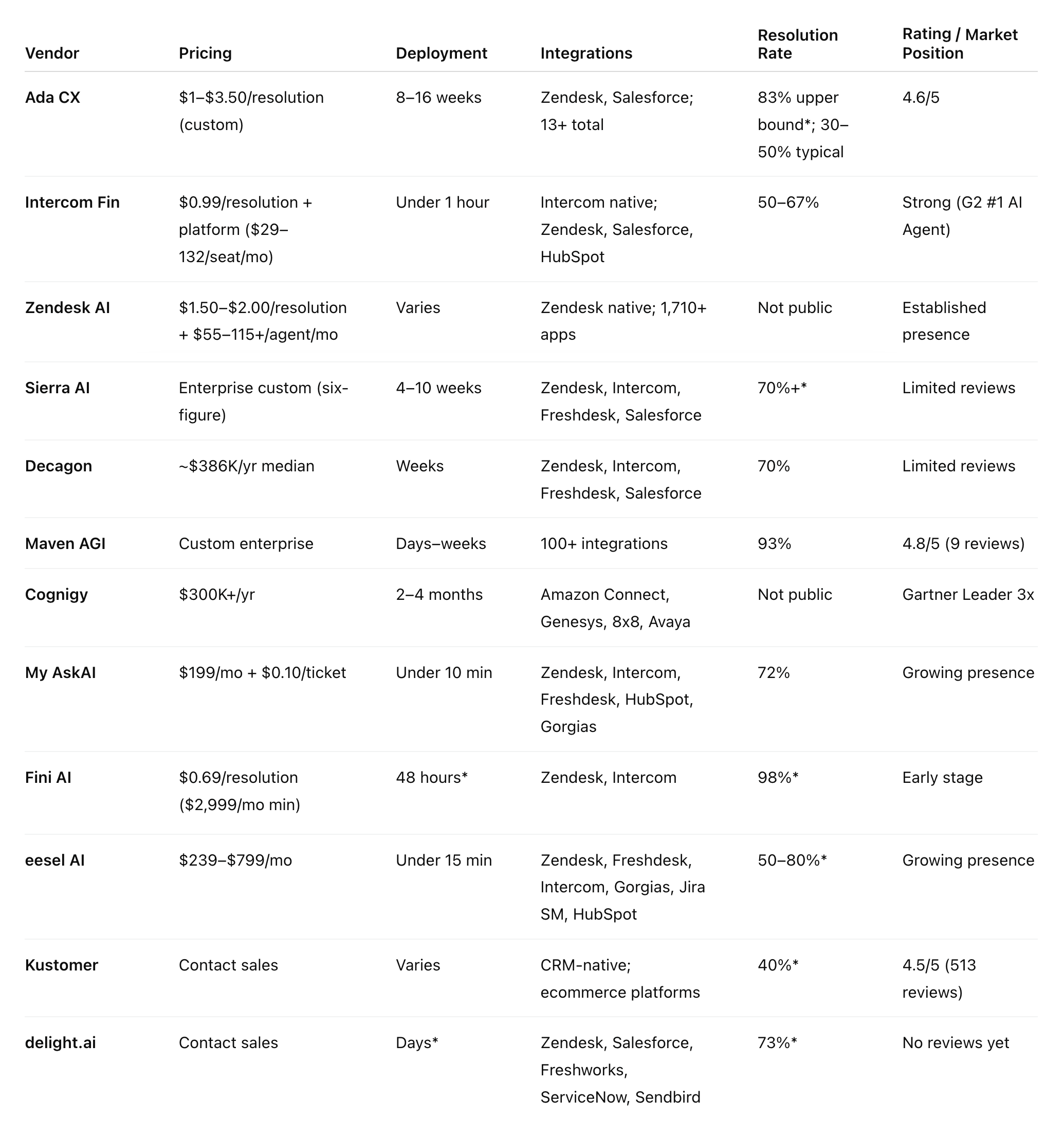
* = vendor claim, not independently verified.
TCO estimates at scale
For platforms with published pricing, here's what monthly costs look like at three volume levels. This comparison uses published rates only—actual costs depend on contract negotiations.
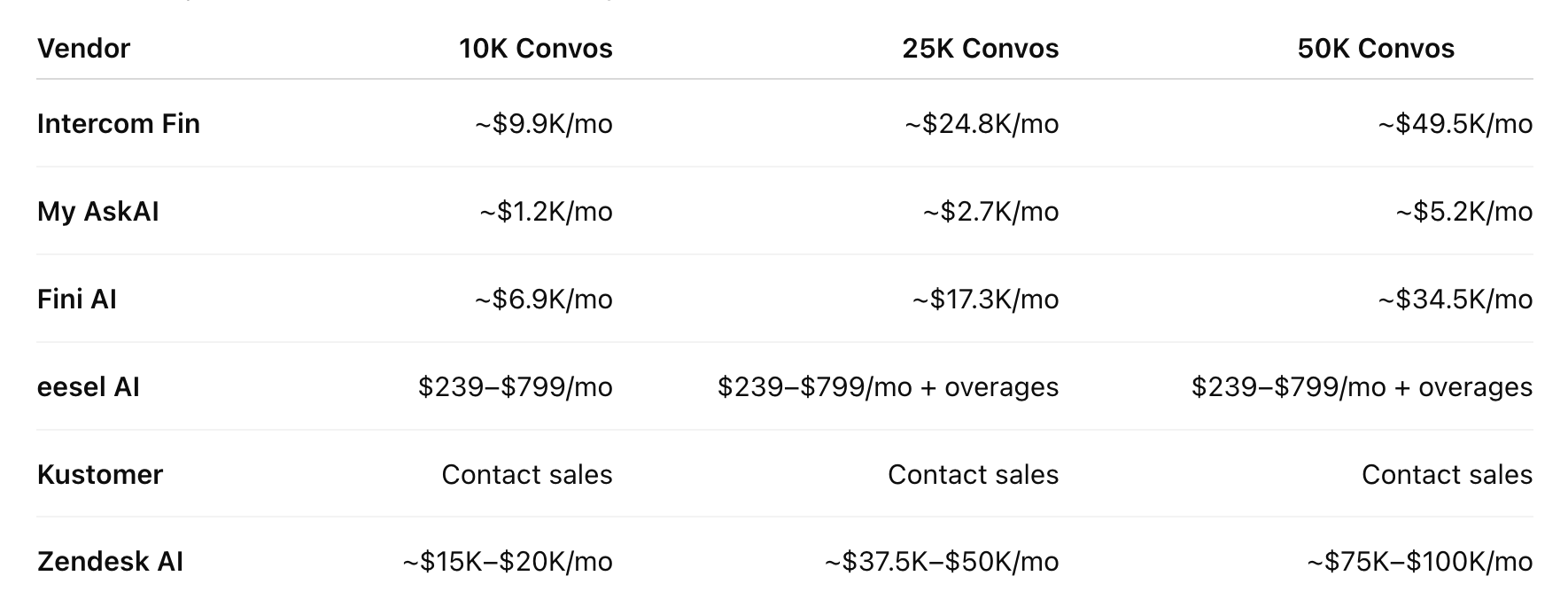
For Ada CX, Sierra AI, Decagon, Maven AGI, Kustomer, delight.ai, and Cognigy, you'll need a direct quote—all use custom enterprise contracts, so there's no way to model TCO from public data alone.
Note: These estimates use published per-resolution or per-conversation rates and assume all conversations result in resolutions. Actual costs depend on resolution rates, plan tiers, add-ons, and contract negotiations. Platform subscription fees are included where published.
Now let's get into each platform — what they do well, where they fall short, and who they're best suited for.
1. Fin by Intercom: Transparent pricing with ecosystem gravity
Intercom's Fin AI agent shows up most frequently in Ada evaluation cycles, and for good reason. Its $0.99 per resolution pricing directly addresses the opacity that pushes many buyers away from Ada. You know what you'll pay before you sign.
Fin achieves 50 to 67 percent autonomous resolution, powered by Anthropic's Claude, and deploys in under an hour for teams already on Intercom. The compliance portfolio is substantial: SOC 2 Type II, HIPAA, GDPR, CCPA, ISO 27001, ISO 27018, ISO 27701, and ISO 42001—8 certifications that exceed what most Ada CX competitors in this comparison can match.
The trade-off is scale economics. At 50,000 monthly resolutions, that transparent $0.99 adds up to $49,500 per month in resolution fees alone, before platform subscription costs. Fin also works best within the Intercom ecosystem. Teams on other helpdesks can use it as an overlay, but the experience is tighter and the feature set deeper for native Intercom customers. And like Ada, Fin operates without persistent memory across conversations—each ticket starts fresh.
Ada CX vs Fin: Both charge per resolution, but Intercom publishes the rate while Ada doesn't. Intercom deploys in under an hour; Ada takes 8 to 16 weeks for enterprise implementations. Ada claims higher peak resolution rates (up to 83 percent in optimized deployments, though 30 to 50 percent is typical), while Intercom's 50 to 67 percent range is more consistently reported. Where Ada requires Zendesk or Salesforce for full functionality, Intercom works natively within its own platform and overlays others. For SaaS teams already using Intercom, Fin is the most natural path away from Ada. For teams on other helpdesks, the ecosystem gravity cuts both ways.
Best for: SaaS teams already in the Intercom ecosystem who want transparent per-resolution pricing and the fastest deployment path off Ada.
2. Zendesk AI: The path of least resistance for existing customers
Many Ada customers already run Zendesk as their helpdesk, which makes the simplest alternative the one they're already paying for. Zendesk offers 1,710-plus marketplace integrations and has pre-trained its AI models on 18 billion support tickets across industries. The March 2026 acquisition of Forethought signals aggressive investment in AI capabilities beyond traditional ticketing.
Upgrading your existing Zendesk to include native AI eliminates a vendor, removes an integration layer, and keeps your data in one system. For companies that have spent years building workflows, macros, and reporting around Zendesk, this path involves the least disruption.
But Zendesk's AI is layered onto a ticketing architecture, not built from scratch around it. Context remains ticket-scoped rather than customer-scoped, so cross-conversation continuity depends on the agent pulling up previous tickets manually. The learning curve is steep—155 G2 reviews mention it specifically. Pricing is complex, with critical features gated to higher tiers and per-agent fees that compound for larger teams. And while the AI handles question answering well, it's weaker at autonomous actions like processing refunds or updating subscriptions. Zendesk hasn't publicly reported its AI resolution rates.
Ada CX vs Zendesk AI: Ada offers deeper AI automation focused exclusively on customer service. Zendesk offers a broader platform with ticketing, analytics, workforce management, and the largest integration ecosystem available. Ada is a specialist; Zendesk is an ecosystem. If your Ada evaluation is driven by integration frustration, Zendesk may solve it simply by being the platform your other tools already connect to. If your concern is AI depth, Zendesk's AI layer may feel like a lateral move.
Best for: Companies already on Zendesk who want to consolidate AI and helpdesk under one vendor rather than adding another tool to the stack.
3. Sierra AI: Premium enterprise autonomy at premium enterprise cost
Sierra plays in a different league—40 percent of Fortune 50 companies are reportedly customers, and the founding team (Bret Taylor, former Salesforce co-CEO; Clay Bavor, former Google product lead) brings the kind of credibility that opens enterprise doors fast.
What sets Sierra apart is action-taking. Its AI agents don't just answer questions—they process refunds, update CRM records, modify subscriptions, and execute backend workflows autonomously. For large business-to-consumer (B2C) enterprises where customer service involves transactions, not just information delivery, this shifts AI from deflection tool to operational participant.
But it comes at a cost—contracts run six figures with 4-to-10-week implementations, and Sierra doesn't publish pricing, SLAs, or uptime guarantees—so you're deep into a sales cycle before you know what you're committing to. Peer validation is thin too: limited G2 reviews despite the enterprise traction, which makes independent diligence harder. And Sierra's architecture splits your data—bot conversations live in Sierra while human conversations stay in your existing helpdesk—so it's worth evaluating how that dispersion affects reporting and handoffs.
Sierra uses a layer-on-top application programming interface (API) architecture that sits above existing CX infrastructure, so it doesn't require replacing your current helpdesk.
Best for: Large B2C enterprises with six-figure budgets seeking autonomous action-taking across backend systems and the patience for an enterprise implementation timeline.
4. delight.ai: Persistent memory and end-to-end resolution
delight.ai takes a different architectural bet: persistent customer memory as the foundation, not a feature. The Agent Memory Platform (AMP) builds evolving customer profiles from every interaction across chat, SMS, email, WhatsApp, and voice—so when a customer who contacted you last week returns through a different channel, the AI picks up where things left off. Buyers evaluating both delight.ai and Decagon should compare memory capabilities in live demos, since both retain context across sessions and channels but take different approaches.
Where Sierra focuses on autonomous action-taking within a single conversation, delight.ai's Agent Steward handles end-to-end resolution that spans sessions, channels, and time. Steward orchestrates specialized sub-agents in parallel—booking systems, compliance, refunds—and continues working in the background when resolution requires waiting on a third party or following up days later. Teams control how much autonomy the AI gets across four graduated levels, starting wherever they're comfortable and expanding as confidence builds.
The platform includes native Sendbird Desk, so AI and human agents share one system without a separate helpdesk—eliminating a $55 to $175+ per-agent monthly line item. Compliance certifications include SOC 2 Type II, HIPAA, GDPR, and ISO 27001, and Voice AI operates with sub-second latency in 15-plus languages.
Case studies demonstrate capability: Hanssem progressed from 48 to 90 percent resolution over 5 months, and Lotte Homeshopping reports 30 to 40 percent workload reduction. Pricing requires a sales conversation, and the integration ecosystem is narrower than Zendesk or Salesforce-native platforms.
Best for: High-volume teams in industries where resolution is complex—travel, healthcare, fintech, retail—who need persistent customer memory and end-to-end issue ownership across systems and channels.
5. Decagon: Engineering-grade AI for fintech and SaaS
Where Sierra targets the Fortune 50, Decagon approaches AI customer service as an engineering problem. Its Agent Operating Procedures let teams define resolution workflows in natural language that get compiled into executable code—a model-agnostic approach that avoids lock-in to any single large language model (LLM) provider.
The production numbers back it up: Chime reports 70 percent AI resolution across both chat and voice, with sub-second voice latency that puts Decagon in the same conversation as dedicated voice platforms. Customers like Eventbrite, Notion, Duolingo, and Rippling round out a roster that skews toward tech-forward companies with high expectations.
Decagon also offers cross-channel persistent user memory, making it one of the platforms in this comparison that retains customer context across sessions and channels. For teams where session-scoped limitations are the primary reason for leaving Ada, Decagon deserves serious evaluation.
The cost, however, is substantial. Vendr procurement data shows a median annual contract of approximately $386,000, making Decagon more expensive than Ada for most deployments. It requires engineering resources for deep integration, Agent Assist is limited to Zendesk only, and the sales-led process means weeks to deploy.
Best for: Tech-forward fintech and SaaS companies with engineering resources and budget to match who need production-grade AI resolution at scale.
6. Maven AGI: Fast-deploying enterprise AI with strong resolution data
Maven AGI has grown quickly since its July 2023 founding, hitting $7 million in ARR within 5 months of launch. Backed by $78 million in total funding—including a $50 million Series B in June 2025 led by Dell Technologies Capital—the founding team brings enterprise credibility: Jonathan Corbin, formerly Global VP of Customer Success and Strategy at HubSpot, and Sami Shalabi, who led engineering for Google News.
What stands out is the resolution data. Mastermind hit 93 percent autonomous resolution in 6 weeks, and K1x reached 80 percent in just 1 week. These are vendor-published case studies rather than independent audits, but the specificity and named customers—TripAdvisor, ClickUp, HubSpot, Rho, impact.com—add credibility. Maven operates as a layer-on-top architecture with 100-plus pre-built integrations across Salesforce, Zendesk, Freshdesk, HubSpot, Intercom, and others, so it doesn't require replacing your existing helpdesk.
Channel coverage spans chat, voice, email, SMS, and WhatsApp—with Maven Voice using the OpenAI Realtime API for sub-second latency through an official OpenAI partnership. On the compliance side, Maven holds SOC 2 Type II, ISO 27001, and ISO 42001.
The limitations are maturity-related. G2 shows 4.8 out of 5, but with only 9 reviews, that score carries limited statistical weight. Pricing is custom enterprise with no published rates, which makes TCO modeling impossible before a sales conversation. The 102-employee team (as of February 2026) is growing fast but remains small relative to the enterprise contracts it pursues.
Best for: Mid-market and enterprise teams seeking rapid deployment (days to weeks) with strong resolution rates, who are comfortable evaluating a high-growth but earlier-stage vendor with opaque pricing.
7. Cognigy: Voice-first enterprise automation backed by Gartner
Cognigy is the analyst-validated choice for voice-first contact centers. 3 consecutive years as a Gartner Magic Quadrant Leader for Conversational AI, plus deep integrations with Amazon Connect, Genesys, 8x8, and Avaya, make it the platform large contact centers evaluate when voice is the primary channel.
The September 2025 acquisition by NICE for $955 million gives Cognigy access to the CXone platform, extending its reach into workforce management and quality assurance. An on-premise deployment option addresses data residency requirements that cloud-only platforms can't meet.
Getting in isn't easy, though—contracts start above $300,000 per year and implementation runs 2 to 4 months. Voice latency of 500 to 800 milliseconds is adequate for most use cases but higher than competitors claiming sub-second performance, and chat and messaging capabilities are secondary to voice, which limits Cognigy for teams that need equal strength across digital and voice channels.
Best for: Large enterprise contact centers with voice-first requirements, the budget for enterprise pricing, and the timeline for a multi-month implementation.
8. My AskAI: The fastest, cheapest path off Ada
If your priority is speed and cost, My AskAI sets the benchmark. Self-serve setup takes under 10 minutes. Pricing starts at $199 per month plus $0.10 per ticket, making it the most accessible AI chatbot for customer support in this comparison by a wide margin. Native marketplace apps cover 5 helpdesks: Zendesk, Intercom, Freshdesk, HubSpot, and Gorgias.
My AskAI reports a 72 percent average resolution rate across 1.1 million-plus tickets—one of the larger verified datasets in this comparison. It trains on 10-plus knowledge sources including past tickets, Notion, Confluence, and Google Drive, which addresses one of Ada's sharpest limitations. Published case studies cite 68 percent deflection at Customer.io and 80 percent resolution at TravelJoy.
The limitations reflect the architecture: as a helpdesk plugin rather than a standalone platform, My AskAI doesn't offer voice support or HIPAA/PCI compliance. For teams that need a complete platform with voice, compliance, and omnichannel coverage, it isn't the right fit. For teams that need a fast, affordable way to automate ticket resolution on their existing helpdesk, it's hard to beat.
Best for: Mid-market teams that need a quick helpdesk plugin, not a platform replacement, and prioritize transparent pricing over enterprise features.
9. Fini AI: Compliance-first reasoning for regulated industries
Fini takes a different technical path. Its reasoning-first architecture verifies responses against source data before sending them and refuses to answer when context is incomplete. For regulated industries where an inaccurate AI response creates legal or compliance risk, that verification step changes the calculus.
The compliance portfolio punches above its weight for a seed-stage company: SOC 2 Type II, ISO 27001, and GDPR—3 audited certifications. Pricing is transparent at $0.69 per resolution with a $2,999 monthly minimum. Fini claims a vendor-sourced 98 percent accuracy across 2 million-plus queries, though this figure hasn't been independently verified.
The constraints are maturity-related. Fini is API-based only, with no native helpdesk apps—integration requires development resources. Support covers Zendesk, Intercom, HubSpot, and Microsoft Marketplace. Seed-stage funding means the company's long-term trajectory carries more uncertainty than established alternatives. And the $2,999 monthly minimum, while transparent, prices out smaller teams.
Best for: Regulated industries on Zendesk or Intercom that need compliance-first AI with transparent per-resolution pricing and the tolerance for an earlier-stage vendor.
10. eesel AI: Test on real tickets before going live
eesel AI offers something no other platform in this comparison does: simulation testing on your actual historical tickets before the AI goes live. You upload past tickets, run the AI against them, and see how it would have performed. That turns deployment from a leap of faith into a data-backed decision.
The platform connects to 42-plus knowledge sources, deploys in under 15 minutes with self-serve setup, and serves 2,000-plus companies. Pricing ranges from $239 to $799 per month. The breadth of knowledge source connectivity—from past tickets and internal wikis to Google Drive and Confluence—means the AI can learn from the same materials your human agents use.
Worth noting: eesel claims 50 to 80 percent deflection rates, but these lack third-party verification. SOC 2 certification is in progress but not yet complete. And like My AskAI, eesel is a plugin architecture—not a standalone platform—which limits its scope for teams needing voice, advanced workflow automation, or deep backend integrations.
Best for: Risk-averse teams that want to validate AI performance on their own historical data before committing to a deployment.
11. Kustomer: CRM-first unified customer timeline
Kustomer rethinks the fundamental unit of customer service. Instead of tickets, it builds a unified customer timeline that aggregates every interaction—chat, email, phone, social—into a single chronological view. The approach uses CRM-based data aggregation rather than AI-driven memory, but the practical result is similar: your team sees the full customer history in one place. The Vuori case study shows up to 40 percent of chat fully automated, though this is a vendor-sourced figure from a single deployment.
A March 2026 development worth noting: Kustomer launched a standalone AI product (Kustomer AI) that layers onto existing helpdesks like Zendesk without requiring migration, with Salesforce on the roadmap. So you don't necessarily need the full Kustomer CRM to access its AI capabilities.
Pricing now requires a sales conversation (previously $89 to $139 per seat per month), with AI Agents adding $0.60 per engaged conversation. Compliance includes SOC 2 Type II, ISO 27001, GDPR, and CCPA, with HIPAA available as an add-on. G2 reviewers (4.5/5, 513 reviews) consistently flag reporting inflexibility and a steep learning curve, and the strongest use cases center on ecommerce—limiting relevance for SaaS, healthcare, or financial services teams.
Best for: High-volume ecommerce brands that want unified customer context, and teams on Zendesk interested in Kustomer's standalone AI without a full platform migration.
Next steps for your evaluation
Request demos from 2 to 3 vendors in your scenario. Where possible, test on real ticket data—My AskAI and eesel both support this. Model your TCO at your actual monthly conversation volume, not a vendor's best-case estimate. And compare what "resolution" means to each platform—deflection rate, resolution rate, and containment rate aren't the same metric, and vendors don't measure them consistently.
Want to see how delight.ai handles it? Request a demo.