A CSAT score of 1 or 2 tells you something went wrong. It doesn't tell you what. Most teams handle it the same way. Someone opens a queue of flagged conversations, reads through them, and tries to find the pattern. It's slow, it's incomplete, and it often just doesn't happen.
Low CSAT Analysis, part of Trust OS 2.0's Observability layer, handles that automatically. Every time a customer submits a score of 1 or 2, the AI reads the conversation and categorizes it. By the time you open the dashboard, the breakdown is already there.
Five ways conversations fail
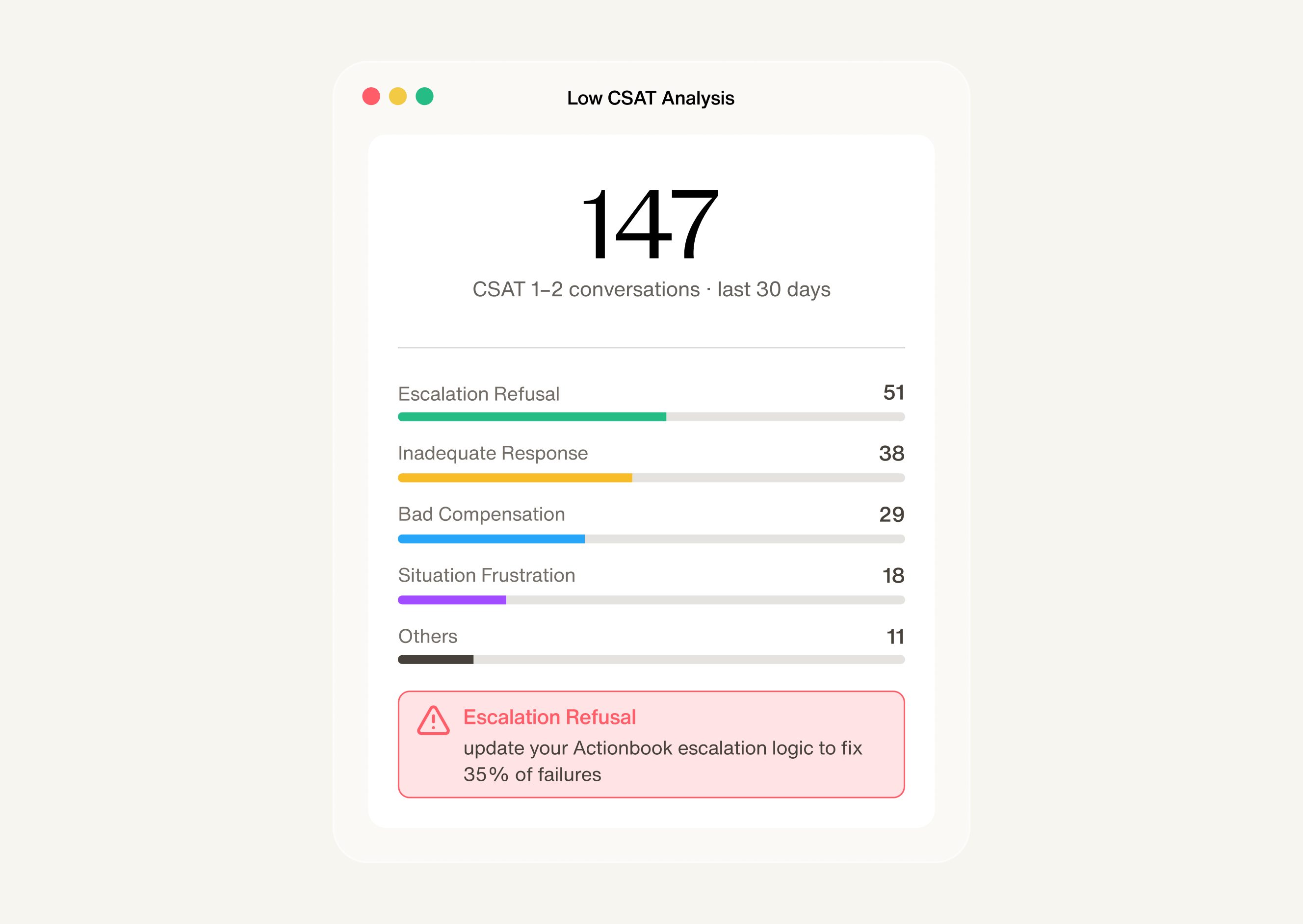
Low CSAT Analysis sorts every flagged conversation into one of five failure types. Each one maps to a real, distinct way that customer service interactions break down.
- Inadequate Response: The agent gave a wrong or incomplete answer. The customer came with a problem and left without a resolution.
- Inadequate Compensation: The resolution was technically correct but not generous enough. The customer expected a larger refund, a credit, or some other gesture of goodwill and didn't get it.
- Escalation Refusal: The customer asked to speak to a human and the agent didn't make it happen. It either declined outright or deflected without giving them a real path forward.
- Situation Frustration: The customer came in already upset. The agent handled the request correctly but didn't acknowledge the frustration, which made things worse.
- Others: Edge cases that don't fit any of the above. Worth reviewing individually, since new failure patterns usually show up here first.
From score to priority
Categorization is what makes a score useful. "Your CSAT is 3.8" doesn't tell you what to fix. "35% of your low scores are Escalation Refusals" does. You go update the escalation logic in your Actionbook.
You can't fix "low CSAT." You can fix "35% of your low scores are Escalation Refusals." One is a number. The other tells you exactly where to go.
Each failure type points somewhere specific. A spike in Inadequate Compensation usually means your resolution thresholds are too conservative. A spike in Situation Frustration usually means your agent needs better acknowledgment logic before jumping to a solution. Different category, different fix.
The first step in the improvement loop
Low CSAT Analysis is also the starting point for Zero-Touch Improvement (ZTI), delight.ai's system for autonomously identifying and fixing agent failures. Before ZTI can propose a fix, it needs to know where to look. The failure category breakdown is what gives it that direction.
Without it, someone on your team has to read through conversations to find the pattern. With it, that work is already done.
Low CSAT Analysis is part of Trust OS, delight.ai's operational layer for running AI agents at production scale. It's available now.