
For the past decade, we have been building the infrastructure that powers how the world's largest brands communicate with their customers — 7 billion conversations a month across companies like DoorDash, Reddit, and Noom. That work has given us a vantage point that few companies share: we understand, at an operational level, what it means when software sits at the center of the customer relationship.
That experience has led us to a conviction that shapes everything we are building at delight.ai: the era of software as a tool is ending. The era of software as a workforce has begun.
We call this shift Agent as a Service — AaaS. It is the most significant transformation in enterprise software since the cloud. Not because AI agents are impressive, which they are, but because they fundamentally change the relationship between a business and its software. For the first time, software does not just enable work. It performs work. It reasons, remembers, takes action, and operates autonomously on behalf of the brand.
This piece is about what that shift actually means — for enterprises, for customer experience, and for the way software companies build.
What is actually changing
SaaS delivered tools. AaaS delivers outcomes. That distinction may sound semantic, but it carries profound implications for how enterprises create value, organize teams, and relate to their customers.
In the SaaS era, software gave your team better instruments. A CRM organized customer data. A helpdesk managed tickets. An analytics platform surfaced insights. But the human was always the one doing the work — making decisions, writing responses, executing processes. Software made people more productive. It did not replace the need for people.
AaaS changes that equation. An AI agent does not help your support team respond faster. It responds. It does not surface a recommendation for a next-best action. It takes the action. It does not organize customer data for a human to interpret. It remembers the customer, understands their context, and uses that understanding to deliver a personalized experience across every channel, every interaction, continuously.
This is a structural change in what software is. And it reshapes three things simultaneously:
- How enterprises deliver customer experience
- How they think about cost and scale
- What they should demand from the platforms they buy
Your AI agent is becoming your brand
The most important implication of AaaS is one that many enterprises have not yet fully internalized: your AI agent is becoming the primary relationship your customer has with your brand.
Not just for support. For everything. The agent that helps a customer discover the right product. The agent that guides them through a purchase, remembers what they bought last time, and surfaces a recommendation they did not know they needed. The agent that rebooks their flight when a connection gets cancelled, extends the hotel, and texts them the updated itinerary before they have to ask. The agent that re-engages a customer who abandoned a cart, not with a generic discount code, but with context — because it remembers what they were looking at and why they hesitated.
This is not customer service. This is the entire customer relationship — from discovery to purchase to post-sale to re-engagement — delivered through an AI that knows who you are and gets better at serving you over time.
When you accept that framing, the requirements change dramatically. You need an agent that maintains living memory across every interaction, every channel, over time — not session memory that resets when the window closes, but relationship memory that deepens. You need an agent that shows up everywhere the customer is — chat, voice, SMS, email, social — with full context preserved. And you need an agent that does not just communicate but acts — completing transactions, resolving issues, and driving revenue, not just answering questions.
This is what we mean by the AI concierge. It is personal, present, and capable enough to represent your brand in every customer interaction — not just the ones that start with a complaint.
Agent washing
This raises an important question: if the bar for what an AI agent needs to be is this high, how much of what the market is selling today actually meets it?
The honest answer is: very little. And there is a term for the gap between what is promised and what is delivered: agent washing.
A year ago, agent washing meant chatbots rebranded as agents. That version is easy to spot. The more relevant version in 2026 is subtler. It is agents that are genuinely capable in a demo — they can reason, they can take action — but that ship without the foundation that makes them viable at enterprise scale. No persistent memory across channels. No governance layer. No ability to deploy gradually and build confidence. Impressive in a controlled environment. Fragile in production.
The damage this causes is real. An enterprise that deploys one of these agents and experiences a failure — a hallucinated policy, an unauthorized action, an inability to explain what the agent did and why — does not just lose confidence in that vendor. They lose confidence in the category. One bad deployment can set an organization's AI adoption back by a year or more.
We think the bar needs to be clear. A real enterprise AI agent requires four capabilities working together:
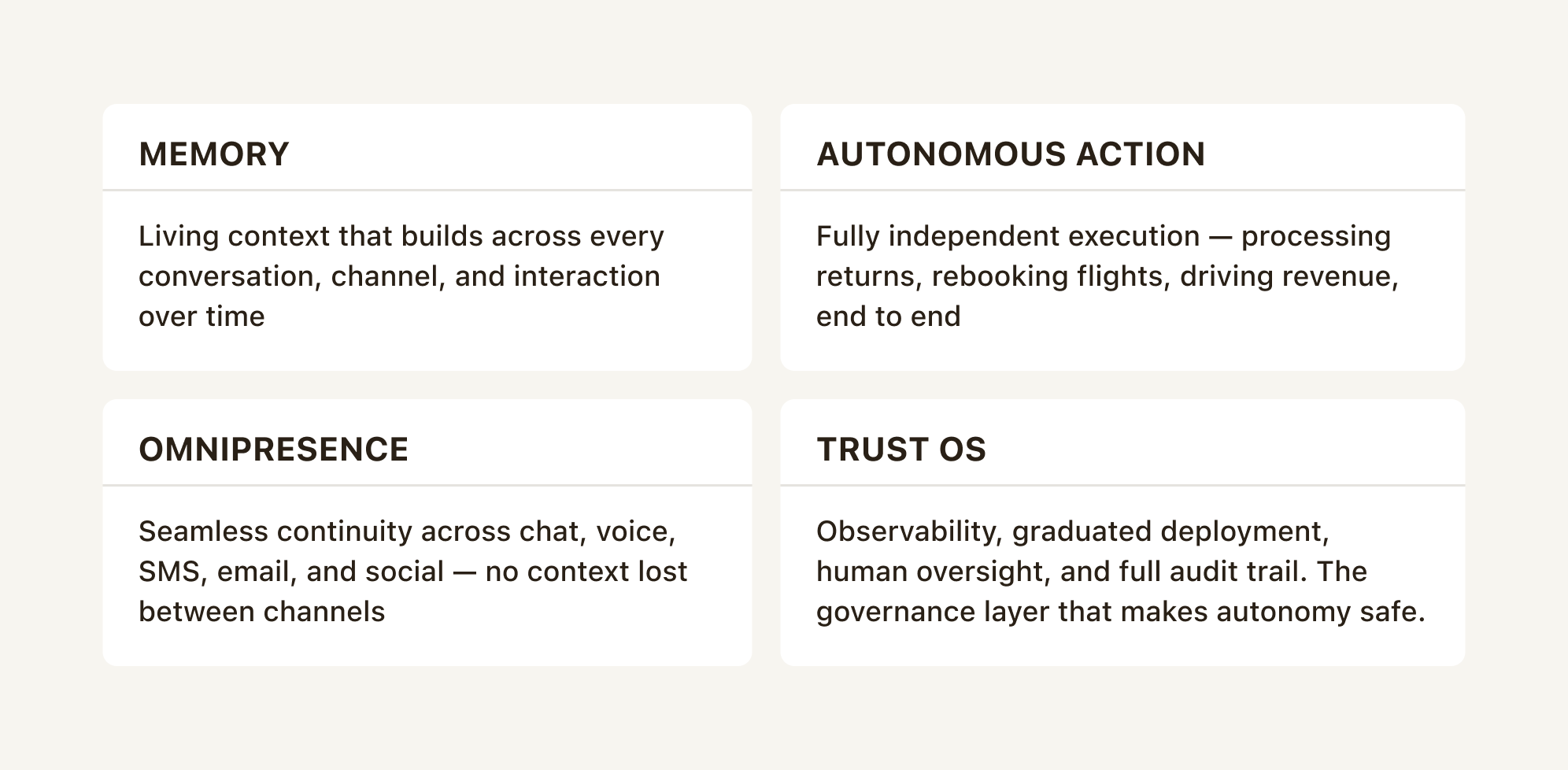
Without all four, an agent may work in a demo. But it will not work at scale.
The economics flip
For most companies today, customer interactions are divided into two categories: the ones that make money (marketing, sales) and the ones that cost money (support, service). These are separate teams, separate tools, separate budgets. And the cost side scales linearly — more customers means more headcount.
AaaS collapses that divide. An AI agent that knows your customer, operates across every channel, and can both resolve a problem and recommend a product in the same conversation does not fit neatly into "support" or "sales." It is doing both. It resolves an issue, then surfaces a personalized upgrade. It recovers an abandoned cart with context, not a coupon. It re-engages a lapsed customer with a message that reflects their actual history with the brand.
When the same agent drives revenue and reduces cost simultaneously, the economics of customer experience change structurally.
This is the triangle that enterprises have never been able to win — grow revenue, cut costs, and elevate the customer experience at the same time. They have always had to choose two at the expense of the third. AaaS, done right, delivers all three. But only when the agent is genuinely capable across the full customer journey — not just reactive support, but proactive engagement, personalized commerce, and relationship management at scale.
Where the market is heading
Based on what I observe across our customer base and the broader market, I believe three dynamics will shape the AaaS landscape over the next 18 months:
The agent becomes the brand
For a growing number of companies, the AI agent will be the most frequent touchpoint a customer has with the brand — more than the website, more than the app, more than any human employee. It will guide purchases, recover abandoned carts, resolve issues, deliver recommendations, and re-engage lapsed customers. The companies that invest in making their agent feel like a genuine, personal extension of their brand — not a generic bot — will build the kind of loyalty that turns customers into fans.
Memory becomes the moat
The ability to remember customers across interactions and channels will separate the leaders from the field. Stateless agents that reset with every conversation will feel increasingly inadequate as customers experience what persistent, relationship-aware AI feels like. Living memory is not just a feature — it is the foundation of personalization at scale.
Governance becomes the qualification gate
Enterprise buyers are already shifting from "does this work?" to "can we trust this in production?" The companies that have invested in trust infrastructure — observability, graduated deployment, human oversight — will clear procurement processes that others cannot. Governance will become the qualification gate for enterprise deals, not a differentiator.
A thesis on what wins
I have a perspective that has guided my approach to building companies over the past fifteen years: there are no right or wrong decisions. You have to make your decisions right. It applies to startups, and it applies equally to how enterprises approach the AaaS transition.
The companies that treat Agent as a Service as an incremental upgrade — a better chatbot, a faster workflow — will underinvest and underperform. The companies that recognize it as a platform shift, one that changes how they relate to customers, how they structure their teams, and what they demand from their software, will build competitive advantages that compound over time.
At delight.ai, we have made our bet clear. We believe the AI agent is becoming the primary relationship between a brand and its customers — across every interaction, not just support. The platform powering that relationship must be built on memory, presence, personalization, and trust from the ground up. Not as features on a roadmap, but as the architecture itself.