The AI Permission Curve
Consumers do not grant AI trust all at once. They grant permission in stages: first to answer, then remember, then recommend, then act.


The 2026 Delight AI Index.
Not all AI actions carry the same risk, or require the same trust.
The Permission Curve maps five stages of consumer trust, from answering questions to acting without approval. Most brands have a permission gap, not a capability gap: the AI can do more than customers have said yes to. The fastest path to broader AI adoption is knowing where your customers actually are, then building the controls that earn the next step.

Where does your AI sit, and where should it?
Answer
High comfort
AI responds to direct questions. Order status, store hours, policy lookups. Table stakes in 2026: consumers expect it and trust it completely.
Remembers
High appetite
AI retains context across sessions: past purchases, preferences, prior issues. 70% say this would make them more delighted. Appetite is high; consent is required.
Recommends
Moderate comfort
AI suggests actions: a rebooking option, an upgrade, a resolution path. Consumer stays the decision-maker. Comfort rises sharply when recommendations are grounded in their own data.
Acts with Approval
Growing trust
AI takes an action (initiates a refund, books a change) but only after explicit confirmation. Override is visible and real. This is where most enterprise AI should be operating right now.
Acts Autonomously
16% ready today
AI acts on behalf of the consumer with no approval step. Only 16% are here today. Not the right default for most use cases in 2026, but 54% expect their trust to grow over the next year.
Trust isn't built at the launch.
It's built in the design.
Three decisions that determine whether your AI earns consumer permission or erodes it.


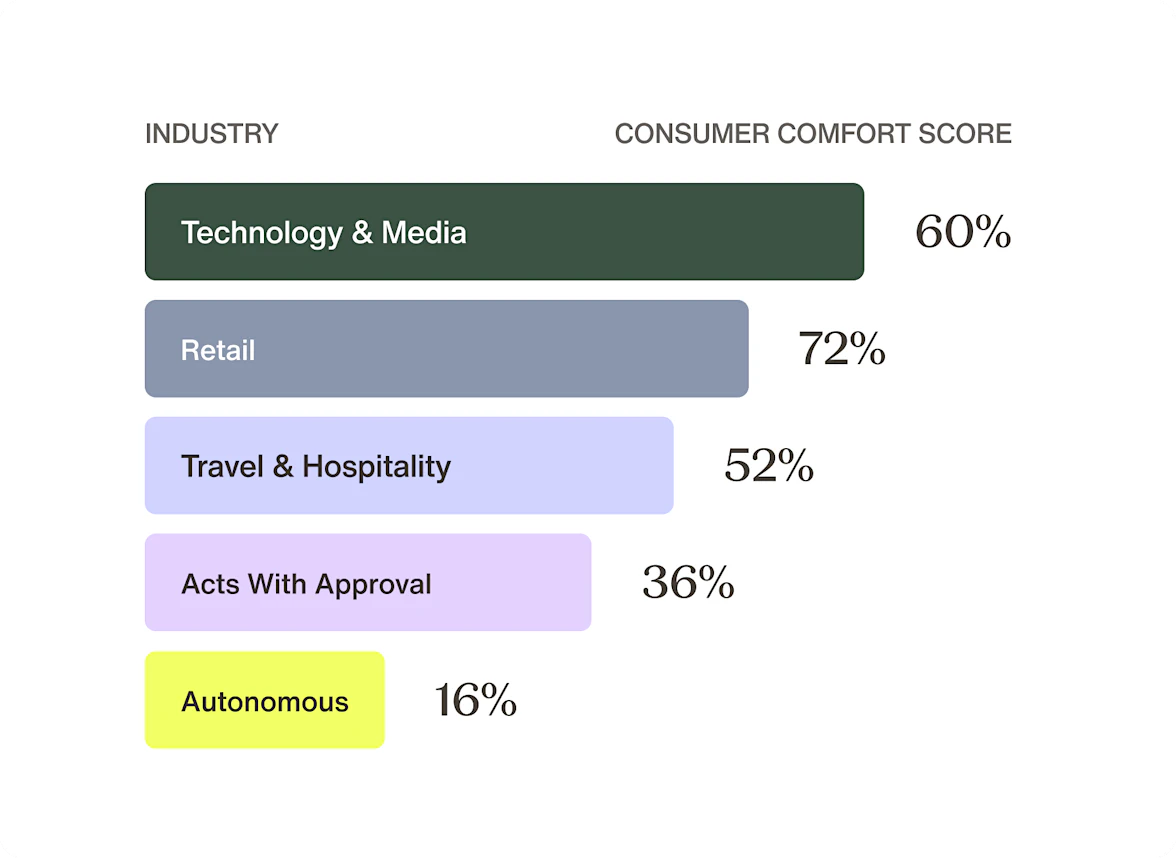
Consumer comfort with AI varies by industry. Know your starting point.
The same AI capability lands differently depending on where you operate. Before deciding how much your AI should do, know where your industry baseline sits.
- 2026 Delight AI Index
Don't leave automation on the table. Don't overshoot the trust that's there.
- Consumer comfort ranges 13 points across industries. Knowing your baseline means you deploy confidently where trust already exists, and earn your way into the rest.