Zero-Touch Improvement: Autonomous AI agent optimization with human oversight built in
Every AI agent eventually plateaus. You’ve refined prompts, iterated through actionbooks, and tuned test scenarios. Your agent handles 95% of cases well. The remaining 5% (novel scenarios, edge cases that require judgment, policy drift from last quarter’s reality) aren’t solved by adding more test cases.
An AI that scores 100% on 50,000 test conversations has mastered your test suite, not customer service. Optimization within existing boundaries is a ceiling. What breaks through it is a mechanism to learn from what’s happening now, not what you prepared for.
Zero-Touch Improvement (ZTI) is an autonomous improvement system that researches failures from real conversations, proposes precise actionbook changes, tests them against the cases that failed, and deploys, progressing through four graduated autonomy levels at the pace your team is ready for.
How it works
- Research from real conversations: ZTI scans actual customer conversations, not test cases, to identify failure patterns. It clusters failures by root cause and surfaces the specific actionbook branch, the scenario type, and how many conversations were affected.
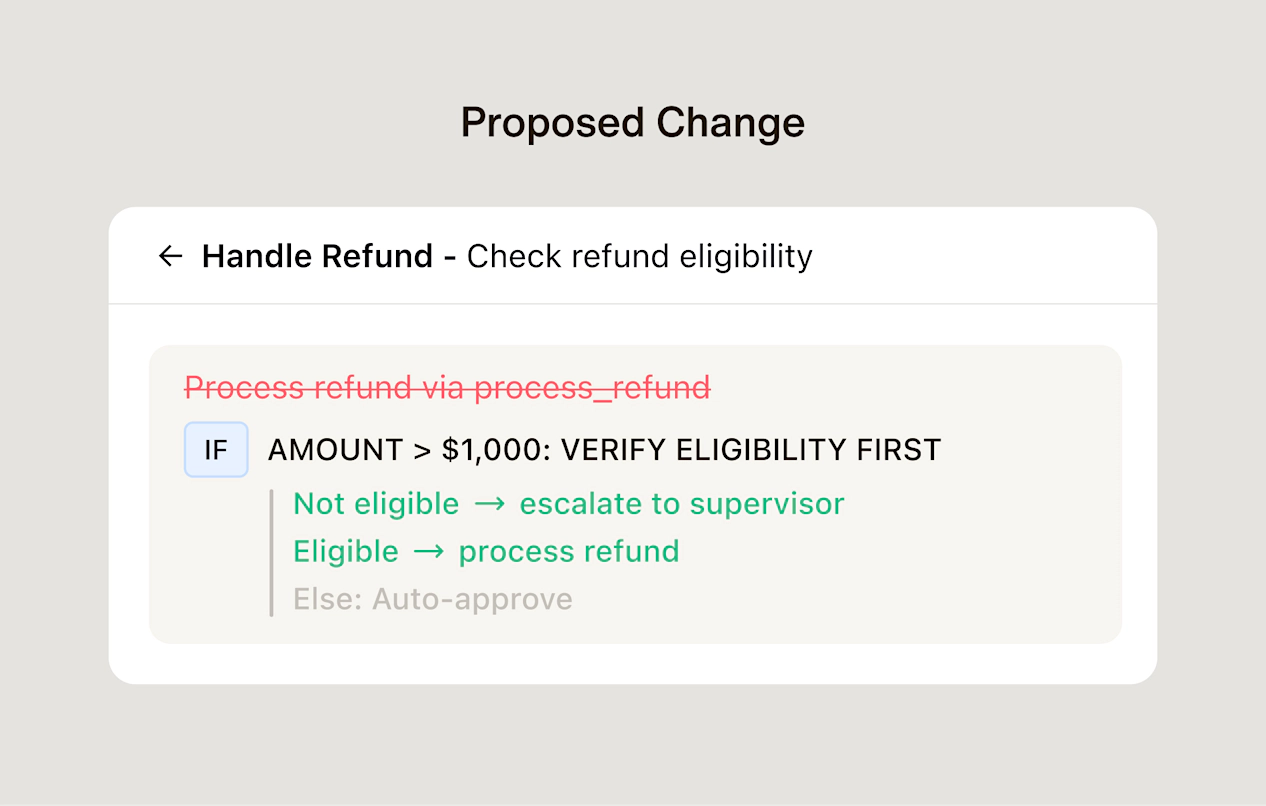
- Precise actionbook proposals: ZTI doesn’t suggest updating a prompt in the abstract. It generates an actionbook diff showing exactly what’s being added, removed, or modified, reviewed and approved by your team before anything changes.
- Iterative test-and-deploy loop: Every proposed fix is tested against the exact conversations that failed. ZTI iterates until the failure set is resolved, then deploys to production. Pass rates at each iteration are visible throughout.
- Four autonomy levels: ZTI operates across four graduated autonomy levels. At L1, the AI proposes every change and humans approve. At L2, the AI runs the improvement loop within approved boundaries while humans steer direction. At L3, it operates fully autonomously with no human gate required. Progression between levels is based on AI-human decision match rate, not a schedule.
- Approval gates at every level: Even at L3, you define the boundaries, including financial thresholds, compliance requirements, and sensitive topics. The AI cannot autonomously change anything you’ve scoped out.
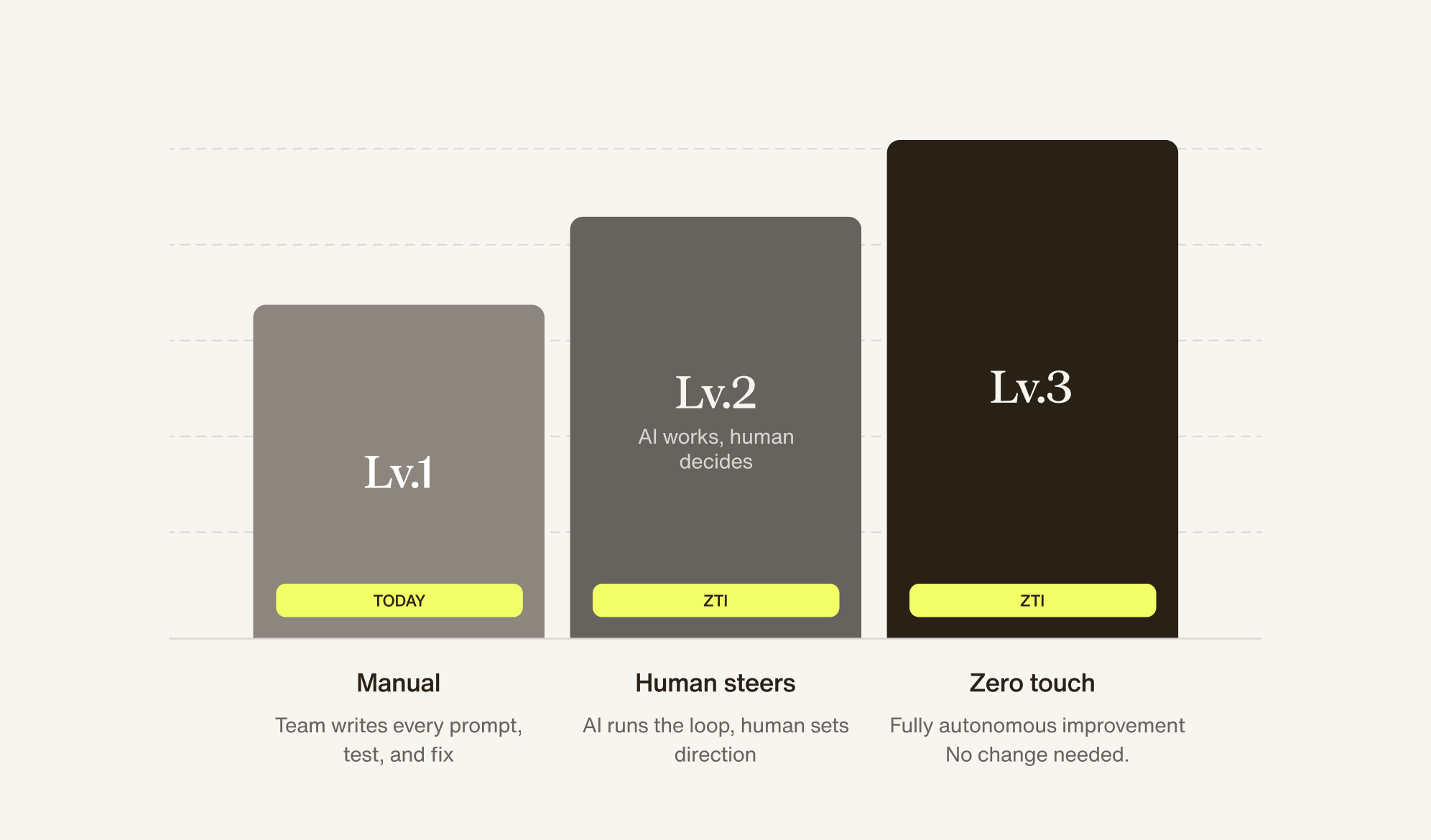
Zero-Touch Improvement is part of Trust OS, turning every human decision at Level 2 into a lesson that makes full autonomy at Level 3 possible.