You already know your IVR needs to change. The question is what "change" actually means for a contact center in 2026, because most of the answers being marketed right now are solving the wrong problem.
AI IVR — AI Interactive Voice Response — takes the same routing infrastructure that's been running contact centers for four decades and adds a language model to it. Customers can say "update my payment method" instead of pressing 3. The AI detects intent, routes appropriately, and sometimes resolves the issue without a human. That's a real improvement over the touch-tone menu. It's not the same thing as knowing the customer.
The companies winning on voice metrics in 2026 aren't running a smarter phone tree. They've moved past the routing model entirely. Their AI knows who's calling before the call connects. It calls customers first, before a problem turns into a complaint. When the call ends, the conversation doesn't — it continues on SMS, chat, or email with full context intact. That's a different product from AI IVR. And the distinction matters before you sign a contract.
This post covers where AI IVR falls short, what the better model looks like, and what to demand from any vendor before you commit.
What AI IVR actually does (and what it doesn't)
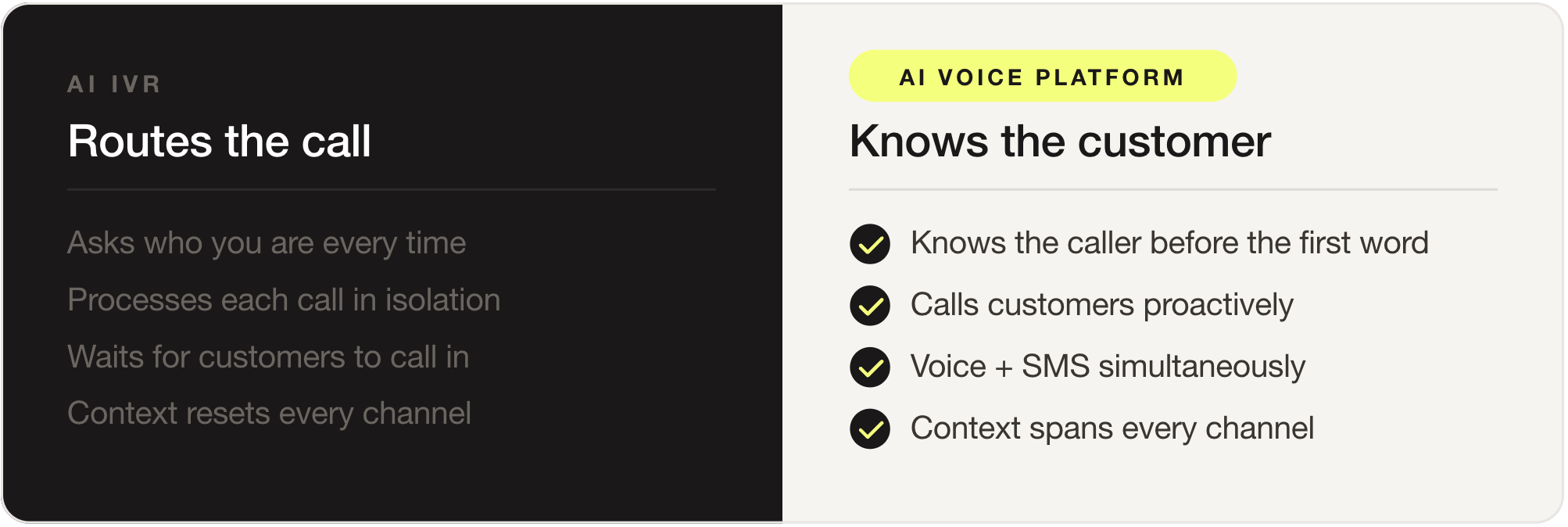
AI IVR is an upgrade to routing logic. The customer speaks naturally, the AI interprets intent, and the call goes where it should. Modern systems offer intent detection that handles natural language, caller authentication via voice biometrics or account lookup, queue deflection that resolves simple requests without a human (account balance, order status, payment due dates), and sentiment detection that flags high-priority calls. Each of these reduces handle time and lowers cost-to-serve. If your current system is a legacy IVR from 2015, AI IVR is a meaningful upgrade.
The gap is in what AI IVR assumes: the call is the unit of work. The customer called. The system processed the call. The call ended. What the customer did on your website yesterday, what they told your chatbot last week, what their account history reveals about the problem they're about to describe, what the right action would be before they think to call at all — none of that is part of the IVR mental model. It's routing infrastructure. It was never designed to know anyone.
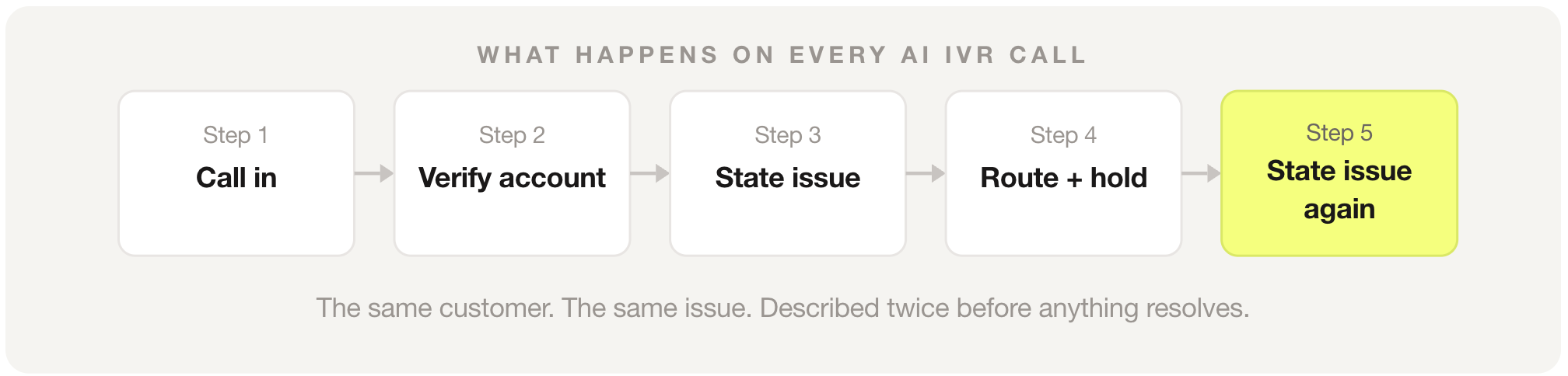
What your customers experience on every call
Your customer has been with you for two years. They call in. The AI asks them to verify their account. It asks for their billing zip. It routes to billing. The billing agent asks why they're calling.
Nothing failed. Everything worked exactly as designed. That's the problem.
The AI should know who they are before the first word. It should know they already tried to self-serve. It should have the relevant account context ready before they finish the first sentence. AI IVR optimizes the routing. It doesn't close that gap.
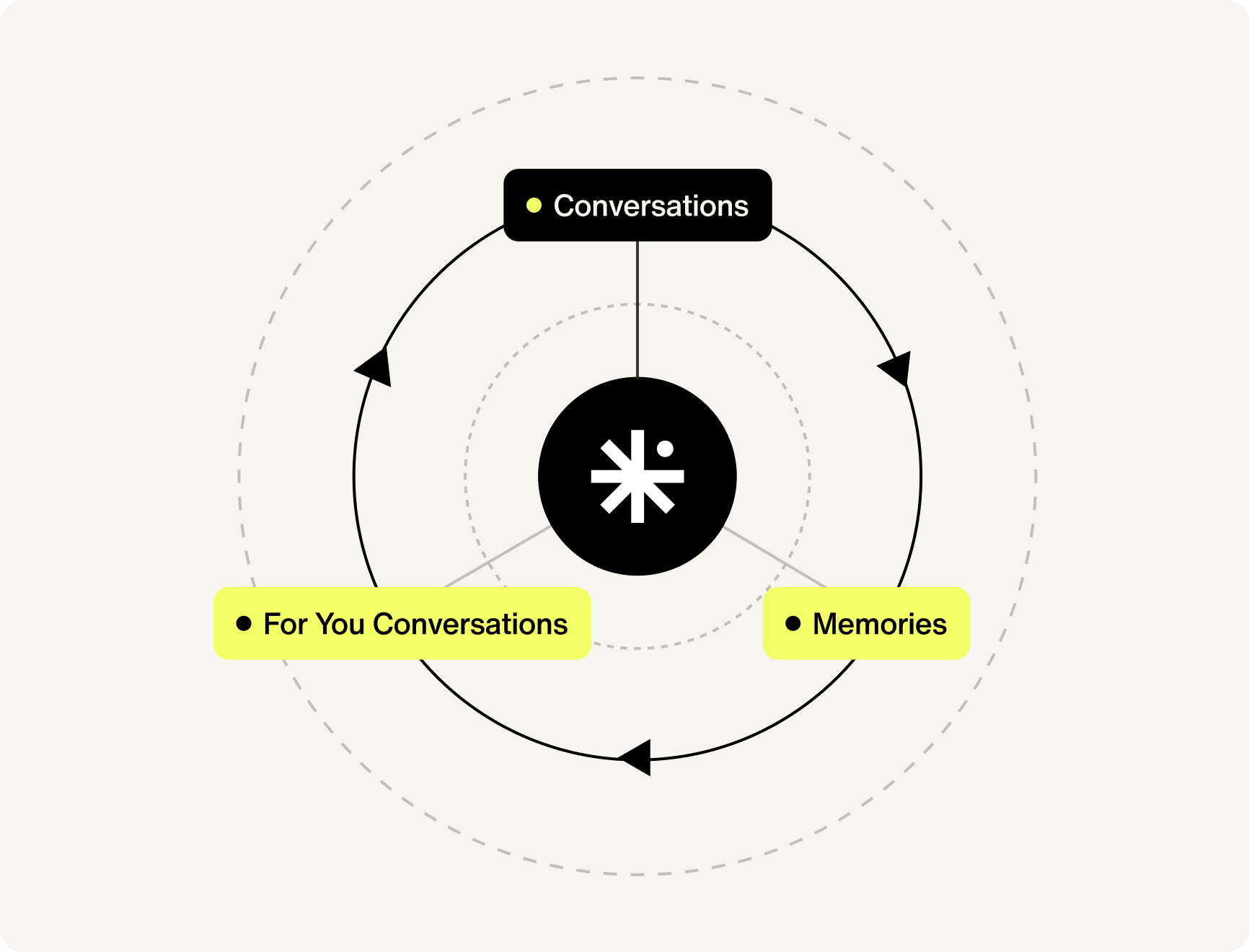
The gap between what customers expect and what AI IVR delivers is exactly what the memory layer closes. When the AI knows the customer before the call starts — their open issues, their recent activity, their account context, their preferred channel — the conversation shifts from processing to serving.
Explore how memory drives personalized voice →
What the companies winning on voice are doing differently
The contact centers with the best voice resolution rates and lowest inbound volumes in 2026 aren't running AI IVR. They've rethought what voice is for. Here's what that looks like in practice.
The AI knows the caller before the call connects
When a customer calls, the AI already knows their name, their recent activity, their open issues, and the context of their last interaction — whether that was a phone call, a chat, or an email. The greeting isn't "say or press 1 for account services." It's: "Hi Marcus, I can see you opened a case yesterday about your order. Are you calling for an update on that?"
That personalization isn't cosmetic. It reduces average handle time because the AI doesn't spend the first 90 seconds gathering context that already exists. It reduces escalation rates because customers who feel known are less likely to demand a supervisor. It changes the emotional temperature of the call from friction to resolution. The technology behind this is agent memory: a live layer that aggregates customer context from CRM, ticketing, prior conversations, and account data, and makes it available before the call connects.
The AI calls the customer before the customer calls you
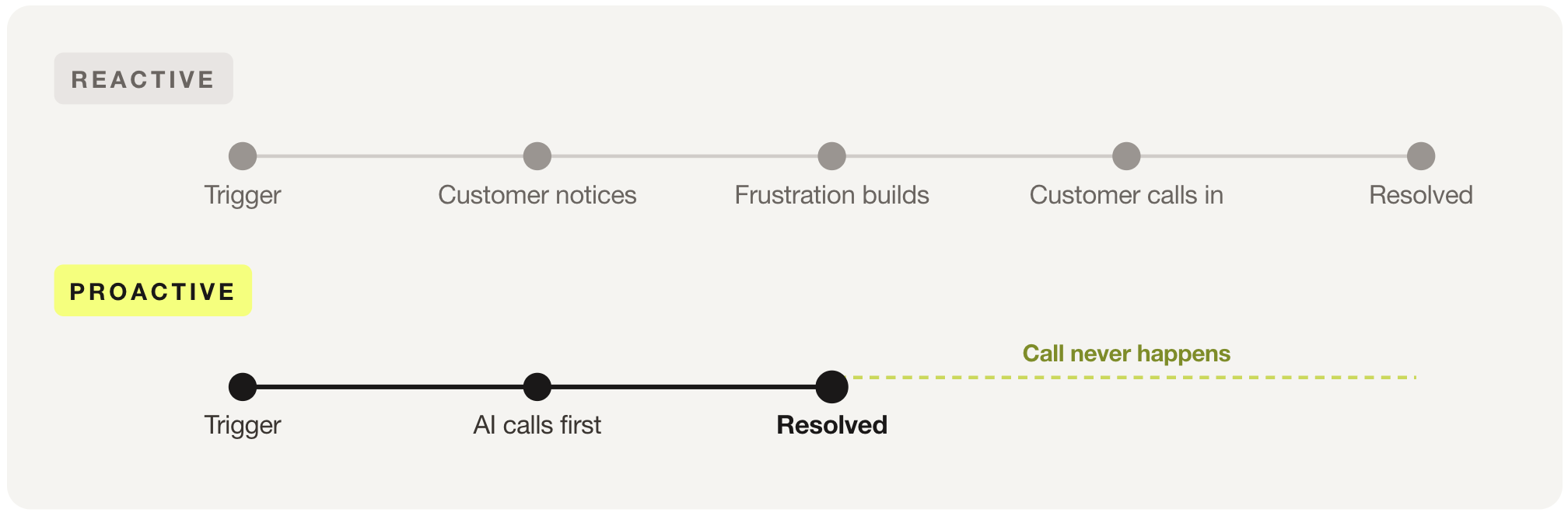
The IVR is inherently reactive. The best AI voice deployments in 2026 are proactive: the AI initiates the outbound call when a trigger condition is met. A payment fails. The AI calls the customer to offer resolution options before they notice the failed charge and call in frustrated. A delivery is delayed. The AI calls to explain the new timeline before the customer opens a ticket. A renewal is approaching. The AI calls to confirm, answer questions, or handle the renewal entirely, before the customer churns from inaction.
Proactive outbound changes the economics of contact center volume. Research consistently shows that 30–40% of inbound call volume in subscription and service businesses is predictable and preventable: payment failures, shipment delays, renewal windows. Inbound calls are expensive because customers who call in are already at the point where the issue is urgent enough to demand attention. Proactive outbound gets ahead of that moment entirely. The AI reaches out first, on your terms, with full context, before the customer's frustration has had time to compound.
This isn't robocall territory. The AI outbound experience is personalized and conversational — the difference between a mass-dialed prerecorded message and an AI that calls a customer specifically because their renewal is in three days and they haven't used the feature they're paying for.
Voice and SMS run simultaneously on the same call
One of voice's persistent limitations is information density. Customers need to confirm an address, capture a case number, or remember an appointment window. Over voice, that's slow and error-prone. People mishear digits. They ask for repetition. They write things down during the call and lose the note.
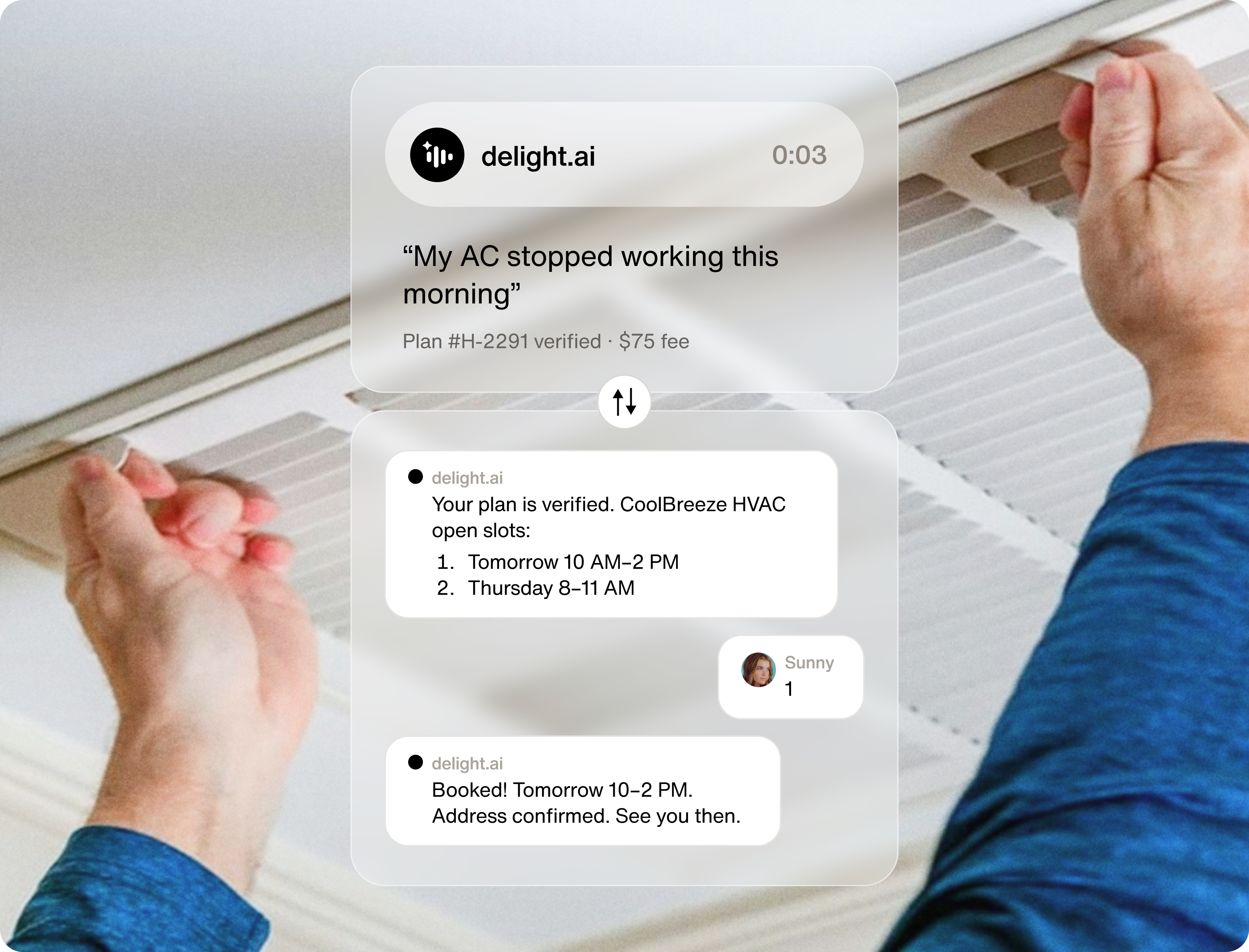
Running voice and SMS simultaneously solves this at the channel level. While the customer is on the call, the AI sends a text with the confirmation details, the appointment window, the relevant link, the case number. The customer confirms on voice. The specifics arrive in text in real time. Nothing gets lost between the call and the follow-through. Voice handles the conversation. SMS handles the information transfer. Together they close the loop that voice alone consistently fails to close.
See dual-channel voice + SMS in delight.ai →
Channel sequencing closes the gaps voice leaves open
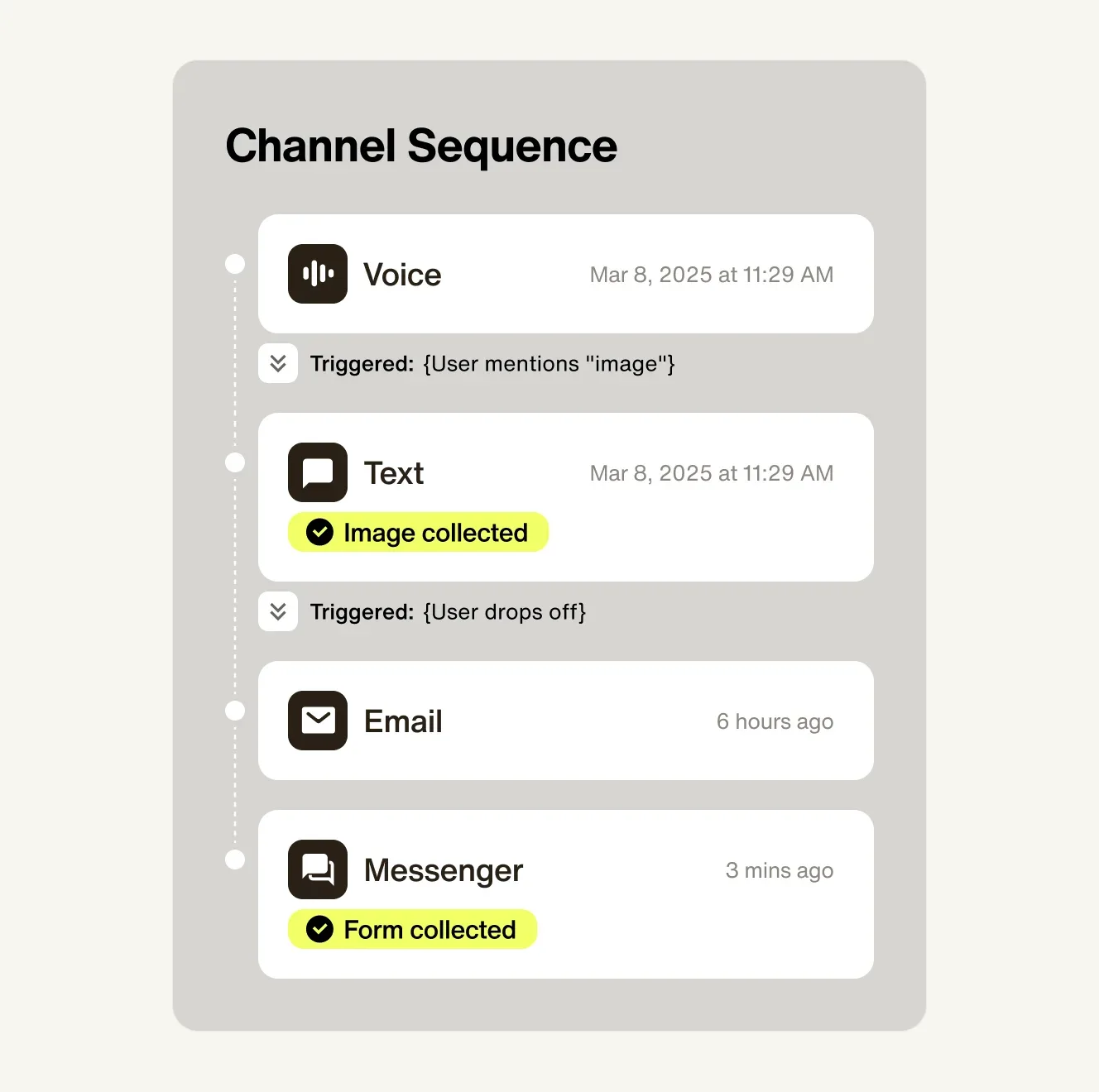
Some conversations start on voice and need to continue somewhere else. A customer calls to report an issue. The AI opens a ticket, confirms it on the call, and the customer needs status updates over the following three days. Those updates don't need to be calls — they should be texts, or in-app messages, or emails, based on what the customer prefers.
Channel sequencing threads this together automatically: the AI moves the conversation from voice to the next channel without dropping context. When the SMS arrives, the customer doesn't re-explain their issue. When the live agent eventually takes the call, they don't need a briefing. The conversation picks up exactly where it left off, regardless of how many channels it crossed.
The contact center benefit is significant. Not every follow-up interaction needs to be a call. Calls require real-time availability on both ends and are the most expensive channel per interaction. If the initial voice contact resolves the acute issue, the subsequent communication belongs on a channel that's cheaper and more convenient. Channel sequencing makes that automatic.
The AI that knows every prior interaction, not just this call
In a siloed multi-channel deployment, the voice AI doesn't know what the chat AI said. The email ticket isn't visible when the call comes in. Every channel restarts from zero. Omnichannel memory means the customer's full history is available regardless of which channel they're using now. When the customer calls, the AI knows they chatted last week, knows what resolved and what didn't, and picks up the thread instead of starting over.
This is where the AI IVR model breaks down structurally. IVR was designed to handle calls. Omnichannel memory requires a platform that spans channels, stores interaction history, and makes that history available across every surface the customer might reach. You can't add a memory layer to a call-routing system. You have to build with memory as a foundation.
Read: Connection starts with omnipresence →
Go deeper
- Voice AI Agent: Natural conversation, sub-250ms latency, built for high call volume
- Agent Memory Platform: The memory layer that makes every call personalized from the first word
- Omnipresent AI: Build once, deploy everywhere, sequence across channels automatically
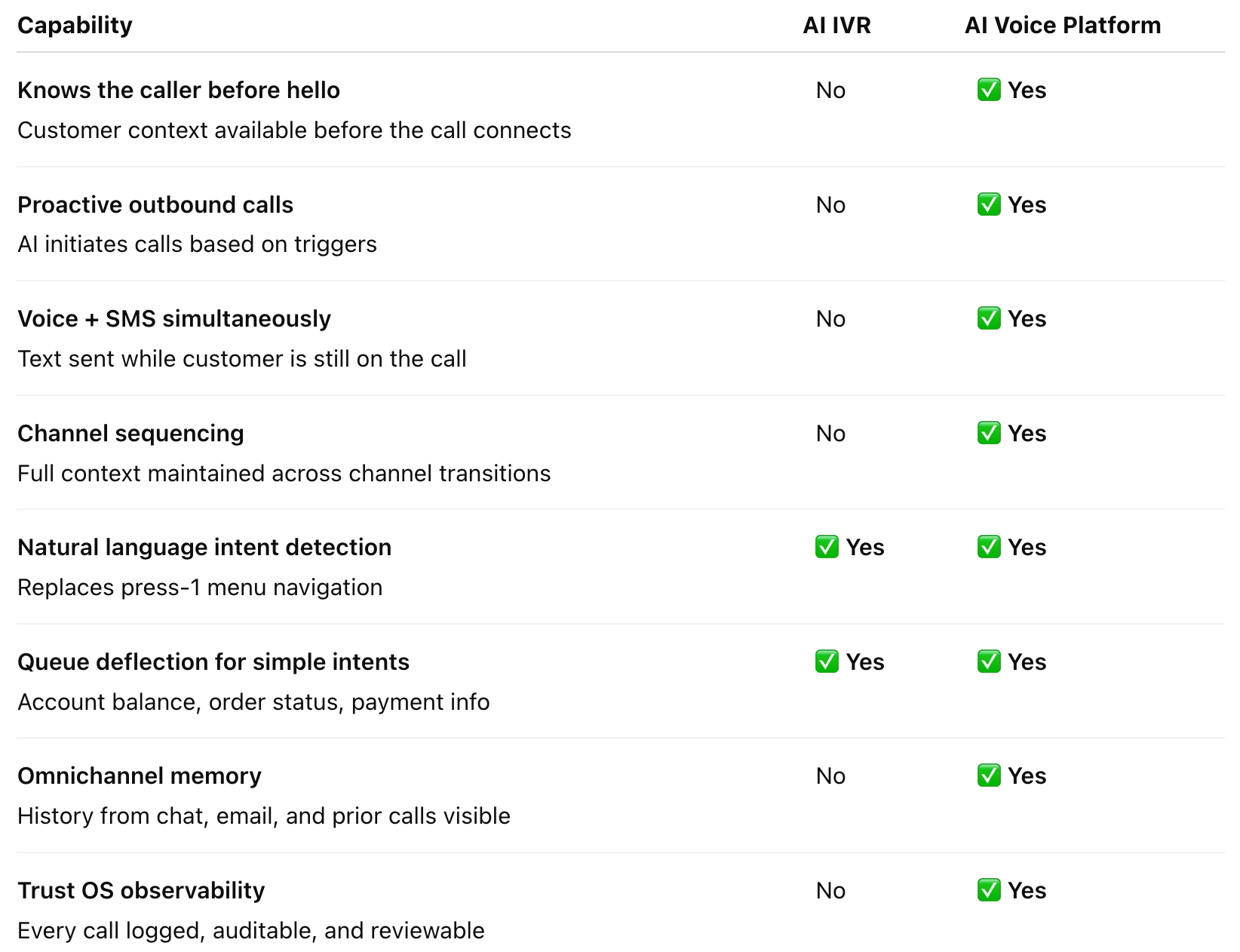
What AI IVR vs. a full AI voice platform actually delivers
Five questions to ask any AI IVR vendor before you sign
Most vendors will show you an impressive demo environment. Here are the questions that separate real capability from a well-rehearsed walkthrough.
1. Does the AI know who is calling before the call connects?
Ask whether the AI surfaces caller history, recent channel activity, and account context before the greeting starts. If the demo shows the AI asking the customer to verify their identity mid-call before doing anything useful, that's the old model. The AI should know the caller on ring, not after a verification sequence.
2. Does the voice AI support proactive outbound?
Ask for a live demo of the AI initiating an outbound call based on a business trigger: a failed payment, a shipment exception, a renewal reminder. If the vendor's outbound story is a campaign-based prerecorded blast, that's a robocall with a language model in the marketing copy. The capability you want is trigger-based, personalized, and conversational.
3. Does it run SMS alongside a live voice call?
Ask specifically: when the AI confirms an appointment over voice, does a text with the confirmation details arrive on the customer's phone during the same conversation? If the answer is "we offer SMS as a separate channel," the simultaneous capability isn't there. Those are two different products with two different value propositions.
4. Does channel sequencing maintain full context across the handoff?
Ask the vendor to demonstrate a conversation that starts on voice and continues on SMS or chat. Does the customer need to re-explain when they switch channels? Does the receiving channel know the full history of what was said on the call? If context resets at the channel boundary, it's multi-channel — not omnichannel.
5. Where does customer memory come from, and how current is it?
Ask what data sources feed the AI's knowledge of the customer, how often that data refreshes, and whether it pulls from CRM, ticketing, and prior conversation history simultaneously. A memory layer that's a nightly CRM export is not the same as real-time context aggregation. The difference shows up in every call where the customer's situation changed in the last 12 hours.
Not sure where your contact center stands? Take the AI readiness assessment →
Three ways AI voice deployments fail in practice
The failure modes in AI voice are predictable. All three can be screened for before you commit.
The AI that routes but doesn't resolve
The most common failure: the AI answers calls correctly, detects intent, and routes to the appropriate queue. The customer waits on hold and explains the issue again to a human agent. The AI improved routing. It didn't improve resolution. Call volume stays flat, handle time stays flat, and the contact center has a new monthly AI spend with no measurable outcome. Resolution happens when the AI handles the interaction end-to-end, not when it hands off more accurately.
The reactive AI that creates inbound instead of deflecting it
The second failure mode is an AI built entirely for inbound, deployed in an environment where most call volume is predictable and preventable. The payment that fails generates an inbound call. The delayed shipment generates an inbound call. The approaching renewal generates an inbound call. None of these calls had to happen. An AI that proactively reaches out before the trigger becomes a customer complaint eliminates the call entirely. An AI that only responds to inbound just handles it more efficiently.
The channel silo with an AI label
The third failure: the contact center deploys AI voice, AI chat, and AI email as separate point solutions. Each has its own memory, its own context, its own conversation history. The customer who called yesterday and is chatting today gets treated as a new interaction. This is multi-channel with AI, not omnichannel AI. The difference is the memory layer that spans all of them.
How delight.ai approaches voice
Delight.ai's Voice AI agent is built on the premise that voice is one channel in a continuous customer relationship, not a routing layer for isolated calls. When a customer calls, Agent Memory Platform surfaces their full context before the call connects: open issues, recent channel activity, account history, interaction preferences. The AI doesn't ask the customer to re-identify. It picks up the thread from wherever the relationship left off.
Outbound calling is native to the platform. The AI initiates calls based on configurable triggers — payment failures, renewal windows, shipment exceptions, proactive service check-ins — with the same conversational quality as inbound. Every outbound call is a personalized conversation, not a broadcast. Voice and SMS run simultaneously. Channel sequencing means the conversation follows the customer across every channel they use next.
Trust OS sits underneath every voice interaction: every call logged, observable, and auditable. And delight.ai integrates with your existing telephony stack and CRM without a rip-and-replace — so the upgrade is additive, not a rebuild.
- Personalized inbound from the first ring: The AI knows the caller's history, open cases, and account context before the greeting.
- Proactive outbound calls: Trigger-based outbound that's conversational and personalized, not prerecorded.
- Voice + SMS simultaneously: Confirmation details, appointment windows, and case numbers delivered in text while the customer is still on the call.
- Channel sequencing across voice, SMS, chat, and email: Full context at every channel transition. No restarting.
- Trust OS observability on every call: Every conversation logged and available for review. Escalation in one click from Desk.
Ready to see what AI voice looks like when it knows your customer? Talk to an expert about your current call volume and what proactive outreach could deflect. Book a demo →
The bottom line
AI IVR is better than the phone tree it replaces. It routes more accurately, deflects more simple intents without a human, and lowers cost-to-serve. For a contact center running on legacy infrastructure, it's a meaningful step forward.
But the contact centers winning on CX metrics in 2026 have moved past the routing model entirely. Their AI knows the caller before the call connects. It reaches out before the customer has a reason to call. It runs voice and SMS simultaneously so nothing gets lost between the conversation and the follow-through. It sequences across channels without dropping context. And it builds a continuous record of every interaction that makes each subsequent one faster to resolve.
That's what an AI voice platform looks like. Not a smarter phone tree. An AI that knows the caller, starts the conversation before they pick up the phone, and holds the relationship across every channel they use.
Keep reading
- Voice 2.0: Outbound calling, proactive outreach, and 2,000+ quality improvements
- Connection starts with omnipresence: How delight.ai sequences conversations across every channel
- Omnipresent AI for customer service: What it is, why it matters, and how to get started
- Introducing Agent Steward: The first AI agent that owns customer issues end to end