Healthcare scored 47 out of 100 in the 2026 Delight AI Index, the lowest of the five industries measured and four points below the national average of 51. That score reflects something real. Healthcare is where the potential consequences of an AI error feel most personal, most irreversible, and most high-stakes. Patients and providers are not wrong to approach AI in their care context with more caution than a shopper checking an order status.
The data points directly at where to begin. There are specific, high-value tasks in healthcare where patients already have meaningful AI appetite, and where getting AI right creates a foundation that raises trust across the entire patient journey.
Healthcare organizations that start at the administrative layer — scheduling, insurance verification, benefits lookup — and earn trust there will be the ones that get to expand AI deeper into the patient experience over time. The ones that skip that foundation will find the trust gap harder, not easier, to close.
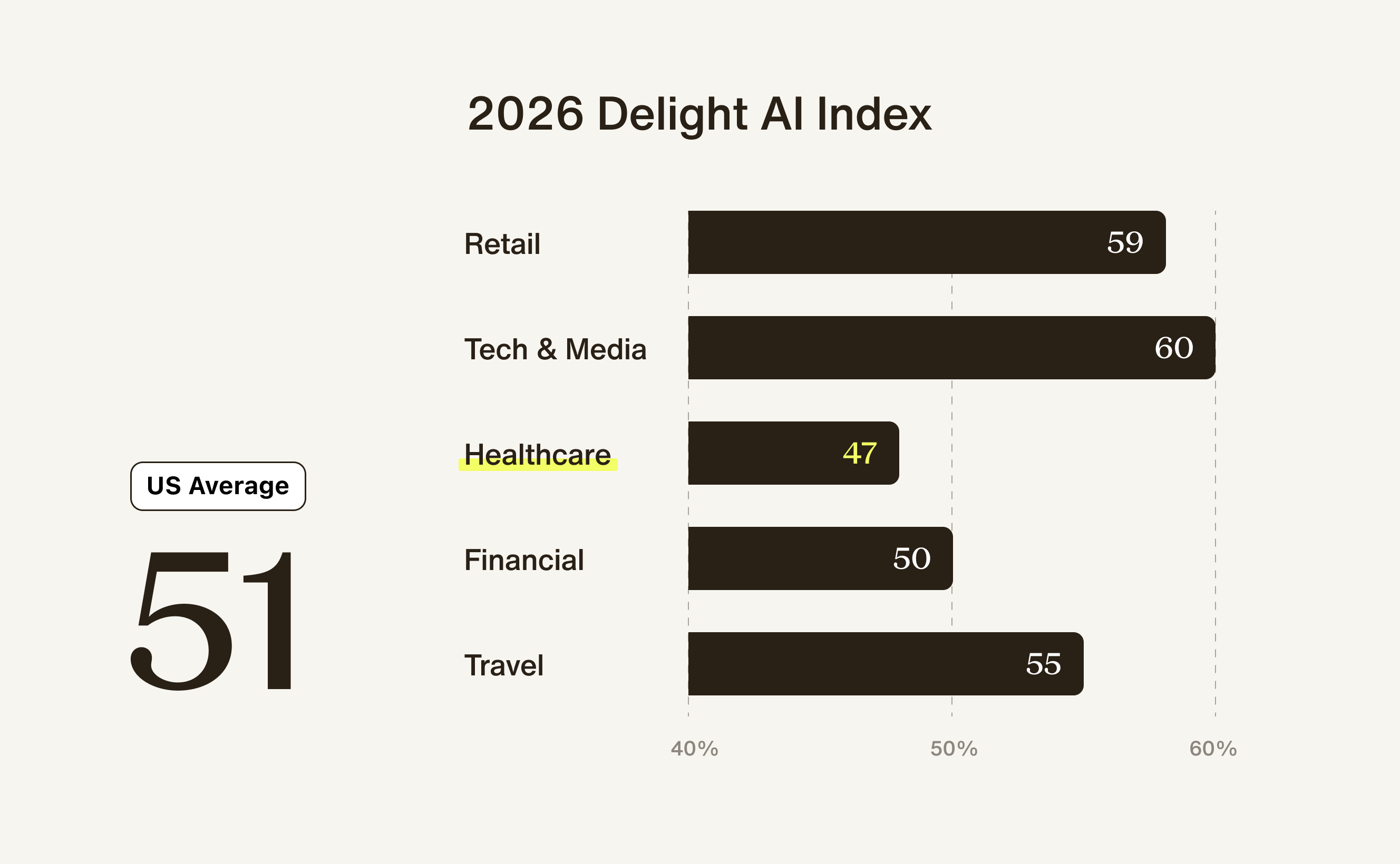
Healthcare trails every other industry in the Index. The 13-point gap between Healthcare and Tech & Media reflects how much emotional weight patients bring to AI interactions in their care context. Closing that gap is achievable, and requires a clear-eyed view of where patient AI appetite actually exists and where it emphatically does not.
Where the window is open — and where it's not
The patient preference data in healthcare is both more granular and more consequential than in any other industry. The slope from most AI-accepted task to least AI-accepted is steep, and the design implications of where you land on that slope are significant.
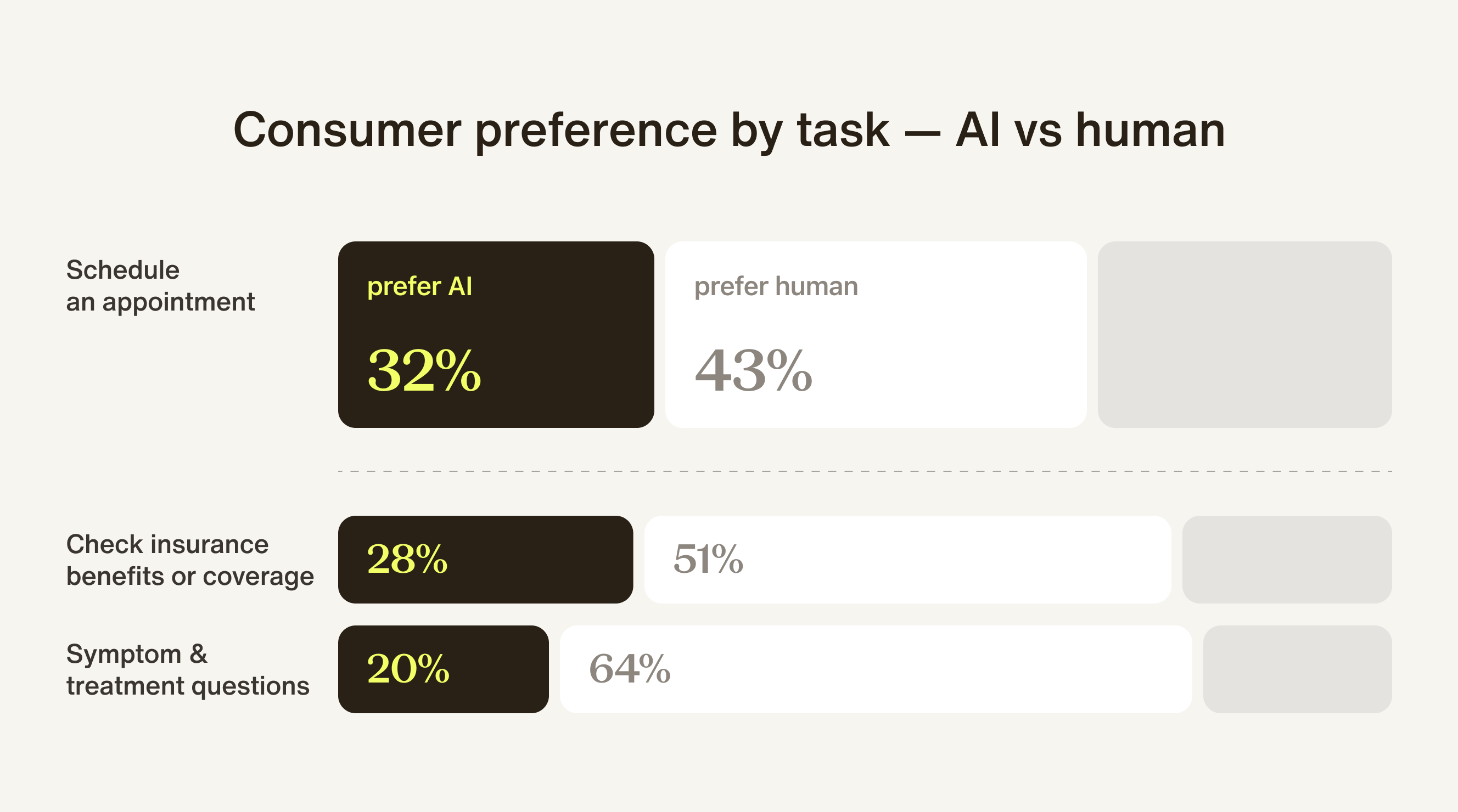
Healthcare may score lowest in the Index, but nearly a third of patients already prefer AI for scheduling. That's a real deployment window. Scheduling also happens to be one of the interactions patients find most frustrating with human agents today. Hold times, wrong information, no-shows that could have been avoided. AI that handles scheduling accurately and quickly earns credibility even with skeptical patients.
Symptoms and treatment questions are a different matter entirely. 64% want a human. That preference reflects the weight of vulnerability in a medical interaction. When a patient is asking about chest pain or a child's fever, they need to feel heard by someone who can be held accountable. That preference won't be moved by a more capable AI. When the stakes involve someone's health, patients need to know there's a person behind the answer who can be held responsible for it.
When AI gets it wrong here, the stakes are different
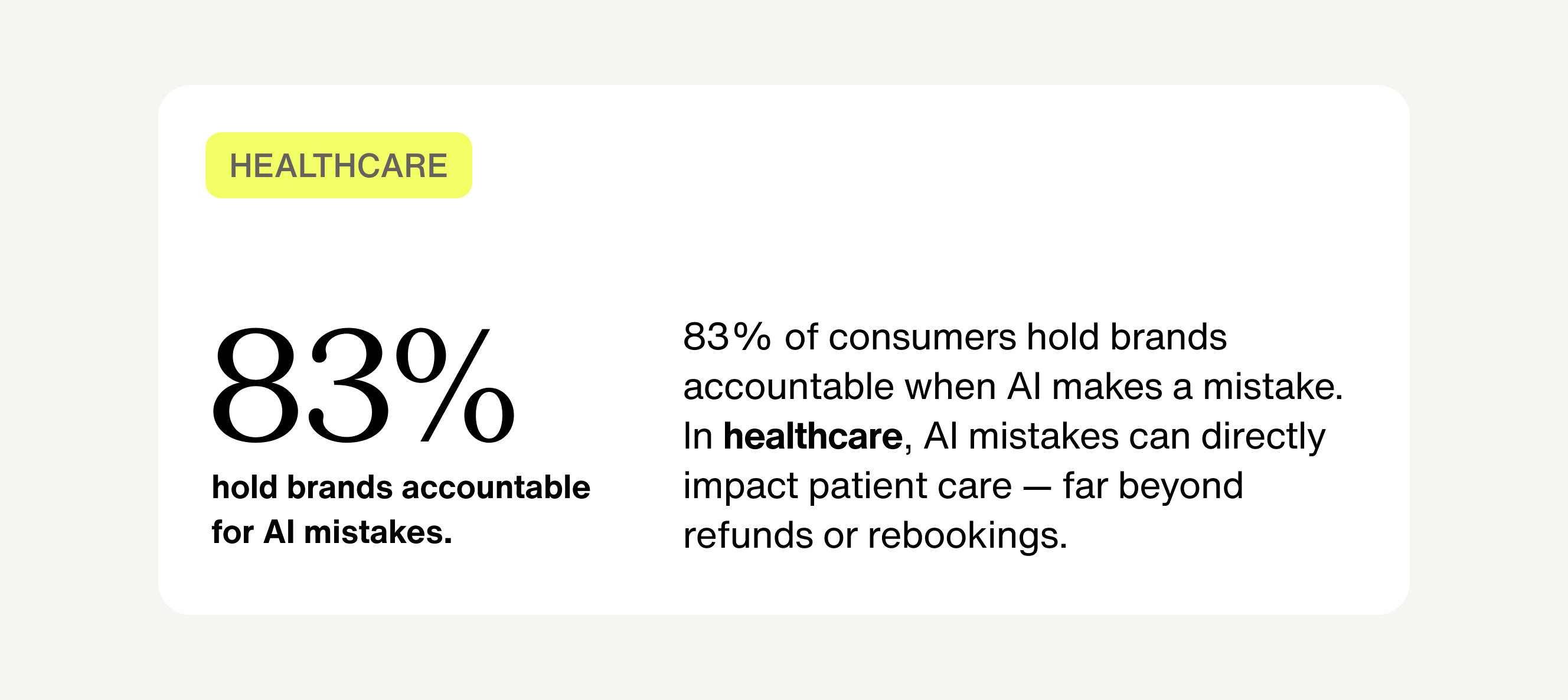
Healthcare accountability is concrete. When AI incorrectly tells a patient their procedure is covered and it isn't, that patient faces an unexpected bill. When AI misbooks an appointment and the patient misses care, the consequences can compound. These are the requirements that patient-facing healthcare AI has to be built around from the start.
64% of consumers expect AI to outperform human representatives. In healthcare, earning that expectation requires AI that is first accurate at the administrative layer before anything else. The trust required to go further on the patient journey has to be accumulated interaction by interaction, starting with the parts patients are already willing to try.
Compliance is the floor. Communication is the product.
When patients were asked what would increase their trust in healthcare AI, the answers converged on data protection and visible human access. Both are achievable today. Neither is a technology problem.
84% of patients say clear data privacy and security safeguards would increase their trust in AI. In healthcare, where a BAA governs how AI systems can handle patient data, compliance is the minimum. Communicating it is where trust actually starts.
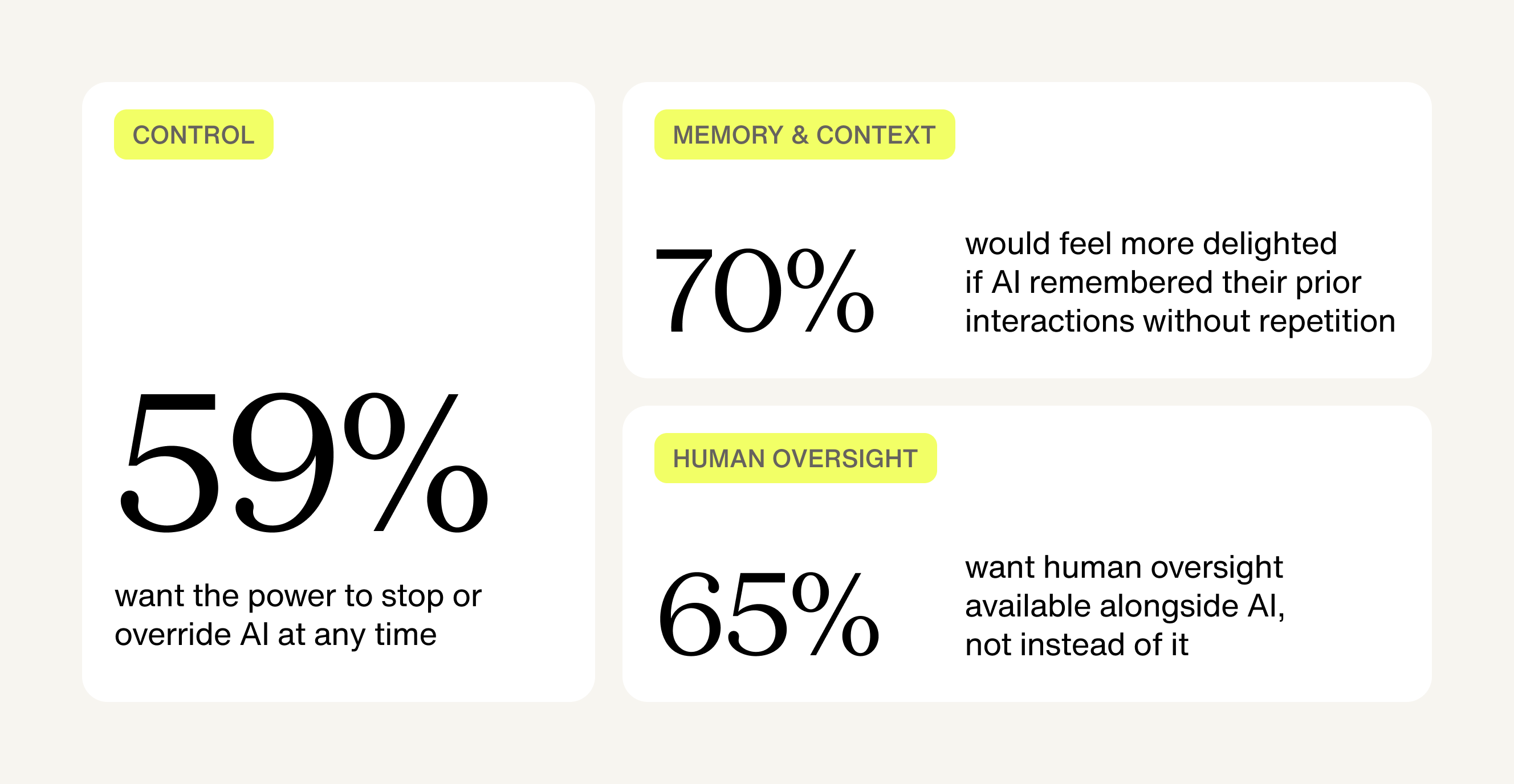
When patients understand that their health data is protected, that their AI interaction is logged and reviewable, and that a human is available when they need one, they are measurably more likely to engage with healthcare AI and trust the outcomes it produces. That's the trust architecture that makes every patient journey better.
54% of all consumers expect to feel comfortable with fully autonomous AI within the next year. Healthcare will take longer to get there than most industries. The providers and payers that use that time to build a patient trust track record at the administrative level will be in a very different position when AI expectations normalize.
The generation most resistant to healthcare AI is the one that uses it most
The generational data in healthcare reveals the central design challenge for the industry. The patients who are most resistant to AI are also the patients with the highest healthcare utilization. Designing around that mismatch is the work.
Millennials at 48% comfort with routine healthcare AI represent a real and growing patient population that is ready for more AI-forward experiences today. Boomers at 19% are the industry's core design problem. They are also the patients most likely to interact with healthcare AI systems on a regular basis — and the ones for whom a bad AI experience has the least room for error.
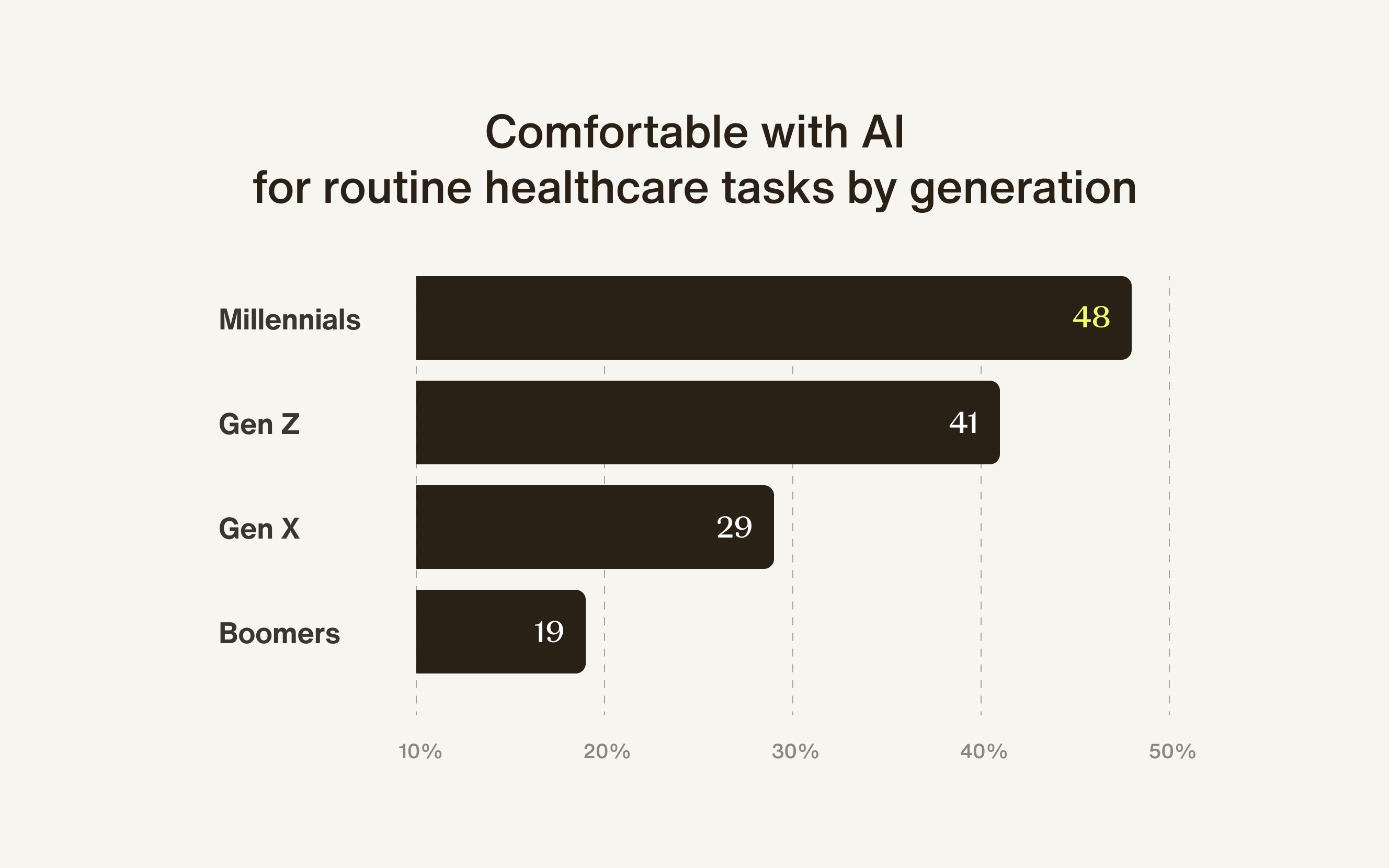
Build for the most cautious frequent patient, and you build something that works for everyone. In practice, that means clear confirmation screens, explicit human access, transparent data use, and visible audit trails. Together they form the foundation every trustworthy healthcare AI experience needs.
Three moves that build lasting trust
1. Build the administrative layer before anything clinical-adjacent.
Insurance verification, benefit lookups, copay estimates, and prior authorization status are the administrative tasks patients find most frustrating with human agents today. They are also tasks where AI can perform accurately without approaching clinical territory. An AI that handles administrative questions quickly, accurately, and with clear correction mechanisms earns credibility even with the most skeptical patient segment.
The providers building trust fastest don't switch from AI to human when interactions get complex. They run both in parallel, with AI surfacing information and handling the administrative layer while a human remains visible and accessible throughout. That architecture is what a score of 47 is telling us patients need before they'll go further.
2. Start at the scheduling layer and earn the next layer from there.
Scheduling and appointment management are where patients have the most AI tolerance in healthcare. 32% already prefer AI there. These interactions are also among the most consistently frustrating with human agents today. Getting AI right at the scheduling layer builds real credibility with real patients, including skeptical Boomer patients who will come to scheduling first before anything more sensitive. Every accurate, easy scheduling interaction deposits trust that makes the next healthcare AI interaction easier to accept.
3. Make compliance visible, not implicit.
BAA compliance and HIPAA-compliant data handling set the floor. What raises you above it is communicating them where patients can see and understand them. Surface data protections in interaction confirmations, in the product experience, and anywhere a patient is being asked to share health information. Patients who know their data is protected under HIPAA are measurably more likely to trust the AI using it and to stay engaged when the interaction asks for something sensitive.
Healthcare scored 47. The path from 47 to something meaningfully higher runs through administrative AI done well, data practices communicated clearly, and handoff design that never lets a patient feel abandoned by the technology. The providers and payers that build that foundation now will be the ones patients trust as AI becomes standard across every part of the patient journey.