Eighty-one percent of consumers expect support agents to pick up where the last conversation left off, so they never have to repeat themselves. A growing number of AI customer service platforms claim to do exactly that, but few do it well.
This comparison evaluates what actually separates enterprise-grade tools: the depth of customer memory across sessions, whether the AI takes action in live systems or just answers questions, and if it holds up in regulated environments. We'll look at eight platforms, with their advantages, weak spots, and ideal use cases.
How do businesses evaluate the best AI customer service software?
Certain capabilities stand out when you vet an AI agent platform through the right questions.
- Does the AI remember customers? Customers shouldn't re-explain their situation every time they call. Session-level memory gets you through a single call. Cross-session memory is what makes support feel like it belongs to a brand that pays attention. Most listicles don't evaluate this criterion at all, but platforms like delight.ai, Sierra (via its Agent Data Platform), and Decagon have started building persistent memory into their architectures—each with different approaches to depth and implementation.
- Can the AI resolve complexity, not just escalate it? Whether AI passes full context on handoff used to be the baseline question—plenty of tools still fail it. But the more important one now: Does the AI even need to escalate? Routine deflection is largely solved. The next bar is end-to-end ownership of genuinely complex cases: issues that span multiple sessions, systems, or third parties. Platforms that can coordinate across teams and tools to drive an issue to close without involving a human are solving a structurally different problem than those that simply hand off gracefully.
- Can you trust it in a regulated environment? For healthcare or fintech teams, performance alone isn't the question. It comes down to whether or not there's an audit trail, who sees the logs, and what happens when the AI encounters a situation it wasn't trained on.
- Does it get better on its own? Most platforms require manual retraining to improve—you find the failures, update the logic, redeploy. The emerging standard is AI that learns from live interactions and self-optimizes without engineering cycles. If a platform compounds its own performance over time, the gap between it and a manually tuned system grows with every week of operation. Ask vendors specifically: What triggers a model update, and who has to do the work?
At a glance: Best AI customer service software comparison
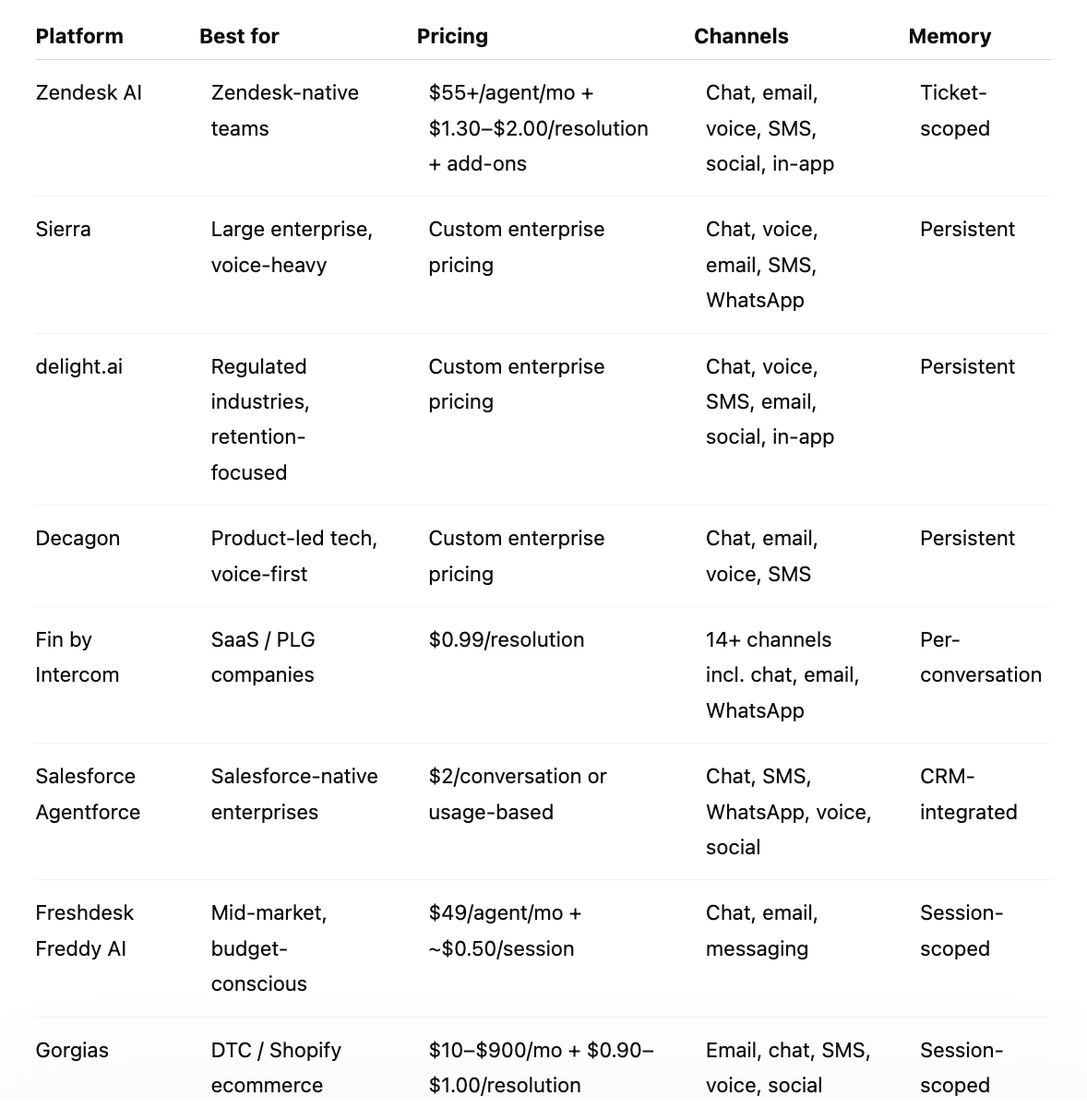
What are the best AI customer service platforms in 2026?
1. Zendesk AI
Zendesk AI adds ticket classification, intelligent routing, agent-assist suggestions, and autonomous resolution natively to a platform most enterprise support teams already run. In addition, Zendesk brings a data advantage that newer entrants cannot match, including over 20,000 AI customers, AI annual recurring revenue (ARR) on track to reach $400–500 million in 2026 (up from $200 million in 2025), and a training dataset of 20 billion customer service interactions.
With 1,710-plus marketplace integrations—the widest network in this comparison—teams already on Zendesk add AI with no new data plumbing. Everything reads from the same system of record.
Disadvantages: The most useful AI features are in the enterprise plan, with several capabilities requiring paid add-ons. Automated resolutions cost $1.30 to $2.00 per ticket—for a team handling 5,000 AI-resolved tickets a month, that's an additional $6,500 to $10,000 on top of base licensing.
And while Zendesk handles question-answering well, action-taking capability (e.g., processing refunds, updating accounts, etc.) is more limited than what AI-native platforms deliver.
Best for: Teams already on Zendesk needing high-volume enterprise support with strong internal documentation.
2. Sierra
Sierra arrived in 2023 with a high-profile founding team—Bret Taylor (former Salesforce co-CEO) and Clay Bavor (Google AR/VR)—and approximately 40% of Fortune 50 companies as customers. Sierra runs multiple AI models simultaneously, with a supervisor layer that checks answers before they reach the customer. The November 2025 launch of its Agent Data Platform added persistent memory across sessions, pulling in CRM records and behavioral history to recognize repeat customers.
Disadvantages: Sierra is essentially a managed service—the vendor's team typically builds and configures agents, creating a dependency some buyers find uncomfortable and extending deployment timelines. There are also documented cases of context loss in longer, multi-turn conversations, and the platform's safety model remains configuration-dependent, as a December 2025 guardrail misconfiguration at Gap.com illustrated. The pricing model creates its own friction. Sierra bills on resolved conversations, but resolution is defined by Sierra.
Best for: Large enterprises willing to pay for managed implementation and voice-heavy deployments.
3. Delight.ai: Best AI customer service platform with persistent memory
Delight.ai runs on Sendbird's infrastructure—the same platform handling over 7 billion conversations per month for more than 300 million users—and asks a different question than most platforms in this space: What would support look like if the AI actually knew the customer?
The Agent Memory Platform (AMP) is the answer. Rather than resetting at the end of each session, delight.ai builds a compounding profile of each customer—what they've asked, what they care about, where they're likely to have friction next.
Agent Steward extends that further: Rather than handing off complex issues to a human, it takes end-to-end ownership—coordinating across systems, teams, and third parties to resolve issues that span multiple sessions and channels. Where compliance requirements are real (e.g., healthcare, fintech, insurance, etc.), Trust OS provides per-interaction audit trails and access controls designed for regulated-industry governance.
South Korean furniture retailer Hanssem deployed delight.ai and reached a 90% inquiry resolution rate after approximately 5 months of iteration.
Disadvantages: The integration ecosystem is narrower than what Zendesk or Salesforce-native platforms offer. Teams that need a wide range of out-of-the-box connectors today may find those platforms a better near-term fit.
Best for: Mid-market to enterprise teams in regulated industries (e.g., healthcare, fintech, insurance, etc.) and organizations that measure customer experience (CX) success by retention and lifetime value rather than deflection rate alone.
4. Decagon
Decagon builds persistent cross-channel memory into its architecture. Like delight.ai, it carries customer context across sessions—but Decagon pairs that with a voice-forward approach, including Voice 2.0 with sub-second latency, customizable tone, and proactive outbound calling added in spring 2026.
Agent Operating Procedures (AOPs) let teams define resolution logic in natural language rather than code, and the Watchtower and Guardrails layer monitors AI behavior in real time. Customers include Notion, Duolingo, and Rippling, and the platform supports 15-plus languages with automatic detection. Decagon integrates with Salesforce, Zendesk, and Intercom for handoff workflows.
Disadvantages: Deployment typically takes around 6 weeks from discovery to launch, and non-technical teams may find setup demanding. The Agent Assist copilot feature is limited to Zendesk only, which constrains teams on other helpdesks. Audit logs and user permissions have been flagged as lacking depth for regulated environments—a notable gap given the platform's enterprise positioning.
Best for: Product-led tech companies and mid-to-large enterprises prioritizing persistent memory and voice-first support.
5. Fin by Intercom
Intercom built Fin for conversational resolution: over 40 million AI-resolved conversations, with a 67% average resolution rate across customers and a ceiling close to 93% for top performers.
Intercom holds SOC 2 Type II, HIPAA, GDPR, CCPA, ISO 27001, ISO 27018, ISO 27701, and ISO 42001—one of the most broadly certified platforms in this comparison. For SaaS companies and product-led growth (PLG) businesses where support and engagement are closely connected, Fin integrates naturally into Intercom's messenger experience.
Disadvantages: The per-resolution pricing model ($0.99 per resolution) is transparent in theory but unpredictable in practice. User complaints about unexpectedly large bills are common enough to be a pattern, and add-ons like Copilot and premium reporting behind higher tiers make total cost of ownership harder to forecast.
Fin also performs best inside the Intercom ecosystem. Organizations deploying it as a standalone agent across a broader infrastructure stack will encounter architectural friction.
Best for: PLG and SMB companies already on Intercom; teams that want fast setup and conversational quality without enterprise-level complexity.
6. Salesforce Agentforce
Agentforce's core advantage mirrors Zendesk's: If your CRM, case management, and service workflows already live in Salesforce, a native AI layer eliminates a class of integration problems. What sets it apart technically is the Atlas Reasoning Engine, which handles multi-step business processes. With $800 million in ARR and over 29,000 deals, the product has reached meaningful enterprise scale.
Disadvantages: Outside the Salesforce ecosystem, the logic inverts. Agentforce doesn't natively integrate with third-party helpdesks, and connecting external systems requires custom MuleSoft API work. Pricing is published but complex: Three competing models coexist, and Data Cloud, which Agentforce depends on for its deepest capabilities, adds $180,000 or more per year. Some capabilities remain locked behind specific license tiers, and full enterprise rollouts typically span several months.
Best for: Salesforce-native enterprises where service and CRM are already unified on the platform.
7. Freshdesk Freddy AI
Freddy AI is worth considering if the goal is genuine capability without the enterprise pricing structure. Ticket classification, agent suggestions, and autonomous resolution are all present, with per-session pricing that starts at roughly $0.50 per session. However, it charges for sessions even when the issue isn’t resolved—unlike platforms such as Fin and Zendesk AI, which bill only on successful resolution.
At a typical 50 to 70% resolution rate, Freddy's effective cost per resolved issue ends up being $0.71 to $1.00. This is comparable to Intercom's $0.99 per resolution, not the dramatic savings the headline pricing might suggest.
Disadvantages: The trade-off is depth. Analytics and reporting are limited compared to what enterprise-grade platforms offer, and customization runs into constraints as workflow complexity increases. Teams underserved by their current stack who need to get AI working quickly will find Freddy a reasonable path. Conversely, teams building toward a sophisticated, compliance-heavy, or cross-channel operation will probably outgrow it within a year or two.
Best for: Mid-market teams, IT service management (ITSM) through Freshservice, and organizations that want to move fast without large upfront investment.
8. Gorgias
If your support operation is primarily post-purchase ecommerce (e.g., order lookups, returns, subscription changes, etc.), Gorgias is one of the more purpose-fit tools in this comparison.
Over 17,000 merchants are on the platform, and the Shopify integration in particular goes deep: Agents can view order history, issue refunds, and edit subscriptions without leaving the support thread. The July 2025 release of AI Agent 2.0 extended this into proactive territory, with the AI initiating sales conversations and handling more complex flows at checkout.
Disadvantages: The ecommerce focus is both the product's strength and boundary. The compliance layer wasn't designed for regulated industries.
Pricing can scale unpredictably; AI resolutions also count as billable helpdesk tickets, creating a double-billing structure that inflates total cost of ownership beyond what the sticker price suggests. If your organization operates across verticals or needs AI that maintains a long‑term understanding of each customer, the architecture will show its limits quickly.
Best for: Direct-to-consumer (DTC) and ecommerce brands, especially on Shopify.
Honorable mentions
Building enterprise AI support since 2016, Ada serves over 350 enterprise customers, including Verizon, Pinterest, and YETI. Channel coverage spans web, mobile, social, SMS, email, and voice, with integrations across 13-plus helpdesk and contact center systems. Annual pricing ranges from $30,000 to $300,000-plus, and deployments typically take 8 to 16 weeks.
Lorikeet focuses on regulated industries with strong audit trail capabilities. Kore.ai brings multi-agent orchestration with 450-plus Global 2000 customers and strong analyst recognition (Gartner MQ Leader, Forrester Wave Leader). Forethought, now part of Zendesk, processes over a billion monthly interactions.
How to choose the best AI for customer service
The honest version of this decision depends on three factors: your existing stack, your industry, and what you're optimizing for.
If your stack drives the decision: Teams on Zendesk, Intercom, or Salesforce should start with their native AI layer; the integration advantage alone justifies the evaluation. For Shopify-first ecommerce, Gorgias is the clear starting point.
If your industry constrains the options: Healthcare, fintech, and insurance teams should evaluate compliance infrastructure early. Intercom, Sierra, and delight.ai's Trust OS are the strongest options here.
If you're a large enterprise with real budget: Sierra for managed, voice-heavy deployments; Decagon for voice-first with persistent memory; Agentforce if your data already lives in Salesforce—but plan for a several-month implementation, not the weeks the marketing suggests.
If you're mid-market and need to move fast: Freshdesk Freddy AI gets you started without enterprise pricing. Watch the session-vs-resolution billing math carefully before committing.
If persistent memory matters to your CX strategy: delight.ai, Sierra, and Decagon are the three platforms building it into their architectures, each with a different approach. This is worth a dedicated conversation during evaluation.
Want to see what AI customer service looks like when it's built around knowing the customer? Explore how delight.ai's Agent Memory Platform handles cross-session context.