

An AI agent can do everything right and still get the interaction wrong.
It can give accurate answers and surface relevant recommendations, then deliver them in a way that creates friction instead of trust. A proactive upsell appears because the system detected an opportunity, even though a complaint remains unresolved. A follow-up fires on schedule, without accounting for the emotional weight of what just happened in the conversation. The tone is cheerful and supportive. Each individual action makes sense in isolation. None of it fits what is actually happening in the moment.
Businesses are giving AI agents more responsibility for direct customer interaction than at any point in the industry's history. What previously required a balance of human judgment, speed, and accuracy now falls to the agent alone. And reading the room is the hardest part to get right.
What separates a helpful experience from an irritating one comes down to judgment. What an agent learns in an interaction. How it adapts. What it carries forward. Done right, agents understand what to surface and what to suppress. What to hold back and when. Here is how to build agents that get that right.
Emotional intelligence starts with memory
From a product standpoint, emotional intelligence is not about how an agent sounds. It is about what the system carries forward from one interaction to the next.
The way human relationships work is that we accumulate attention over time. We do not hold every detail at the top of our minds. We surface what matters enough to shape the current moment, and let the rest recede. The same principle applies to agents. Today, most agents treat every interaction like a first meeting. That is why they struggle to feel situationally aware. Emotional intelligence begins when an agent stops resetting and starts operating with continuity.
But this is where it gets complicated. The system already knows far more than it should ever surface at once. The challenge is knowing what should stay present and what should fall away.
Memory that persists too long starts to feel invasive. Memory that disappears too quickly forces customers to repeat themselves. Emotional intelligence lives somewhere between those two extremes.
That is the design challenge behind Agent Memory Platform. It gives agents full context across sessions and channels, so every resolution is informed by the complete customer history. The customer does not have to repeat themselves because the agent never stopped carrying the thread.
Personalization gives memory meaning
Memory captures what an agent knows. Personalization is about what to do with that knowledge in the moment. The distinction is subtle but it changes everything.
Today, most systems treat memory as a trigger. They apply what they know the moment a condition is met, without stopping to ask whether this is the right time. A customer mid-resolution does not need enrichment. They need focus. A customer returning after friction does not need cheerfulness. They need acknowledgment. A customer exploring something new for the first time does not need the same guardrails as someone already having a bad day.
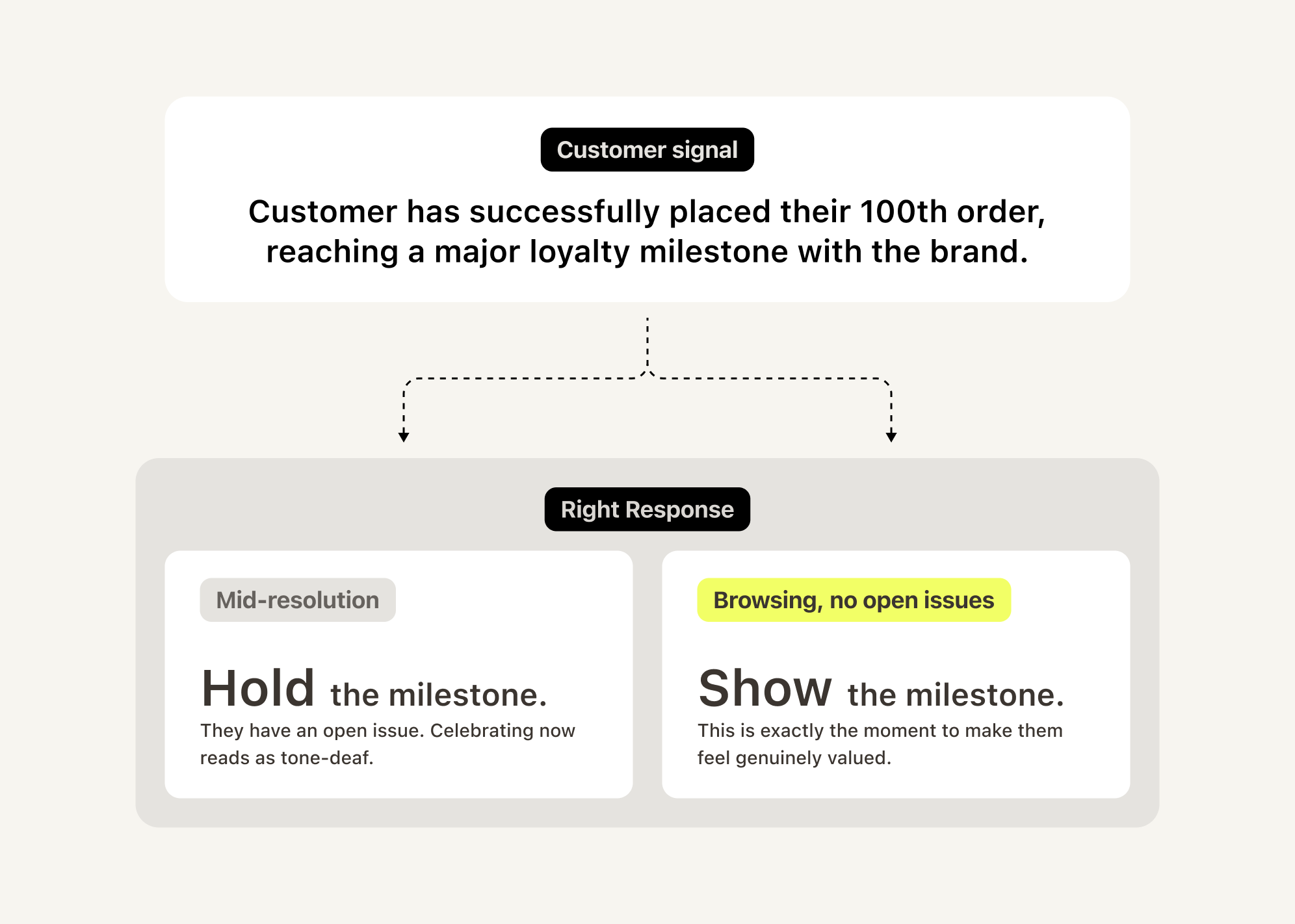
When personalization accounts for where a conversation actually is, it fades into the background. When it does not, even accurate and relevant context can feel like noise. That is the difference between an agent that feels attentive and one that feels oblivious. The information was technically correct. The timing was wrong. And the customer still felt misread.
That is what For You Conversations is designed to do. Rather than applying what the system knows the moment a condition is met, it accounts for where a customer actually is in the interaction, so personalization feels like attentiveness instead of automation.
Emotional intelligence requires restraint
The biggest decisions an agent makes are often the ones customers would never notice.
An agent that exercises restraint knows when not to follow up, when not to prompt, and when not to adjust tone or introduce new information into a conversation that is already heading somewhere. These are the behaviors that keep an interaction from tipping into frustration. They are invisible when done well. Unmistakable when done poorly.
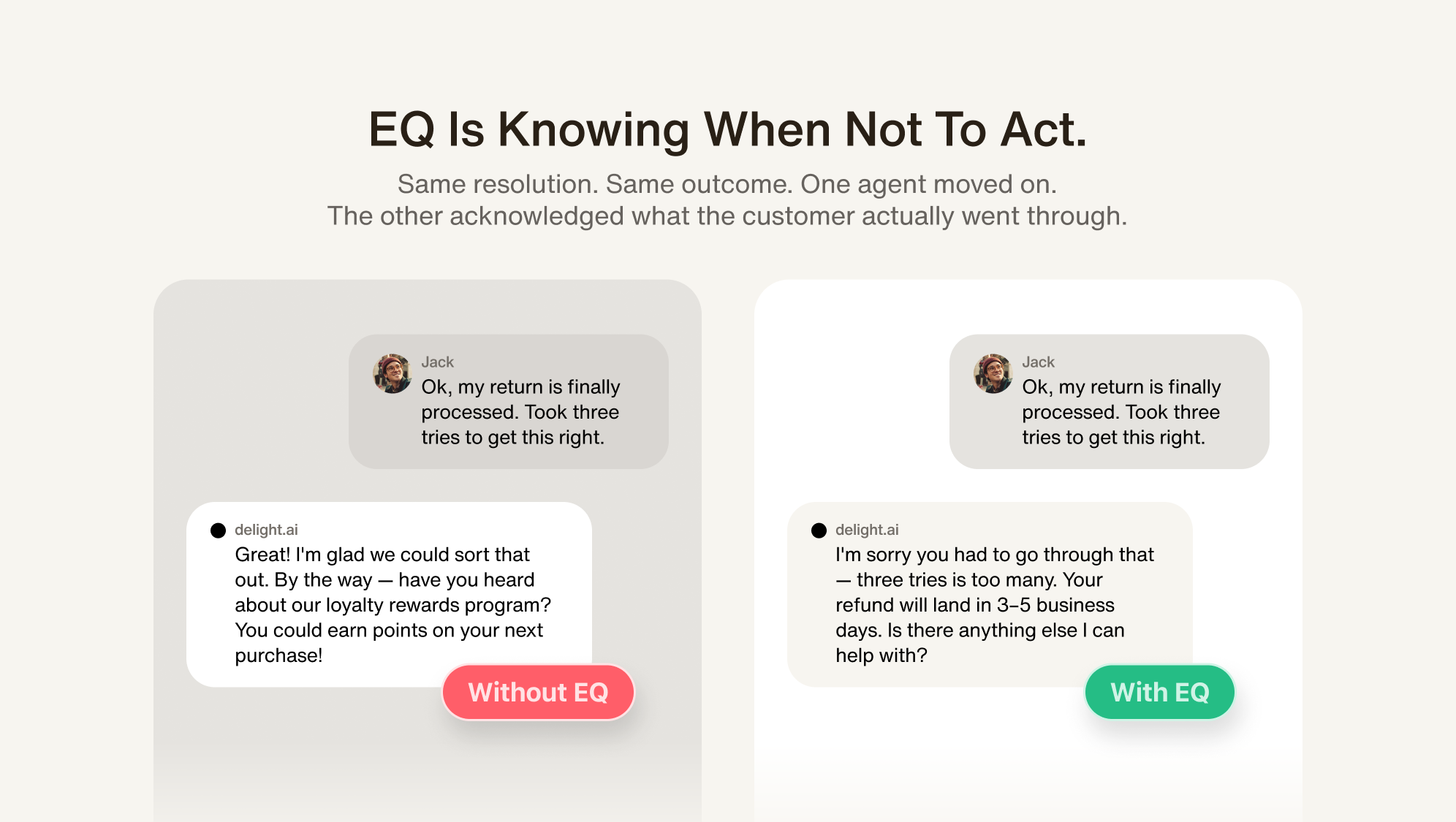
Without built-in restraint, agents default to action. Every signal gets acted on. Every opportunity gets taken. Interactions become transactional. Optimized for completion, not for the person on the other end. This matters especially as agents move from text-based chat into voice, where the stakes of a mistimed or tonally wrong response are immediate and audible. A cheerful tone after a difficult resolution is not a neutral choice. It is a signal that the agent was not paying attention.
An agent that knows when to hold back is not underperforming. It is exercising the kind of judgment that makes customers want to return.
Emotional intelligence is the path to mass adoption
Emotional intelligence in AI agents will not come from better scripts or more expressive language. It will come from systems that know what to remember, how to apply it, and when to step back.
The simplest way to think about it is to channel what a fulfilling conversation with another person actually feels like. It comes down to timing and an awareness of how tone shifts from one moment to the next. These are not features you bolt on. They emerge from how a system is built at its core, from what it accumulates, what it surfaces, and what it holds back.
As agents take on more prominent roles in customer relationships, reading the room is their make-or-break capability. The agents that reach mass adoption will not be trusted because they sound human, or look human, or increasingly act human. They will be trusted because they behave in ways that make sense when it matters most.
That is not a feature. It is an architecture decision.