Sierra is a strong autonomous-resolution platform. It positions itself as an Agent OS, providing autonomous, action-taking agents that sit above your existing CX infrastructure, running across every major channel and orchestrating more than 15 models under the hood.
Its agents take real actions across backend systems (e.g., refunds, order updates, scheduling) at scale, with a roster the company describes as roughly 40% of the Fortune 50 and strong G2 ease-of-use scores. Chime lifted its resolution rate from 50% to over 70% after deploying Sierra, then added Decagon on top for voice.
That pattern—deploying Sierra and still reaching for a second platform to fill the gaps—is exactly the kind of multi-vendor complexity that sends enterprise CX teams looking for alternatives.
So why shortlist alternatives? Four frictions tend to surface during evaluation:
- outcome-based pricing that's hard to forecast
- changes that route through engineering or a services team
- bot conversations that live apart from the rest of your helpdesk
- platform gaps that force you to string together multiple vendors
The right alternative is transparent on cost and timeline, lets your customer experience (CX) team operate it without a developer, and keeps customer history unified across bot and human, chat and voice.
This guide compares the alternatives buyers actually shortlist alongside Sierra—starting with Decagon, the one teams most often run head-to-head—crediting each platform's strengths, naming its gaps, and telling you which buyer it fits.
Why teams look for Sierra AI alternatives
Sierra delivers when the budget and engineering depth are there. The friction shows up at the edges. Here are the four main reasons teams evaluate competitors.
1. Outcome-based pricing that's hard to forecast
Pricing is outcome-based—you pay per successful resolution—with no public rates and a sales-led motion. Budget conversations start in the six figures. But the forecasting challenge goes deeper than unknown volume: You first have to agree with Sierra on what counts as a resolution, and that definition shapes every invoice that follows.
Once you're live, you'll need to audit your resolutions on an ongoing basis to verify you're being charged correctly. A common thread in any Sierra AI review is limited pricing transparency, and that auditing burden is the part most buyers don't anticipate until they're already in the contract.
2. Changes that route through engineering or services
Implementation runs four to 10 weeks and can stretch to months. Integration runs through Sierra's Agent SDK (custom API work) and Integration Library (a no-code connector path for standard integrations, launched late 2025). G2 reviewers consistently score Sierra lower on integrations than on ease of use or support.
One caveat: When people call Sierra "rip-and-replace," that applies to the agent layer, not your helpdesk; Sierra is explicitly a layer-on-top via APIs. The real complaint is that changes route through engineering or services, not that you tear out your stack.
3. Bot conversations that live apart from your helpdesk
Then there's data dispersion: Bot conversations live inside Sierra while human conversations stay in your original helpdesk, so there's no single unified view of the customer.
4. Platform gaps that require a second vendor
Sierra's strengths are autonomous resolution and action-taking depth. But when a channel isn't mature enough—voice being the most common example—enterprise teams don't abandon Sierra; they add another tool.
Chime is a documented case: Sierra for core resolution; Decagon for voice. Running two autonomous-agent platforms in parallel means two vendor relationships, two pricing models, two integration layers, and two sets of guardrails to maintain. For most CX orgs, that's operational overhead they'd rather not carry.
Those four frictions are where evaluations start, but they aren't the whole test. The right alternative also has to hold up on the criteria CX teams weigh once Sierra is on the table.
How to evaluate a Sierra alternative (what actually matters)
Based on our conversations with CX leaders evaluating an AI customer service platform, these are the criteria that matter the most.
- Pricing model and cost predictability. The No. 1 reason teams leave Sierra. Can you forecast annual spend, or does a usage-based model make budgeting a guessing game?
- Sierra-vs-Decagon fit. Decagon is the alternative teams most often run head-to-head with Sierra—covered in its own section below.
- Implementation time and time-to-value. How long from contract to production, and who's in the room—your CX team or a vendor's engineers?
- Integration depth and stack fit. Native connectors to Salesforce, Zendesk and the rest, versus custom API work—where buyer frustration runs hottest. One leader described their Salesforce and Microsoft Teams stacks as siloed, none of it talking to anything else.
- Voice maturity and latency. If voice is a real channel for you, latency under concurrency is a hard requirement, not a nice-to-have.
- CX-team operability vs. engineering dependency. Who owns the agent after launch? Rarely framed as a buying criterion, but it should be—it sets how fast you can iterate.
- Enterprise governance, security and compliance. Audit trails, role-based access control (RBAC), and certifications. Your CISO and legal team screen on this before features enter the conversation.
- Persistent customer memory and context unification. Whether bot and human history stay connected, so a customer never starts over—context persistence, customers not repeating themselves—is the personalization ask we hear most. It's the mechanism behind much of the context-loss pain buyers describe, and one most comparison lists ignore.
- Scale and production-proven deployments. Proof the platform holds up at volume.
- Platform completeness—can one vendor cover your full footprint? If the answer is no, factor in the cost and complexity of the second platform you'll need to run alongside it.
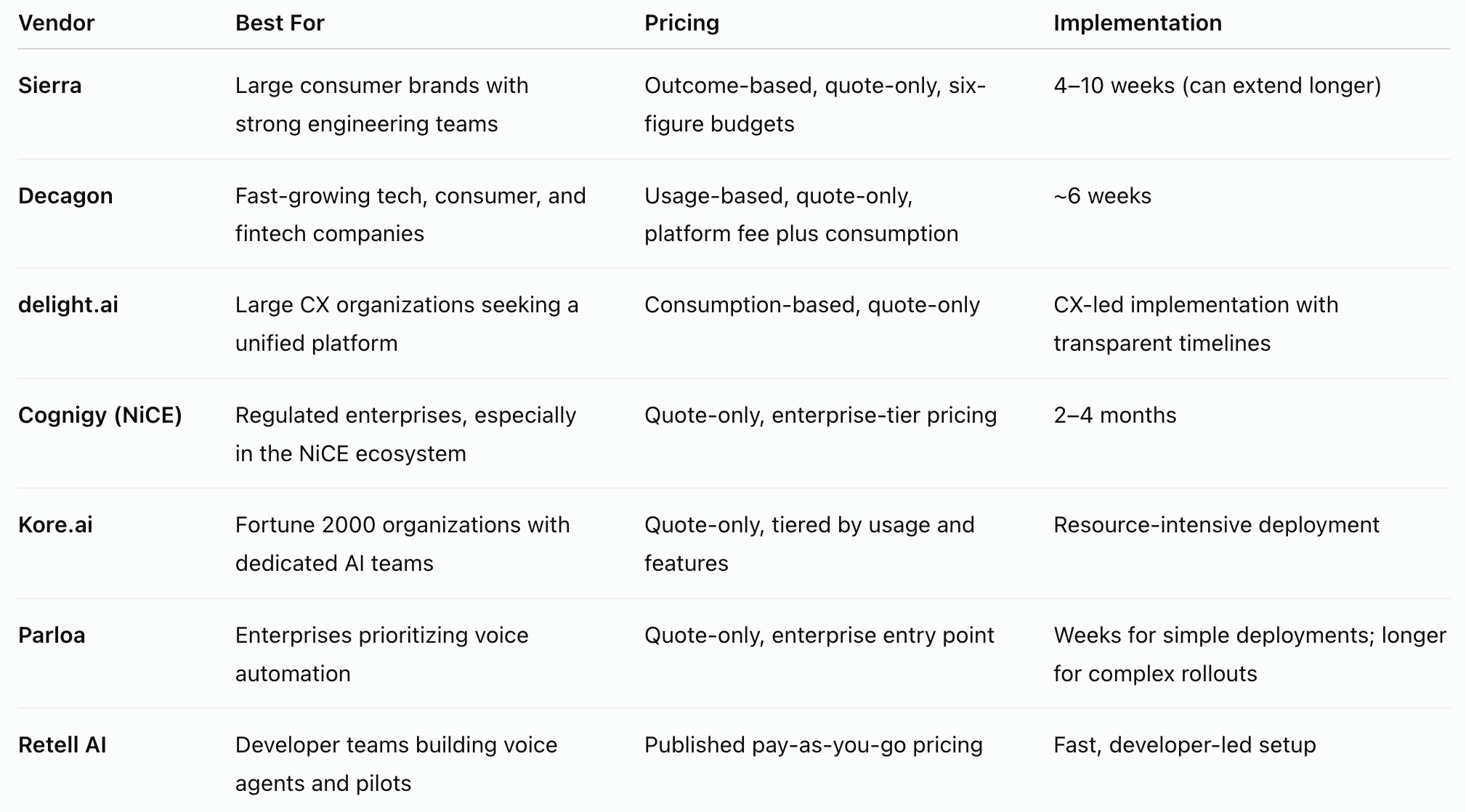
One note upfront: On pricing transparency, the enterprise field—Sierra, Decagon, Cognigy, Kore.ai, Parloa, and delight.ai alike—is quote-only. The vendors that win on published pricing are developer- and voice-focused tools like Retell AI (per minute) and Intercom Fin (per resolution). More on that below.
Sierra AI alternatives at a glance
Each vendor’s ideal customer, pricing model, and implementation approach
How each vendor compares on voice capabilities, integrations, and compliance
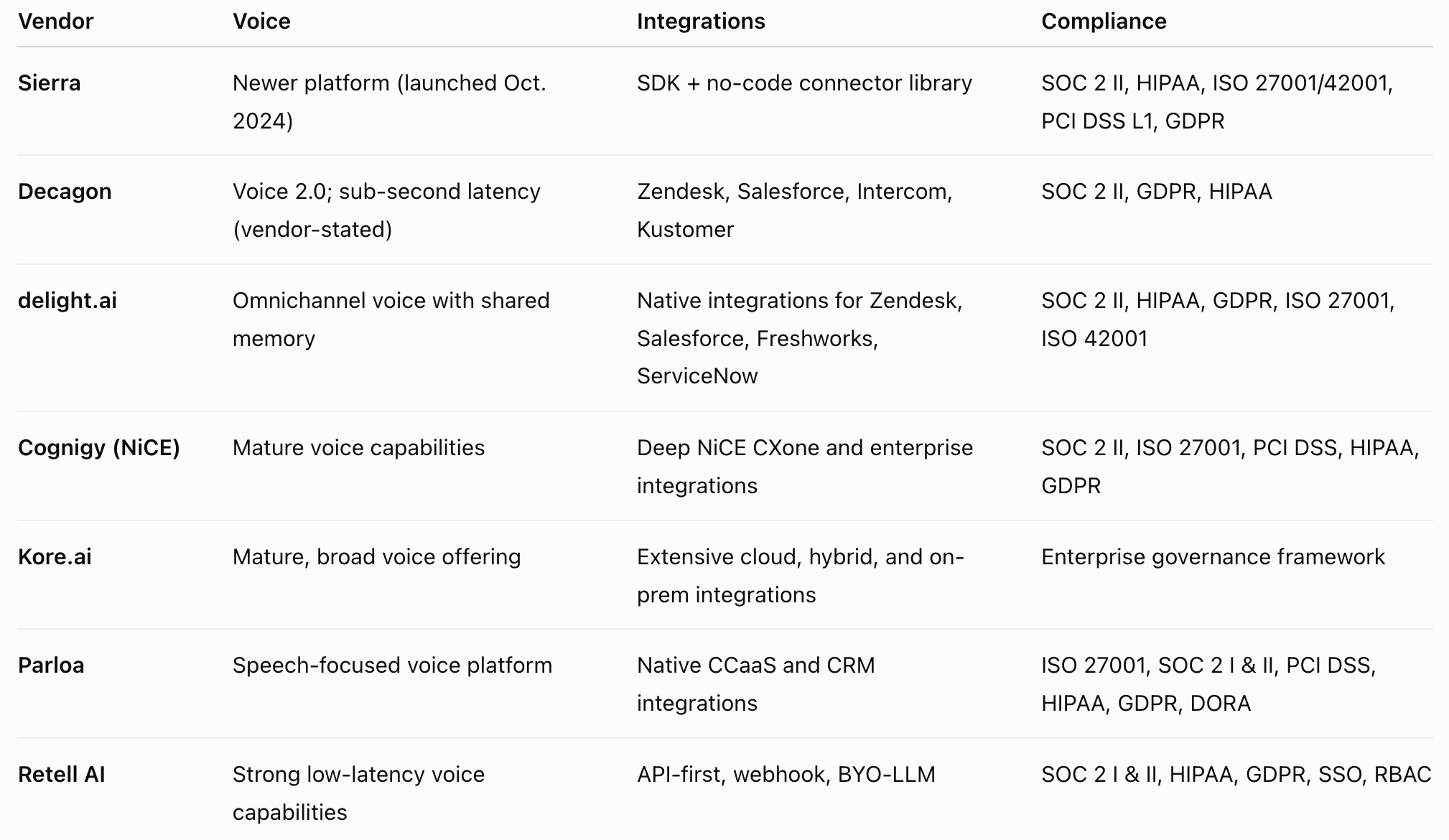
Intercom Fin (helpdesk-native, with published per-resolution pricing) and Ada (digital-first CX automation) were not included in this analysis because they serve a different category of buyer than the autonomous-agent platforms above—the digital-first, helpdesk-native buyer rather than the enterprise autonomous-agent one. Both publish or semi-publish pricing.
Decagon—the most-co-evaluated alternative
In our conversations with buyers, Decagon is the alternative they co-evaluate with Sierra most often, and the one most frequently named as a direct competitor. It builds autonomous, large-language-model-native (LLM-native) agents across chat, email, and voice, with confirmed cross-channel persistent memory so context carries across sessions.
Where it's strong
- Agent Operating Procedures (AOPs). Its signature concept: plain-English workflows your CX team writes and updates, which the platform executes with deterministic guardrails around defined actions. Plus Watchtower analytics and Simulations (used both pre- and post-launch), for shorter feedback loops than a model that routes every change through engineering.
- Reviewer sentiment. Relatively easy implementation, responsive support, and the deterministic control AOPs provide.
- Autonomy track record. Duolingo reports roughly 80% deflection, and Rippling went from 38% to over 50%—both Decagon case studies.
Where it gives ground
- Integration. Connects to existing helpdesks via API (Zendesk, Salesforce, Intercom) rather than migrating you off them, but it's not a marketplace plug-and-play overlay, has no Freshdesk connector, and has no built-in ticketing, so it needs a separate helpdesk to function.
- Forecasting. Usage-based, per-conversation/per-resolution billing is quote-only and hard to forecast.
- Voice. Newer but maturing fast. Voice 2.0 reports sub-second latency (<400ms p95, vendor-stated), and Chime is its highest-profile voice reference. But Chime also runs Sierra for core resolution and kept it rather than replacing it with Decagon. That's not a ringing endorsement of either platform. Chime tried both best-in-class options and still couldn't get what it needed from one vendor.
The criteria-by-criteria pricing and integration detail lives in the Sierra vs. Decagon section below.
Best fit: fast-moving tech, consumer and fintech support orgs running primarily chat and email volume.
Delight.ai—native-integrated, CX-team-operable, unified platform
Where Sierra and Decagon each do some things well—and where customers like Chime end up running both—delight.ai (a Sendbird product) covers the full footprint in a single platform: native integrations, unified memory, omnipresent support, and CX-team operability without a developer in the loop.
The value proposition isn't just feature parity. It's eliminating the operational overhead of stitching vendors together: two pricing models to manage, two integration layers to maintain, two sets of guardrails to update when something changes.
Where it's strong
- Native, CX-owned integration. Zendesk, Salesforce, Freshworks, ServiceNow, and Desk AI Copilot connect without custom API work, and no-code Actionbooks let the CX team make changes rather than routing every update through a vendor services team (see how the AI agent platform handles this). Against Sierra's custom-API model and weaker G2 integration ratings, that's a real, buyer-validated difference.
- Unified memory. Its Agent Memory Platform (AMP) keeps bot and human history unified across channels and sessions, so context carries through a handoff intact, directly closing the data-dispersion gap from Sierra. This is the personalization ask we hear most.
- Omnichannel voice without a separate vendor. Voice AI runs on the same memory architecture as chat and email, so there's no seam in the customer record and no second platform to manage. It's the channel gap that pushed Chime to add Decagon—covered natively here.
- Concrete results. Teams see an average 73% deflection rate, and Hanssem climbed from 48% to 90% resolution over five months as that memory compounded. It runs on Sendbird infrastructure with Trust OS governance carrying the certifications in the table.
Where it gives ground
- Ramp time. The memory architecture compounds context over time, so peak performance takes months and initial resolution starts below competitors' published figures. Hanssem's climb from 48% to 90% over five months is the upside of that curve; teams that need peak performance in week one may find another platform a better near-term fit.
- Pricing visibility. Consumption-based and quote-only, the same opacity as the rest of the field; you can't model costs before a sales conversation.
- Connector breadth. While integrations are native and CX-owned, the connector catalog is narrower out of the box than Zendesk- or Salesforce-native platforms offer, so confirm your specific stack is covered.
In short, it competes on integration, scale, and unified memory, not on logo count or a long deflection track record.
Best fit: >1,000-employee CX orgs with high-volume support that want native-integrated, CX-operable, governed, unified-memory CX and are comfortable with quote-based pricing.
Cognigy (NiCE Cognigy)—the enterprise CCaaS incumbent
Where delight.ai and Decagon are newer pure-plays, Cognigy is the serious contact-center incumbent on this list, with credentials that aren't in dispute—named a Gartner Magic Quadrant Leader three times, most recently in 2025.
Where it's strong
- Analyst and customer credentials. Counts customers like Mercedes-Benz and carries strong ratings on both G2 and Gartner Peer Insights alongside broad enterprise compliance.
- NiCE ecosystem. Acquired by NiCE for roughly $955M in September 2025, giving it deep CXone integration and the backing of a major contact-center-as-a-service (CCaaS) player. If your contact center already lives in the NiCE ecosystem, Cognigy is a natural fit.
Where it gives buyers pause is cost and complexity
- Cost. Enterprise-tier minimums, with voice, chat, and LLM usage metered separately; the modular billing structure means all-in TCO can climb well above the platform minimum depending on usage.
- Voice latency. Higher than the voice-first players; Cognigy does not publish latency specs, and third-party estimates suggest multi-turn flows add meaningful overhead.
- Implementation. Typically two to four months, and despite the "low-code" positioning, logic-heavy flows and API integrations still lean on developer support.
Best fit: large regulated enterprises in or near the NiCE ecosystem that can absorb the suite's cost and configuration overhead.
Kore.ai—broad enterprise automation
If Cognigy's reach is the contact center, Kore.ai's is everything around it—the breadth play. Its platform spans customer experience, employee experience, and operational process automation under one governance layer.
Where it's strong
- Analyst recognition. Two Forrester Wave Leader designations and a Gartner Magic Quadrant Leader placement back the scope.
- Deployment breadth. Deploys across cloud, hybrid and on-prem, brings broad mature integrations across CRM and collaboration stacks, and scores strongly on natural-language understanding.
- Proven at scope. AMD reports an 80% reduction in HR inquiry resolution time and 70% employee satisfaction improvement.
For a Fortune 2000 enterprise standardizing automation across many functions, that breadth is the point.
The trade-off is operability
- Learning curve. It’s steep; reviewers consistently call the console and UI complex and overwhelming.
- Scale management. Migration and version management get complicated at scale, the platform is resource-heavy, and it's explicitly not plug-and-play.
- Pricing. Quote-only.
The framing that matters for a CX buyer is fit, not customer count: If you want a CX-focused tool your own team can operate, a broad enterprise-automation platform that expects a dedicated AI/IT team may be more machinery than you need.
Best fit: large enterprises with the technical staff to run a wide, complex platform.
Parloa—production-grade voice for regulated enterprises
Where Kore.ai spreads wide, Parloa goes deep on one channel: voice.
Where it's strong
- Production-grade voice. Speech-centric architecture with a full lifecycle (Design, Test, Scale, Optimize) built for voice, supporting 130-plus languages.
- Regulated-buyer compliance. Coverage extends to DORA on top of the usual enterprise certifications (full list in the table), and it counts customers like Swiss Life.
The constraints are pricing, timeline, and accessibility
- Pricing. Opaque and quote-only; entry is enterprise-tier and a poor fit for mid-market budgets.
- Timeline. Simple deployments can go live in weeks; complex enterprise rollouts typically take longer and need technical resources. Non-technical users tend to need handholding.
- Review footprint. Its independent G2 footprint is thin (a single verified review as of mid-2026), though that says more about review volume than product quality.
Best fit: regulated enterprises—particularly in Europe—that need production-grade voice at global scale.
Retell AI—the transparent-pricing benchmark (and a different buyer tier)
Where every vendor so far is quote-only, Retell AI is the clear answer to the pricing question, even if it isn't a head-to-head match for Sierra.
Where it's strong
- Pricing transparency. Transparent, pay-as-you-go: a published per-minute base rate, no six-figure minimum, and low latency (sub-second, vendor-stated). On the criterion buyers care about most, Retell AI wins.
- Developer experience. Drag-and-drop building and webhooks for connecting to your data.
- Governance. Single sign-on (SSO), RBAC, audit logs, encryption at rest and in transit, PII redaction, and SOC 2 Type I and II, HIPAA, and GDPR compliance. It’s not missing enterprise controls.
Where it's a different tier: It's voice tooling, not a full CX platform
- Built for developers. API-first, for developer teams standing up voice agents and proofs of concept, not non-technical CX teams running omnichannel support.
- Residency and resourcing. Data residency is US-only, and production use requires developer resources.
- Cost at volume. The all-in per-minute cost escalates past the headline rate once you add an LLM and telephony.
Intercom Fin is the other transparent reference point—helpdesk-native with published per-resolution pricing, and customers like Vanta report a 71% resolution rate after deployment.
The takeaway isn't "Retell AI beats Sierra"; it's that transparent pricing exists for the developer/voice buyer, while the enterprise CX buyer still needs native integrations, omnichannel coverage, and a full platform that voice tooling alone doesn't provide.
Best fit: developer teams building voice agents or proofs of concept that want transparent per-minute pricing and low latency, not a full omnichannel CX platform.
Sierra vs. Decagon: Control vs. convenience
This is the head-to-head most buyers actually run. The cleanest frame: Decagon offers structured control; Sierra offers lower-overhead deployment.
- Pricing. Both are quote-only, usage-based and hard to forecast. Sierra bills per successful resolution; Decagon combines a platform fee with per-conversation or per-resolution consumption charges. Neither publishes rates—that's the transparent choice—and both require a sales conversation to model costs. For a published benchmark, see Retell AI and Fin.
- Control and operability. Decagon's edge. Its Agent Operating Procedures let a CX team update agent logic in plain English, generally faster post-launch iteration than routing changes through Sierra's SDK or services team. Both, though, require engineering upfront to wire up APIs and guardrails.
- Integration. Sierra's custom-API model shows up in weaker G2 integration scores relative to its ease-of-use ratings. Decagon also integrates via API, layering onto an existing helpdesk through a managed ~six-week implementation rather than a migration—but with no marketplace plug-and-play, no built-in ticketing of its own (it needs a separate helpdesk), and no Freshdesk connector, so confirm your specific stack.
- Voice. Both are newer to voice than the voice-first players, but Decagon's Voice 2.0 reports sub-second latency (<400ms p95, vendor-stated) and references like Chime, closing that gap quickly.
- Autonomy track record. Both have longer-running, more proven autonomous-resolution deployments than most newcomers—their shared strength.
- Platform completeness. Neither covers the full enterprise CX footprint on its own, which is why customers like Chime end up running both. That's worth sitting with: Chime is a flagship reference for Sierra and a flagship reference for Decagon. If either platform were truly delivering, the other wouldn't be in the stack. If avoiding that kind of multi-vendor complexity is a priority, it belongs on the evaluation scorecard alongside pricing and integration.
How to choose the right Sierra alternative
There's no single winner here—the right Sierra AI alternative for enterprise depends on what's constraining your decision. A quick map by situation:
- You're a developer team building voice agents or POCs → Retell AI. Transparent published pricing, low latency, no minimum.
- You're a voice-first regulated enterprise → Parloa (or PolyAI). Production-grade voice and deep compliance.
- You already live in the NiCE/CCaaS ecosystem → Cognigy. The analyst-leading incumbent with deep CXone integration.
- You want broad CX + EX + ops automation and have an AI/IT team → Kore.ai. Breadth and deployment flexibility, if you can staff it.
- You want the closest autonomous chat/email comparator with plain-English control → Decagon. AOPs and a strong autonomy track record.
- You want helpdesk-native, pay-per-resolution simplicity → Intercom Fin.
- You want native-integrated, CX-team-operable, unified-memory enterprise CX → delight.ai.
If you're still early in scoping the category, our overview of enterprise AI customer service platforms maps the buying landscape in more depth.
See it on your own stack
If the frictions that sent you looking—opaque cost forecasting, changes that wait on engineering, and a customer history split between bot and helpdesk—are the ones you're solving for, the fastest way to judge fit is to see it against your own integrations and ticket volume.
Request a delight.ai demo and ask how AMP unifies the bot-and-human history we described, and how your CX team would own Actionbooks without a developer in the loop.