Airlines, like many industries, are steeped in tech debt and legacy systems. With AI solutions popping up left, right, and center, it’s a jungle to navigate and even harder to triage alongside existing systems. Legacy providers are branding themselves as AI-first, but in reality, AI is an afterthought. It’s difficult to know if one is working with a truly native AI company.
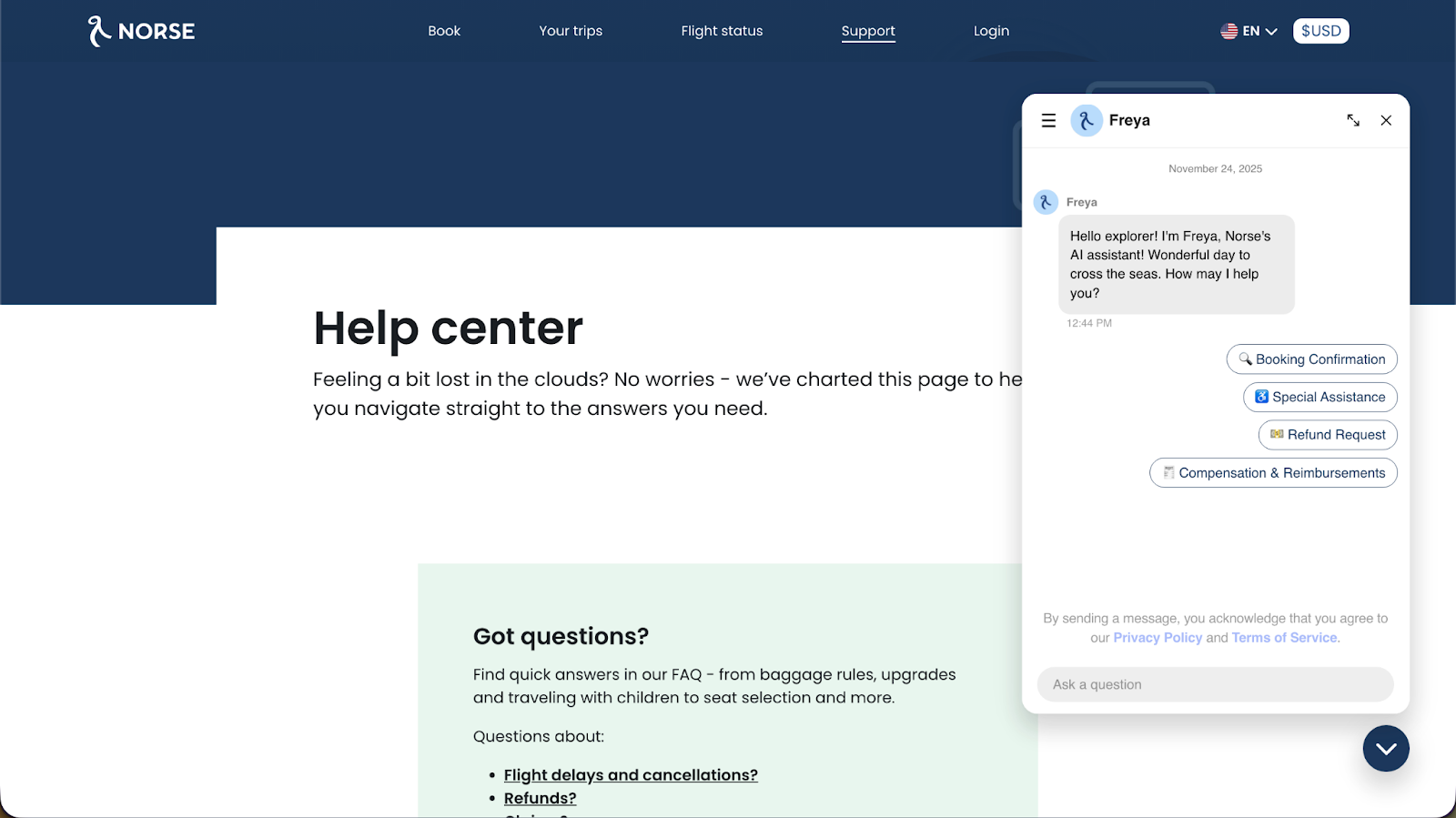
Norse Atlantic Airways was also grappling with the same challenges: how does one adapt, should one adapt, or is it just a fad that will die out? That rapidly changed after meeting delight.ai. In less than two months, Norse had sunset their old chatbot and gone live with their flagship AI agent, “Freya,” powered by delight.ai. While Freya was a major milestone, she was only the opening move. While other airlines looked at AI as a way to patch holes in customer service, Norse and Delight.ai see an opportunity to fundamentally rethink how a business runs on AI.
The mandate: Rethink work, not just workflows
The aviation industry usually treats automation as a finish line—chasing better resolution rates, lower Average Handling Times, and smarter FAQ bots. Norse recognized that these metrics, while necessary, are merely the baseline.
Norse asked a deeper question:
What does an AI-ready organization actually look like?
That single question reframed the entire transformation. AI-readiness isn’t a technology milestone, it’s an organizational one. It forces a company to rethink how decisions are made, how knowledge moves, how teams collaborate, and how AI can participate in the business as a true teammate—not a feature bolted on the side.
And Norse understood they couldn’t become AI-ready without changing the workforce itself. Freya was suddenly their most active “employee.” Someone had to own her evolution, shape her behavior, and ensure she kept getting better.
“Freya became a core part of the team, and we quickly realized that Freya needed a “manager”. However, we were entering uncharted territory. There was no LinkedIn template for an AI agent manager role. We worked closely with the Delight.ai team to reverse-engineer the role. We literally co-authored the job description from scratch to find someone that can be the operator and manager for the AI agent Freya. In addition, we needed to upskill our current customer support team into specialists who continuously optimize, train and step in when human-touch is required. We see the future of our customer support team as AI agent managers.”
— Alf Lim, Chief Product Officer at Norse Atlantic Airways
The "AI high performer" blueprint
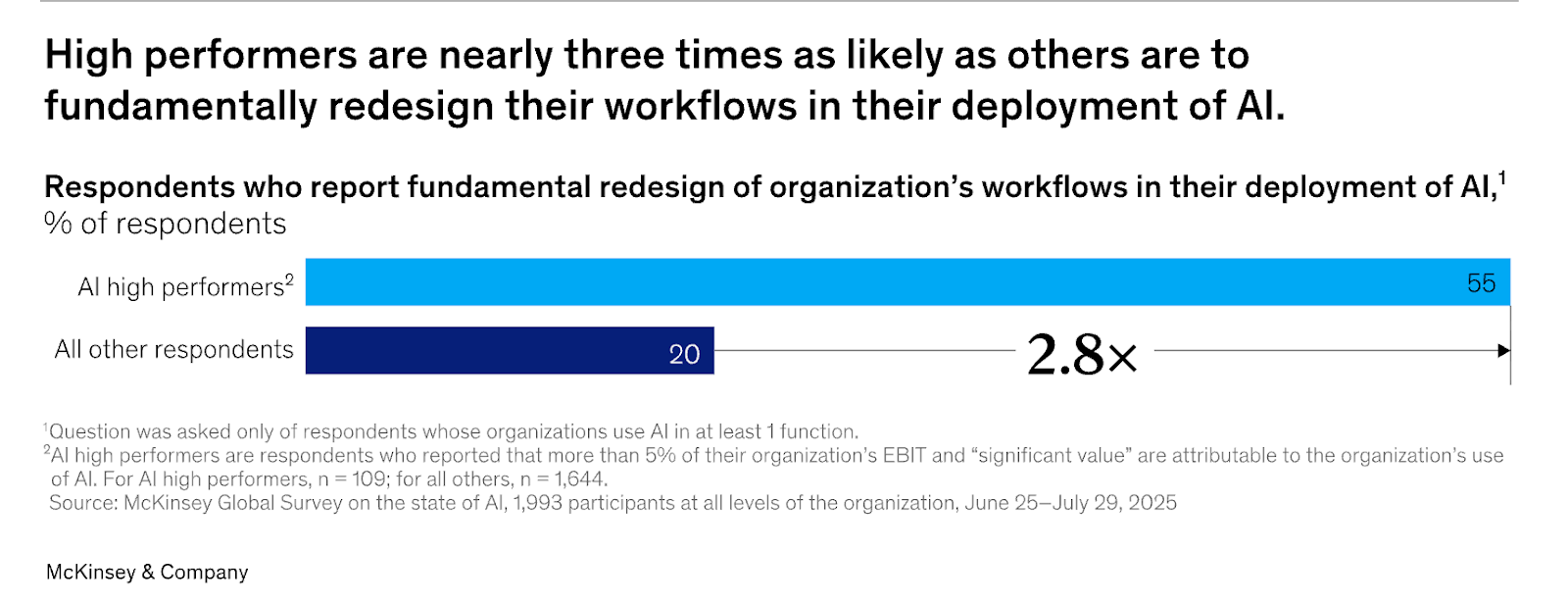
Norse’s approach mirrors the shift McKinsey calls out in their research: The companies that see 5%+ EBIT impact from AI—their “AI high performers”—are the ones that redesign the organization itself.
They are 2.8× more likely to rebuild workflows and responsibilities around intelligent systems rather than adapting AI to old processes.
To become AI-ready, Norse first had to reimagine how the airline organizes knowledge, how teams make decisions, and how AI could participate in the business as a true collaborator—not a tool, not a project, but a new kind of teammate.
Designing the AI workforce
The shift required answering foundational questions about the nature of work:
- What should AI own? What should humans own? And what should they co-own?
- How do we make sure knowledge lives in one accessible, structured, ever-improving brain?
- What does the workforce look like when AI becomes part of the operating rhythm?
- How do we build a role responsible for ensuring that improvement never stops?
The answer led to a new discipline.
The birth of a new operational discipline: AI operations
To run this new intelligence, Norse is opening a role the airline industry has never seen: AI Agent Manager.
The AI Agent Manager is the clearest signal of their shift into AI Operations: a discipline built around owning, training, and improving AI as part of the workforce.
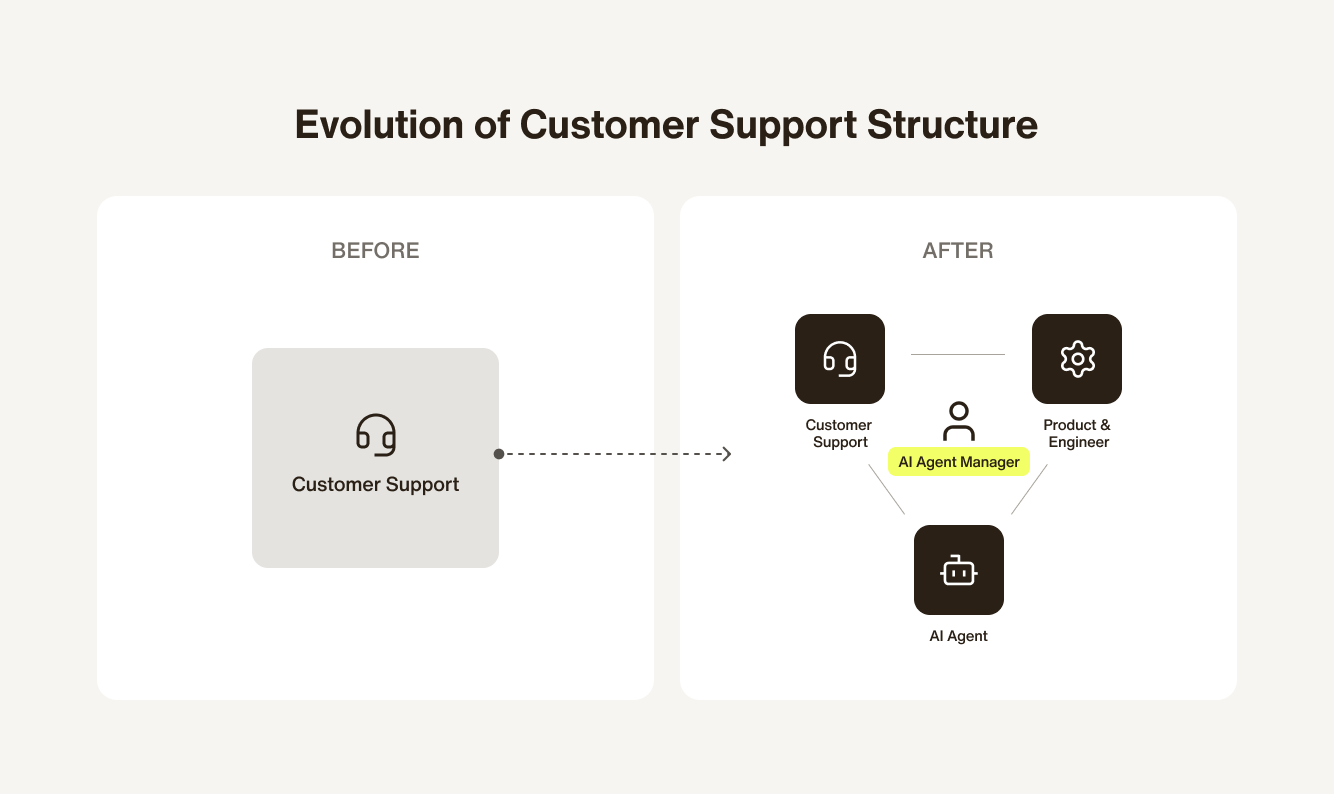
Traditionally, customer support has been a human-only discipline: a single team handling every interaction manually, with improvements tied to training or headcount. Introducing an AI agent breaks that model open. It creates a new, cross-functional operating layer where technology, product thinking, and frontline expertise must stay tightly coordinated.
The AI Agent Manager sits within the customer support team, but the work itself stretches far beyond it. The role operates at the intersection of human support, Product & Engineering, and the AI agent—acting as the connective tissue that keeps all three aligned, informed, and moving as one system. It’s a hybrid operator position blending product intuition, prompting skill, and day-to-day performance ownership.
This person manages Freya’s accuracy, behavior, guardrails, workflows, RAG sources, and failure patterns. They audit conversations, diagnose issues, design new automations, and tune prompts like a continuous improvement engine.
And because passengers expect one seamless experience—whether they’re booking a flight or dealing with a delay—the role is cross-functional from the start. It touches product, engineering, operations, and policy. The AI Agent Manager becomes the connective tissue that keeps the agent unified, on-brand and coherent across every part of the traveler journey.
From alignment to impact: 60% → 80% containment
AI is never perfect on day one. It becomes powerful through structured learning, deliberate tuning, and continuous operator feedback. Through a tight collaboration between Norse and Delight.ai’s Forward Deployment Team, containment climbed from 60% to 80% in just two weeks.
“What stood out was the Forward Deployment team’s bias for action. We assigned a clear goal—80% containment—and they treated it as their own. They dissected our conversation logs, re-engineered the Actionbooks, and shipped the necessary logic updates to get us there. It was a masterclass in iterative improvement. Coming from the consulting industry, this feels like a new form of consulting delivery: tech solutions + human ingenuity.”
— Alf Lim, Chief Product Officer at Norse Atlantic Airways
Looking ahead: Beyond support, the pivot to revenue
While most airline bots are defensive (cutting costs), Freya plays offense. She now leverages conversation context to drive commerce: a question about legroom can transition into a seat upgrade, an inquiry about weight limits can convert into immediate baggage cross-sales.
Freya is no longer just solving problems; she is actively increasing customer lifetime value. This signals the end of the artificial wall between "Support" and "Sales".
“We are moving past the idea of 'support bots.' The future is one unified agent for sales and support—a single digital concierge that knows you, helps you, and travels with you. Whether she is fixing a ticket or upgrading your seat, it’s the same brain, the same context, and the same seamless experience.”
— Alf Lim, Chief Product Officer at Norse Atlantic Airways
This is the next era of airline service: intelligent, adaptive, revenue-aware, and deeply customer-centric. And Norse is already building it in a strategic partnership with Delight.ai.