
Agentic AI is here and operational. From automated AI customer care to revenue recovery, AI agents are increasingly embedded across customer journeys and back-office processes. However, as the adoption of these agents grows, pricing becomes a top concern for technology and operations leaders.
CIOs, CTOs, and CX leaders are asking an increasingly urgent question:
How should AI agents be priced in a way that reflects the value they create—without introducing unpredictability or inefficiency?
While there’s no one-size-fits-all answer, the market is clearly evolving from static models rooted in legacy software economics to more dynamic, performance-linked approaches.
Let’s review the different types of pricing models for AI agents you'll find among the best AI agent builders.
What are the different pricing model types for AI agents?
Understanding today’s AI pricing landscape requires revisiting the broader software pricing journey. Over the past two decades, we’ve seen a shift from fixed licensing models to flexible, metered usage—and now, toward pricing mechanisms that attempt to measure actual outcomes, which is especially relevant for AI agents.
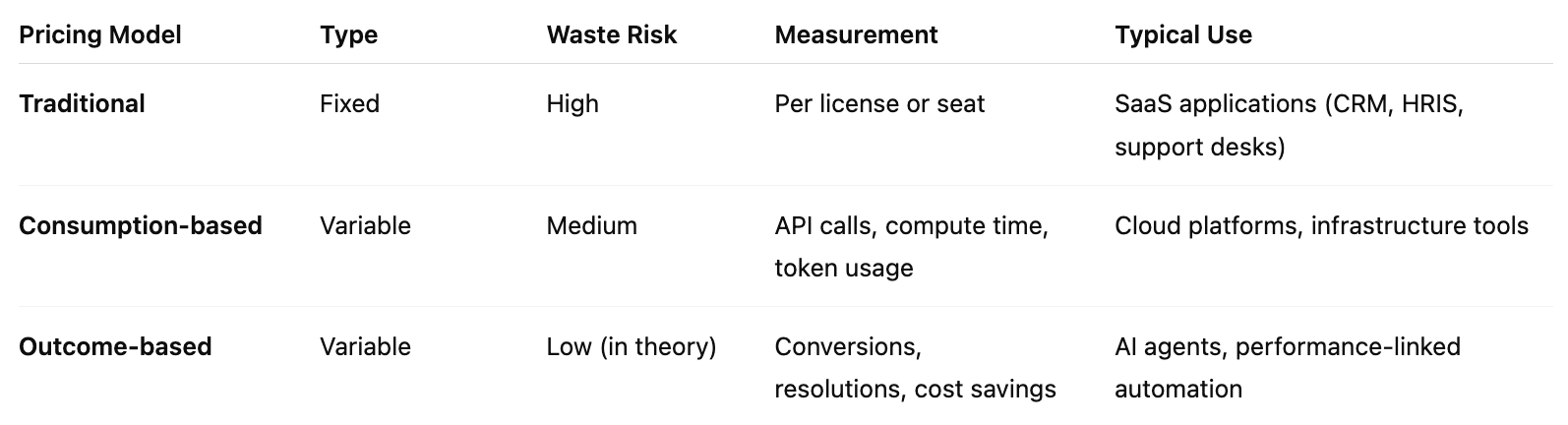
Quick pros and cons of AI agent pricing models
Each pricing model has trade-offs. While consumption models offer flexibility over traditional models, they may still reward volume over effectiveness. Unlike static software or raw computing, AI agents require pricing that reflects business value, not just usage. See FAQs for more pricing model details.
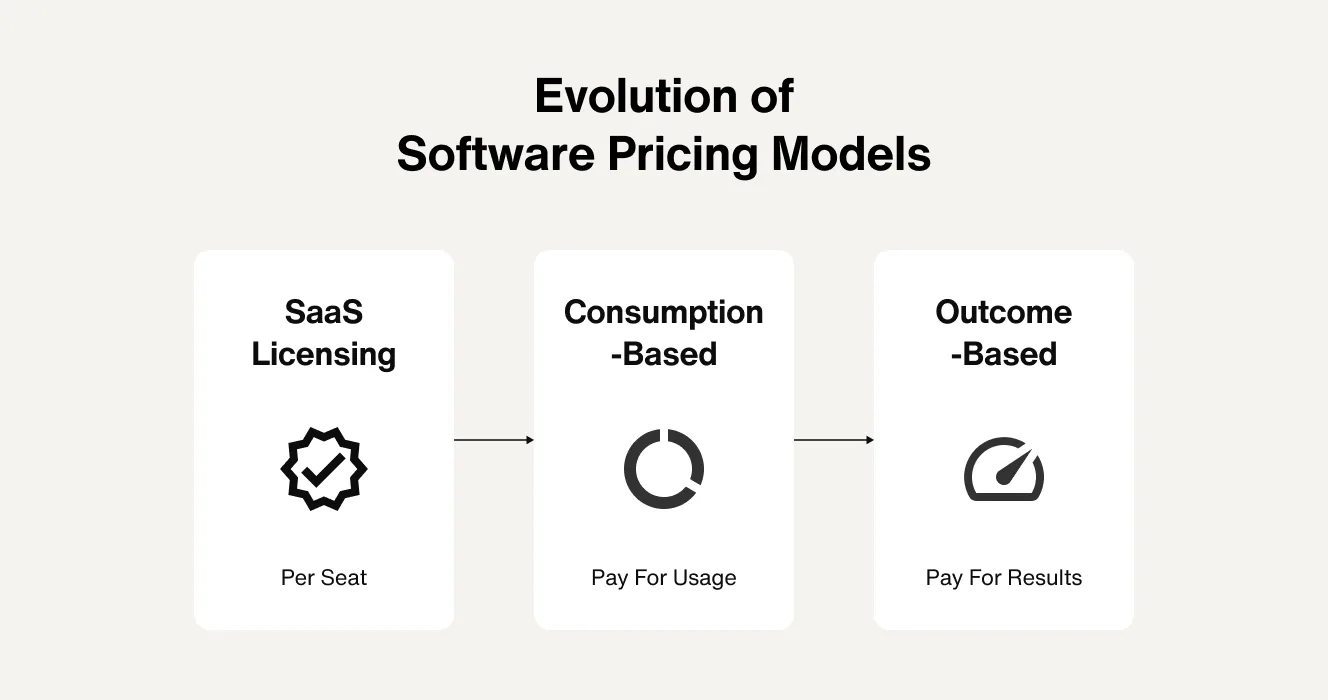
The emergence of outcome-based pricing for AI agents
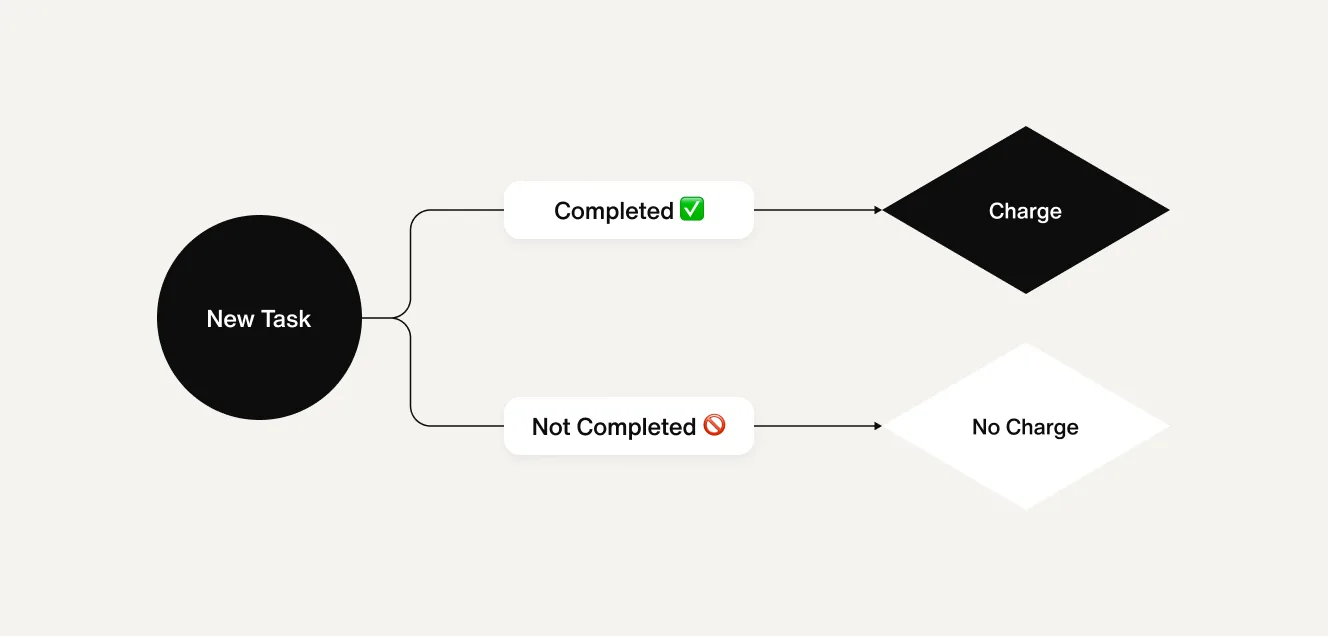
Outcome-based pricing has gained attention for its promise of alignment: pay only when the AI agent or software achieves a meaningful, measurable result. That might be a resolved ticket, a completed transaction, or a retained subscriber.
Advocates of this model argue it offers benefits such as:
- Closer alignment between vendors and customers
- Reduction of waste from underperforming automation
- Clearer ROI attribution for budgeting and forecasting
Yet, despite its conceptual appeal, adoption has been cautious. Defining and agreeing on outcomes is complex, especially across functions or industries with ambiguous or multi-step success metrics.
Examples of AI agent pricing models in the market
Several pricing frameworks are now in play across the AI vendor landscape. Each reflects different priorities—whether it's predictability, accountability, scalability, or simplicity.
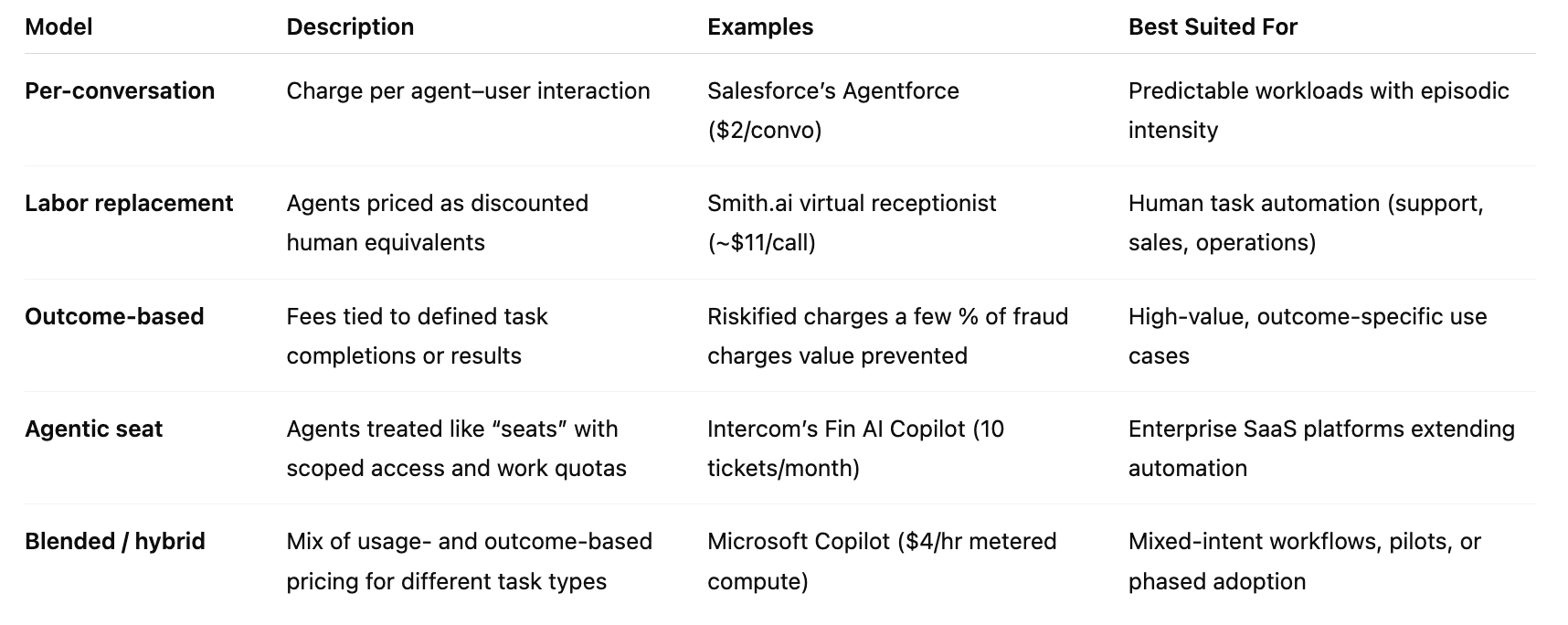
What’s notable is not just the variety but also how these models represent philosophies about AI agents. Are they tools, teammates, infrastructure, or labor replacements? Pricing is, in many ways, a reflection of that stance.
The challenge of outcome-based pricing for AI agents
One of the most significant constraints on outcome-based pricing is clarity around what constitutes a “successful” result. This becomes especially complex in enterprise environments with multi-touch workflows or partial contributions from AI systems.
Some recurring questions include:
- Is success binary (done/not done) or partial (assistive)?
- Who gets credit for collaborative outcomes involving AI and humans?
- Can success metrics be audited and verified by both sides?
Sophisticated vendors often co-define outcomes with their customers, building shared frameworks for measurement and governance of their AI agents. But not every organization has the internal analytics maturity—or cross-functional alignment—to support this level of nuance.
Common customer concerns about outcome-based pricing
Despite growing interest, outcome-based pricing still prompts fair skepticism. Here are a few concerns heard in executive conversations:
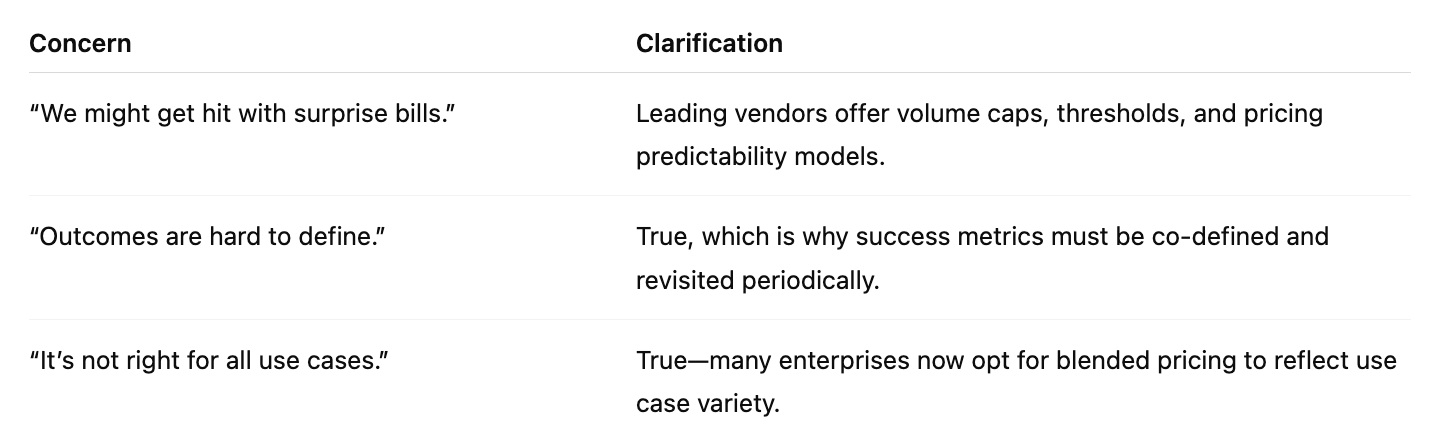
Outcome-based pricing isn’t inherently “better.” Like any model, it succeeds when aligned with a clear use case, strong metrics, and operational trust.
Avoiding AI shelfware: A lesson from SaaS
In the early days of SaaS, companies overbought software licenses “just in case.” This led to the rise of “shelfware”—unused seats that quietly drained budgets.
AI agents, if priced without accountability, risk a similar fate. Fixed-seat models for a use case like AI for customer service can overstate adoption; token-based models can obscure efficiency. Without visibility into how much value each agent interaction creates, organizations may be left with flashy automation that fails to deliver.
Some enterprises now prioritize pilots or performance-linked contracts before scaling agent use across workflows.
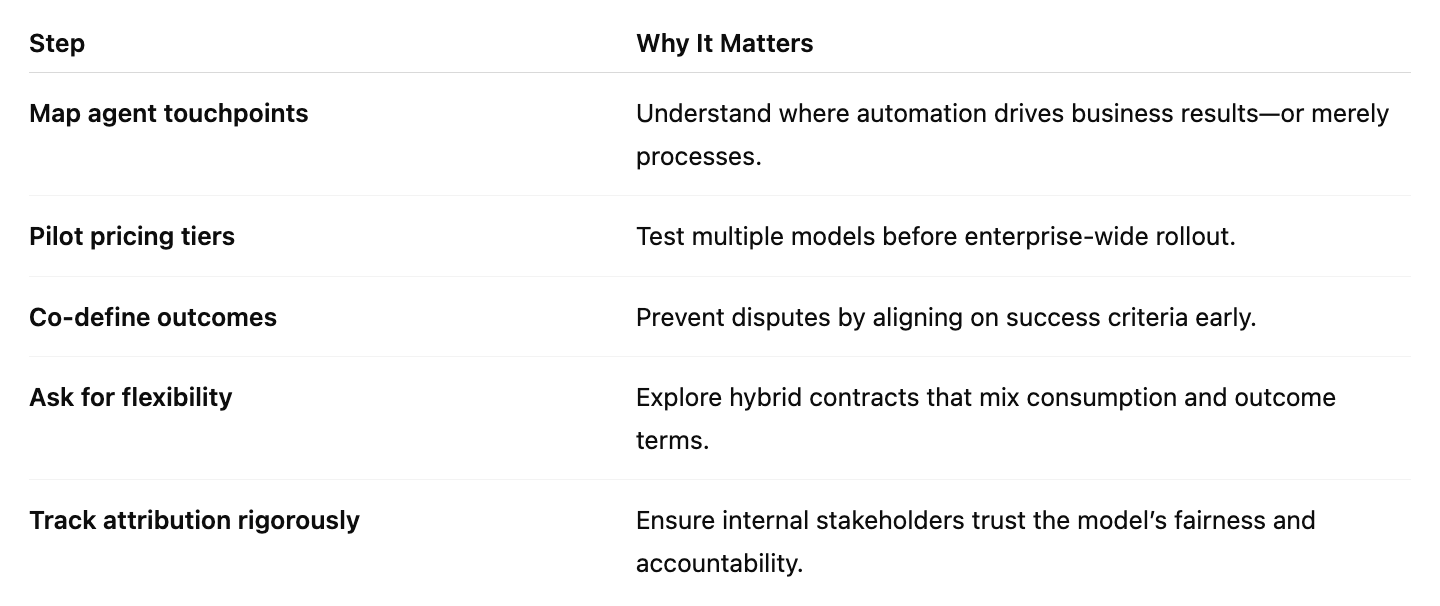
Practical next steps for AI agent pricing evaluation
Whether you’re in procurement, operations, or product, the right pricing model depends on the clarity of goals and maturity of implementation. Consider the following steps:
What does the future hold for AI agent pricing?
AI agent pricing is not yet standardized—and that’s a good thing. Enterprises are experimenting, learning, and adapting pricing to match their risk appetite and business maturity.
Some will continue to prefer the simplicity of usage-based contracts. Others will invest in performance-linked pricing to extract maximum value. Many will blend the two.
The only constant? Value is being redefined—and pricing must evolve with it.