
AI customer service is no longer a bet on the future. The results are already in, and the numbers are hard to ignore. The market is projected to grow from $12.06 billion in 2024 to $47.82 billion by 2030, driven by real pressure. Support teams are being asked to handle more with the same headcount, while customers have less patience for wait times than ever.
And the early adopters are proving what’s possible. Across industries, companies that have redesigned their customer service around AI are seeing results that would have looked unrealistic several years ago. A few noteworthy examples of AI in customer service that we’ll examine:
- Bank of America's Erica has handled more than 3 billion client interactions, with 98% of users getting what they need without a human agent.
- The Home Depot's AI voice agents resolve customer calls four times faster than traditional phone menus.
- Mixpanel cut first-response investigation time from 10 minutes to near-instant by giving its AI full account context before the first reply, turning support into a growth channel.
- Swiggy automated 70% of its customer support tickets and cut resolution time from five minutes to under 40 seconds.
But for every deployment that holds up, plenty don't. In 2025, 42% of companies scrapped substantial AI projects—up from 17% the year before—and only 20% of AI initiatives delivered on expectations.
The demand is there; the execution is where teams diverge. We’ll break down each case study mentioned above to show the mechanics behind their success and how you can replicate them.
To start, let’s define the scope of AI in customer service.
How is AI used in customer service?
The term AI customer service has become a catch-all to describe a variety of functions. In reality, here's what's under the hood:
- Generative AI customer support uses large language models (LLMs) to draft responses, summarize tickets, or power conversational agents capable of handling open-ended queries
- AI chatbots and virtual assistants include rule-based or natural language processing (NLP) systems that handle structured interactions like order status, account lookups, and appointment scheduling
- Agent-assist tools involve AI that works behind the scenes, surfacing relevant knowledge base articles, drafting suggested replies, and flagging sentiment shifts during live conversations
- Routing and triage automation classifies incoming contacts and directs them to the right queue or self-service path before a human ever touches them
In practice, these capabilities come together into a single, seamless workflow. It can handle a conversation, brief a human agent, and flag an escalation at the same time.
What are real-world examples of AI customer service?
From retail and financial services to healthcare and travel, organizations are leveraging AI tools for customer service in almost every sector.
Financial services: Bank of America's Erica
Bank of America (BoA) launched Erica in 2018 as the first widely adopted AI-driven virtual financial assistant. Almost a decade later, it has become one of the most concrete proof points in the industry.
In 2024, clients interacted 676 million times with Erica, bringing total interactions since launch to more than 2.5 billion. And those aren't passive views. More than 98% of users find the information they need through Erica, significantly decreasing call center volume and allowing financial specialists to focus on more complex client conversations.
The internal deployment is equally telling. Over 90% of BoA employees use Erica for Employees, and the virtual assistant has reduced calls into the IT service desk by more than 50%. The BoA case has a deliberate architecture behind it. Erica relies on deterministic AI rather than generative AI, which can hallucinate.
As Jorge Camargo, BoA’s head of digital platforms, says of AI customer service for finance: "The AI is all about trying to understand your question, but then we're going to give you an answer that we are 100% comfortable with. For spaces like financial services, we can't afford to be 90% right."
That instinct is backed by data. The 2026 Delight AI Index found that 64% of consumers expect AI to outperform human representatives in financial services, meaning the bar isn't "good enough." It's better than the best agent on the floor. In an industry where a wrong balance display can cause an overdraft and a failed transfer can mean a missed payment, that standard isn't unreasonable. It's the only one that earns trust.
The takeaway: Erica works because BoA made a deliberate decision—prior to launch—about what the AI would and wouldn’t do. Most teams make that call only after something breaks. BoA treated it as an AI trust decision, not a capability limitation. That’s why Erica can deliver a 98% resolution rate while many generative deployments are still wrestling with accuracy.
B2B: AI customer service becomes a retention system with delight.ai
AI customer service for B2B companies involves a different problem profile than consumer support. The bottleneck usually isn't knowledge, but context. Before answering queries, companies need to know who's asking, which includes details like their account tier, permissions, implementation setup, and history. In B2B, that deep dive can take longer than providing the actual answer.
Delight.ai’s Mixpanel case study shows the depth of that problem. Every ticket demands context before it can be resolved.
"Our support agents were spending the first 10 minutes of every interaction just figuring out who they were talking to," says Kathleen Matthews, Global Support at Mixpanel. "Checking account status, verifying permissions, reviewing their setup. The actual problem-solving came second."
Mixpanel, the analytics platform behind high-growth startups and enterprises like Salesforce and DocuSign, deployed delight.ai with intelligent AI personalization: The AI agent authenticates users and retrieves their account history, tier, access level, and current workflow context before it responds. The investigation that once took 10 minutes happens instantly, before the first reply.
But the more significant shift was what that context enabled beyond deflection. Support became a growth channel. When a free-tier user asks about an advanced feature, the AI explains how it applies to their specific situation and presents relevant upgrade options. When an enterprise customer has paid for a feature they've never configured, the AI proactively walks them through setup.
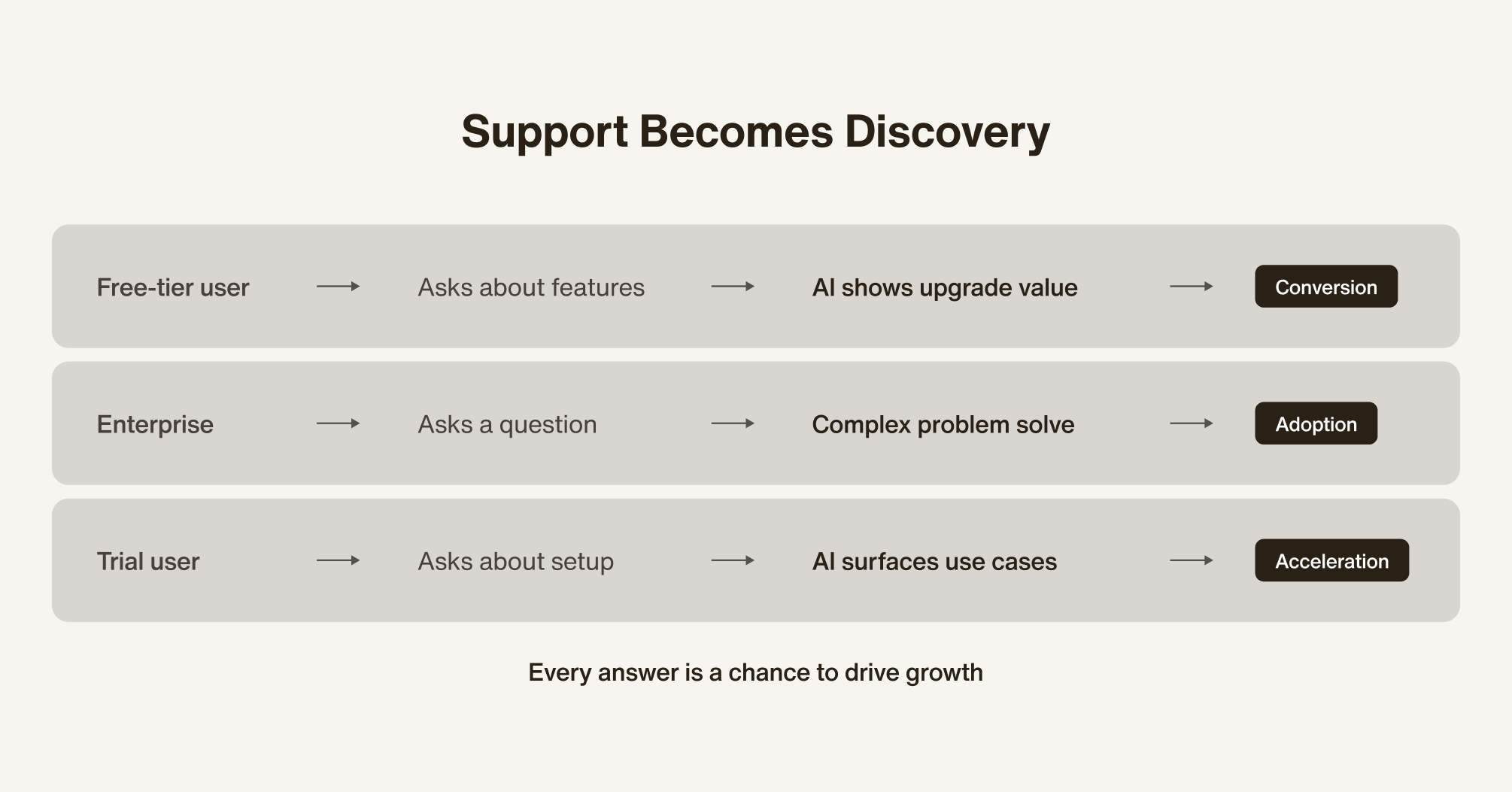
"We're not just answering faster," Matthews says. "We're answering smarter. The AI knows if you're asking because you don't have access yet, or because you're trying to configure something advanced. In the first case, we're converting curiosity into revenue. In the second, we're driving deeper product adoption."
That reframe—from support as cost center to support as growth function—is the principle behind delight.ai's B2B architecture. Instead of deploying AI reactively, delight.ai uses its Agent Memory Platform, hyper-personalized For You Conversations, and behavioral signals to intervene proactively, before a customer churns or disengages.
Context gets maintained across chat, voice, SMS, and email, so when a customer switches channels or returns weeks later, the AI picks up where it left off. That omnipresent support proves particularly useful for B2B relationships, where context accumulates over months of interactions.
For B2B teams, the ROI calculation is also different. A single enterprise account relationship often represents enough revenue that improving resolution quality—and expanding it—matters as much as reducing resolution cost.
The takeaway: What separates Mixpanel's AI deployment from the ones that stall is that the company identified the actual bottleneck—context, not knowledge—before choosing a solution.
The AI agent wasn't layered on top of an existing broken process. Instead, it was purpose-built to solve the specific issue making that process break. For B2B teams, that diagnostic step is often exactly what the failed deployments skip.
Retail: The Home Depot and the voice AI overhaul
Deployments for AI customer service in retail face a distinct set of challenges: high contact volume, repetitive inquiry types (e.g., order status, product availability, store information, etc.), and customers who expect fast answers regardless of channel or time of day.
The Home Depot, with more than 2,300 North American stores, identified a specific friction point: Customers calling stores were funneled through complex, multi-level phone menus that frustrated them and slowed resolution. To address this, The Home Depot announced the launch of an AI voice agent system.
The system eliminates phone menus entirely. Customers describe their situation, and the AI understands the reason for the call within 10 seconds. It checks order status, confirms product availability, initiates service requests, sends items to a digital cart, and completes purchases over the phone—with real-time support, multilingual translation, and a direct path to a human associate available.
A pilot program across 50 stores produced the headline result. Customers reach a solution four times faster than with traditional phone menus. Associates in the pilot reported higher job satisfaction, freed from routine call-handling to focus on more complex issues and in-store customers. The Home Depot plans to expand the system to all US stores in the year ahead.
Jordan Broggi, EVP of customer experience at The Home Depot, explains: "Using customer service AI voice agents, we’re moving away from 'please listen to these options' and toward ‘how can I help?’ AI does a tremendous job at recognizing customer intent and taking direct action to help complete a purchase or even start a service request. And of course, if they need to speak with an associate, we’ll quickly connect them."
The takeaway: The Home Depot case reflects a pattern in retail where the most tractable AI wins come from replacing the most friction-filled, lowest-complexity touchpoint. In this case, menu-driven phone support led to the win rather than attempting to transform the entire customer journey at once.
On-demand: Swiggy and the scale problem in real-time delivery
AI customer service for on-demand platforms is a volume problem first. Swiggy, India’s leading on-demand delivery platform for food, groceries, and household goods, handles up to 200,000 customer inquiries per day across 700-plus cities, with peak concurrency of 2,000 simultaneous conversations. At that scale, every second of resolution time and each escalation to a human agent has a direct cost.
Before automating its support, Swiggy's phone-based resolution process averaged around five minutes per inquiry. Most of those inquiries were routine: order status, delivery delays, refund requests—high volume, low complexity, and well-suited to automation. Swiggy deployed an AI-powered chatbot that brought resolution time down to 30–40 seconds and automated 70% of all customer support tickets.
By 2025, Swiggy had moved further, deploying an enterprise-scale agentic AI system that routes all customer queries through the AI agent, with human escalation reserved for genuinely complex cases. It delivers accuracy above 99% and answers almost instantly—within half a second for 99% of responses. Customer satisfaction rose alongside the speed gains, driven by responses that were faster, more consistent, and more personalized.
The takeaway: This case makes a point that applies broadly to on-demand support. The ROI on AI is highest when the inquiry volume is large and the issue types are predictable. Swiggy's support load (e.g., order tracking, refunds, delivery exceptions, etc.) maps directly onto what AI handles well.
Swiggy’s results came from a disciplined deployment. The team started with the highest‑volume, lowest‑complexity tier of support and proved the model there before expanding. The agentic system the company runs today is the result of that phased approach, not the starting point. Teams that try to automate everything at once rarely see numbers like Swiggy’s.
Healthcare: Constraints are the point
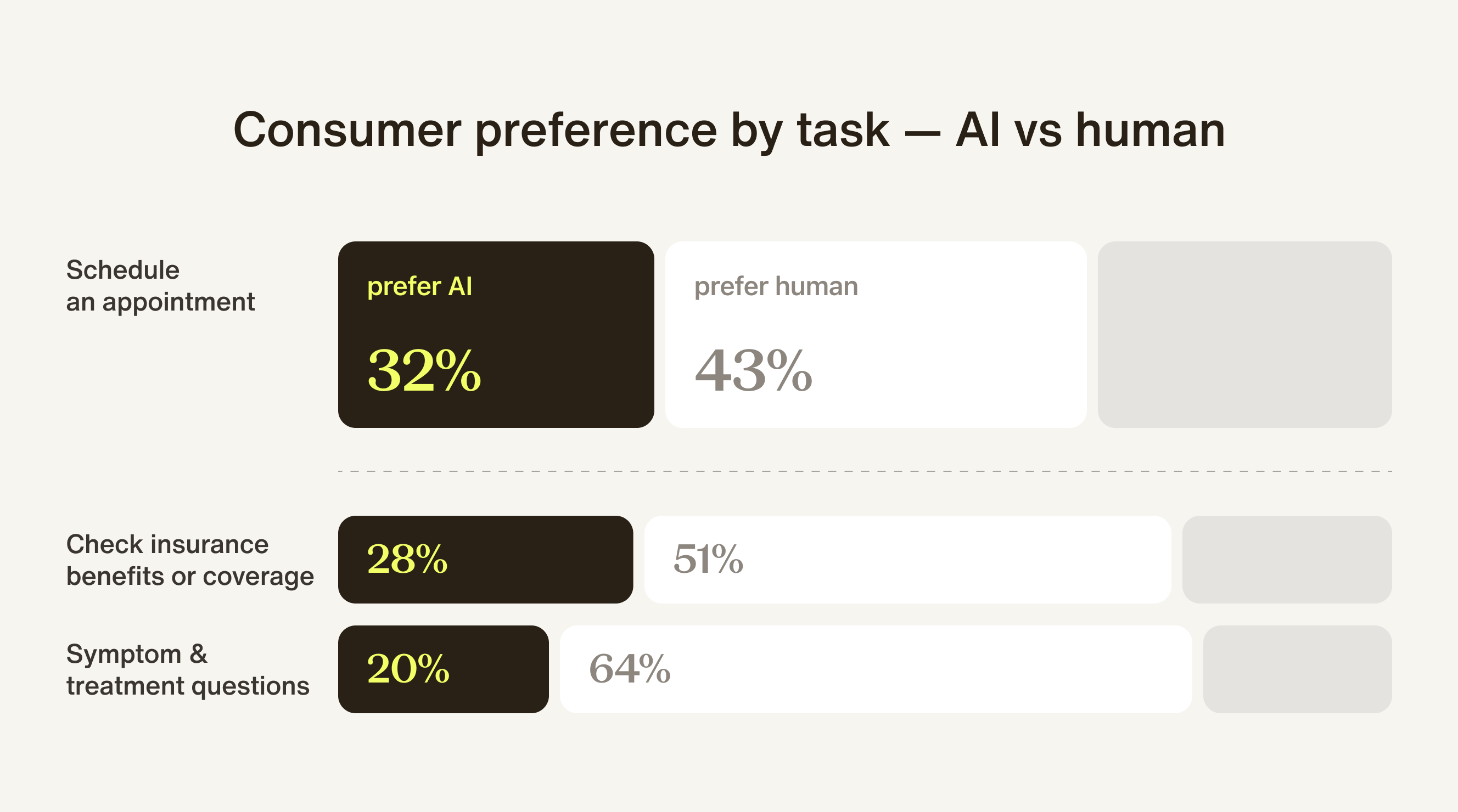
Facilities using healthcare AI customer service tools have to consider accuracy requirements, privacy regulations, and the stakes of bad information. Delight.ai's 2026 AI Index found that 84% of patients say clear data privacy and security practices would increase their trust in healthcare AI. This means healthcare organizations tend to deploy AI narrowly, with hard guardrails, and measure success differently.
Healthcare use cases often center on appointment scheduling, reminders, intake questions, medication guidance, and basic service inquiries, not complex clinical decision-making. Strong deployments define clearly what the system can answer, when it must escalate, and how compliance requirements shape the experience.
On the patient-facing side, Kaiser Permanente’s AI-powered patient portal for Southern California’s 4.9 million members lets patients describe their needs in plain language instead of choosing from preset menus. The system references patient data to recommend appropriate care pathways and flag urgent cases.
Across nearly 3 million encounters between October 2024 and March 2025, it detected high-acuity cases with 97.7% accuracy. The system also raised booking success from 34% to about 53.7%, improved patient satisfaction by roughly nine percentage points, and kept abandonment near 3%.
Many hospitals have deployed AI chatbots to handle routine patient questions (e.g., surgery prep instructions, rescheduling requests, billing inquiries, etc.), freeing clinical staff from administrative interruptions. Apollo Hospitals, for example, has allocated 3.5% of its digital budget to AI with a focus on automating routine tasks like medical documentation.
The takeaway: Healthcare AI deployments that succeed don't try to do too much. The teams that get it right spend as much time deciding what the AI won't handle as what it will. That clarity—built into the implementation before go-live, not patched in afterward—is what keeps the system trustworthy enough to scale.
Travel and hospitality: Volume, language, and the disruption problem
Among the clearest use cases is travel and hospitality AI customer service, which involves heavy ticket volume, predictable issue categories (e.g., booking changes, loyalty questions, cancellations, etc.), and a multilingual customer base that's hard to staff for around the clock.
A McKinsey study found that AI-driven service orchestration reduced check-in times by nearly 20% and boosted customer satisfaction scores by 15%.
The nuance in travel AI is timing. A chatbot can handle booking support or itinerary changes efficiently. During an actual disruption, such as a weather cancellation or delayed flight, customers can be distressed, and the bar for escalation to a human agent drops substantially.
Travel AI case studies, such as Norse Atlantic Airway’s partnership with delight.ai, are worth studying closely. They show that in this industry, when the AI responds matters just as much as how it responds.
Norse Atlantic Airways is a useful counterpoint to how most airlines approach AI customer service. The industry default is defensive: Deploy a bot to contain costs, measure resolution rate, call it done. Norse asked another question, “What does an AI-ready organization actually look like?”—and that reframe changed everything.
In under two months, Norse sunset its legacy chatbot and launched Freya, its flagship AI agent powered by delight.ai. Within two weeks of going live, containment climbed from 60% to 80% through iterative tuning with delight.ai's forward deployment team. But the more significant shift was organizational.
Norse created a role the airline industry hadn't seen before—an AI Agent Manager, embedded in customer support but working across product, engineering, and operations to own Freya's accuracy, behavior, and continuous improvement.
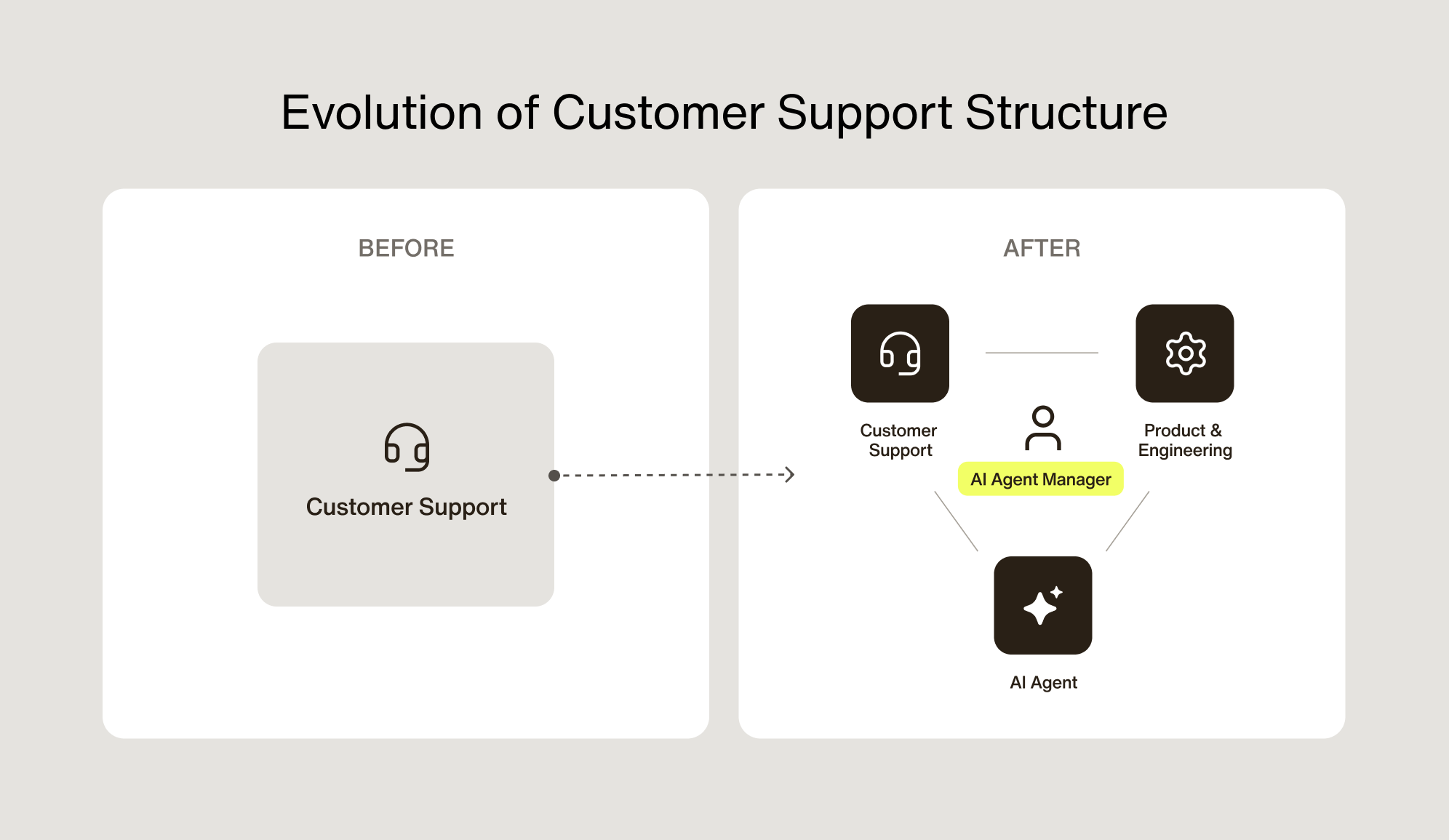
"Freya became a core part of the team, and we quickly realized that Freya needed a manager," says Alf Lim, Chief Product Officer at Norse Atlantic. "We literally co-authored the job description from scratch."
Freya has since moved beyond containment into commerce. A question about legroom can convert into a seat upgrade; an inquiry about baggage limits becomes a cross-sell. The wall between support and revenue is coming down. For Norse, that's the bottom line: not a cheaper support operation, but a fundamentally different one.
The takeaway: Norse’s advantage wasn’t that it simply deployed a better bot. Instead, it designed the organization required to make that bot succeed. Treating Freya as a real team member, with ownership, oversight, and a dedicated AI Agent Manager, turned the system into an operational capability rather than a cost-cutting experiment.
The travel and hospitality teams that win aren’t the ones with the flashiest models; they’re the ones that redesign the work around them. In an industry defined by disruption, the differentiator is the AI execution and organizational design behind it.
What the best companies using AI for customer service do differently
Zoom out across industries and the story is similar. Some teams get real results from AI; others go live, see middling numbers, and quietly scale back. The difference usually comes down to a handful of decisions made before the AI ever talks to a customer.
Start narrow, then earn the right to expand
Every deployment that held up in this piece started with a deliberately limited scope: one problem, one user segment, one interaction type.
Swiggy didn't try to automate its entire support operation on day one. It started with the most predictable, highest-volume tier (e.g., order tracking, refunds, delivery exceptions) and proved the model there before expanding into a fully agentic system. BoA took a similar path, building Erica on a constrained set of deterministic responses before broadening its capabilities over years.
Norse Atlantic didn't launch Freya across every customer interaction simultaneously. The company tuned it, watched the containment rate climb from 60% to 80% in two weeks, then pushed further.
The narrow starting point wasn't a limitation in any of these cases. It was the foundation the results were built on.
Emphasize escalation quality over escalation rate
Most teams measure how often their AI hands off to a human. Far fewer measure what happens in that handoff, such as if the agent receives enough context to pick up the conversation without making the customer start over.
That’s the fault line where CSAT starts to slip. Consider what Mixpanel's support team was dealing with before delight.ai: agents spending the first 10 minutes of every interaction just establishing whom they were talking to.
A smooth handoff keeps the customer's trust intact. A clumsy one (e.g., "Can you explain the issue again?") signals that the AI created more friction than it resolved. Designing that transition well is as important as designing the AI interaction itself.
Track the right metrics, not only automation rate
Automation rate is the vanity metric of AI customer experience. The industry-wide average AI resolution rate sits at 44.8%, meaning more than half of AI-initiated interactions still require a human. That number isn't alarming on its own. What’s meaningful is whether those escalations are handled well or poorly.
Optimizing for automation rate alone is how teams end up with impressive-looking dashboards and a declining CSAT. Swiggy doesn't lead with automation rate; the metric that matters is that resolution time dropped from five minutes to under 40 seconds, and customer satisfaction improved alongside it.
Kaiser Permanente measures if high-acuity cases get flagged correctly and if patients actually complete their bookings. What those teams track instead: resolution quality, repeat contact rate, customer effort score, and—especially in B2B like Mixpanel—if AI-assisted interactions correlate with better retention and revenue downstream.
Let AI manage volume and humans handle what matters most
Forty-two percent of customers expect empathy and compassion from AI assistants, and consumers favor businesses whose AI is 73% managed by humans.
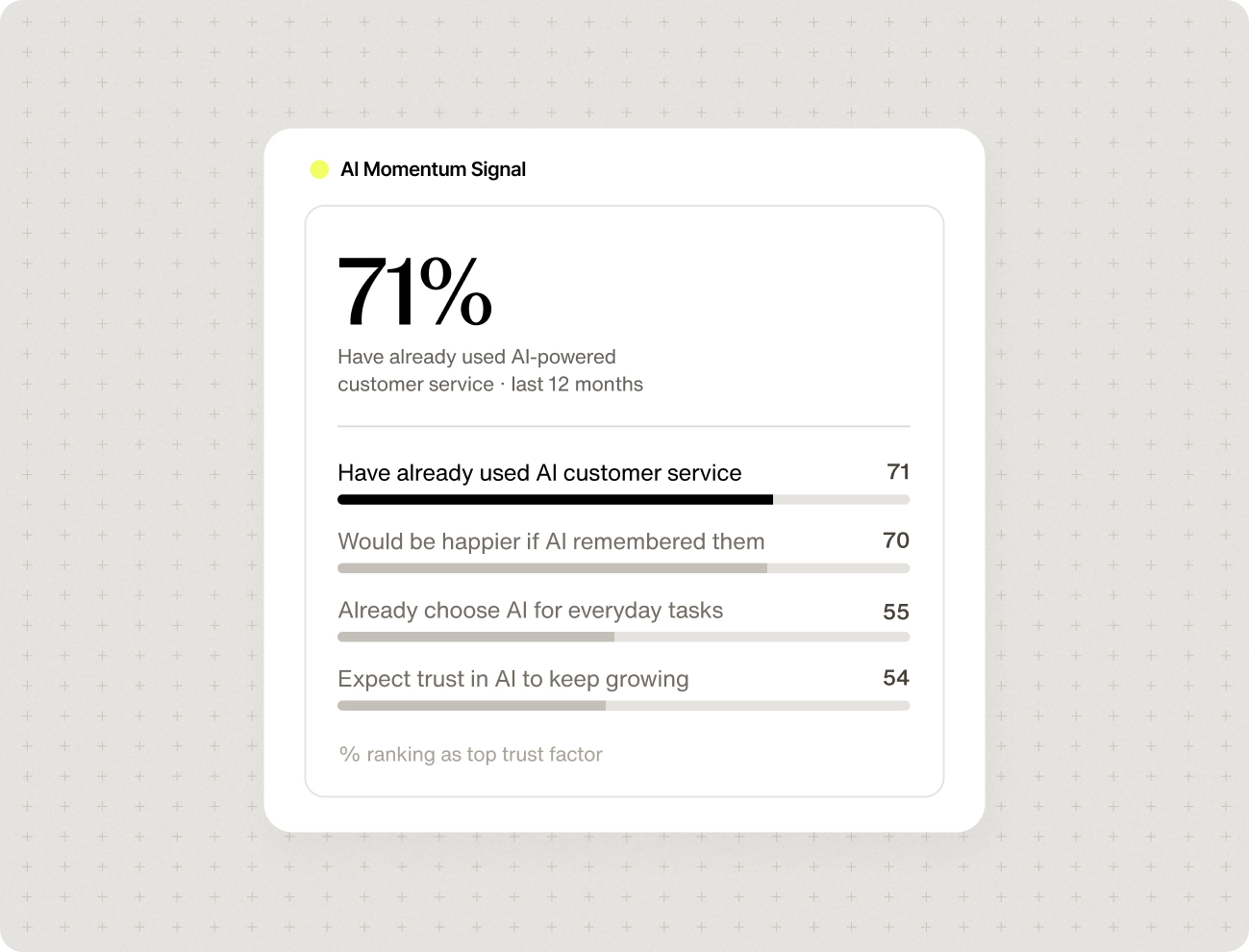
According to the 2026 Delight AI Index, 71% of consumers have already used AI customer service, but only 57% report a positive experience. That 14-point gap is where the execution conversation gets real.
The most durable implementations—Mixpanel, The Home Depot, Norse Atlantic Airways—treat AI as handling the routine tier while keeping humans accessible for complexity and emotional weight. Customers don't object to talking to AI; they object to being trapped by it.
Establish the knowledge base before building the AI
Sixty-one percent of customer service leaders say they have a backlog of knowledge base articles that need updating, and more than a third have no formal process for keeping that content current.
Generative AI brings up what it's given. When the source material is accurate and well-structured, the responses are, too. When it's patchy or outdated, the AI confidently delivers wrong answers.
Mixpanel's deployment worked partly because the context the AI needed (e.g., account history, tier, permissions) was structured and accessible from the start. Teams that deploy AI on top of a messy knowledge base and then blame the AI for underperforming are solving the wrong problem. AI readiness starts with getting the foundations right.
How to get AI customer service right with delight.ai
AI for customer service works. The evidence across industries is consistent enough that the question is no longer whether or not to deploy it—it's where, how, and with what expectations.
The companies with the strongest outcomes typically share the same fundamentals:
- scoped their initial deployment narrowly
- invested in the knowledge infrastructure the AI depends on
- designed escalation paths as carefully as they designed the AI interactions
- measured outcomes, not just automation rates
Organizations that fell short often used AI for customer service as a substitute for people instead of a redesign of the customer journey. That framing may deliver short‑term cost savings, but it can lead to service‑quality issues soon after.
For teams aiming to get AI right from day one, delight.ai provides the strategy, tooling, and support to turn good intentions into meaningful results. Request a demo to get started today.