Financial Services scored 50 out of 100 in the 2026 Delight AI Index, landing right at the national average. In the Index, Financial Services falls between Travel at 55 and Healthcare at 47. More trusted than the industry where clinical stakes are highest. Less trusted than the industries where mistakes feel recoverable.
Sitting at the average is a baseline, not a verdict. In an industry where customer trust is literally the product, a client who loses confidence in your institution moves their accounts. The brands that move from 50 to significantly above it will do so by building AI that earns trust deliberately, interaction by interaction.
The data is clear about what that takes. There's real AI appetite in financial services, concentrated in specific tasks. There's equally real resistance, concentrated in others. The brands that read that map accurately will build AI programs that expand trust over time rather than burning it with a single bad interaction.
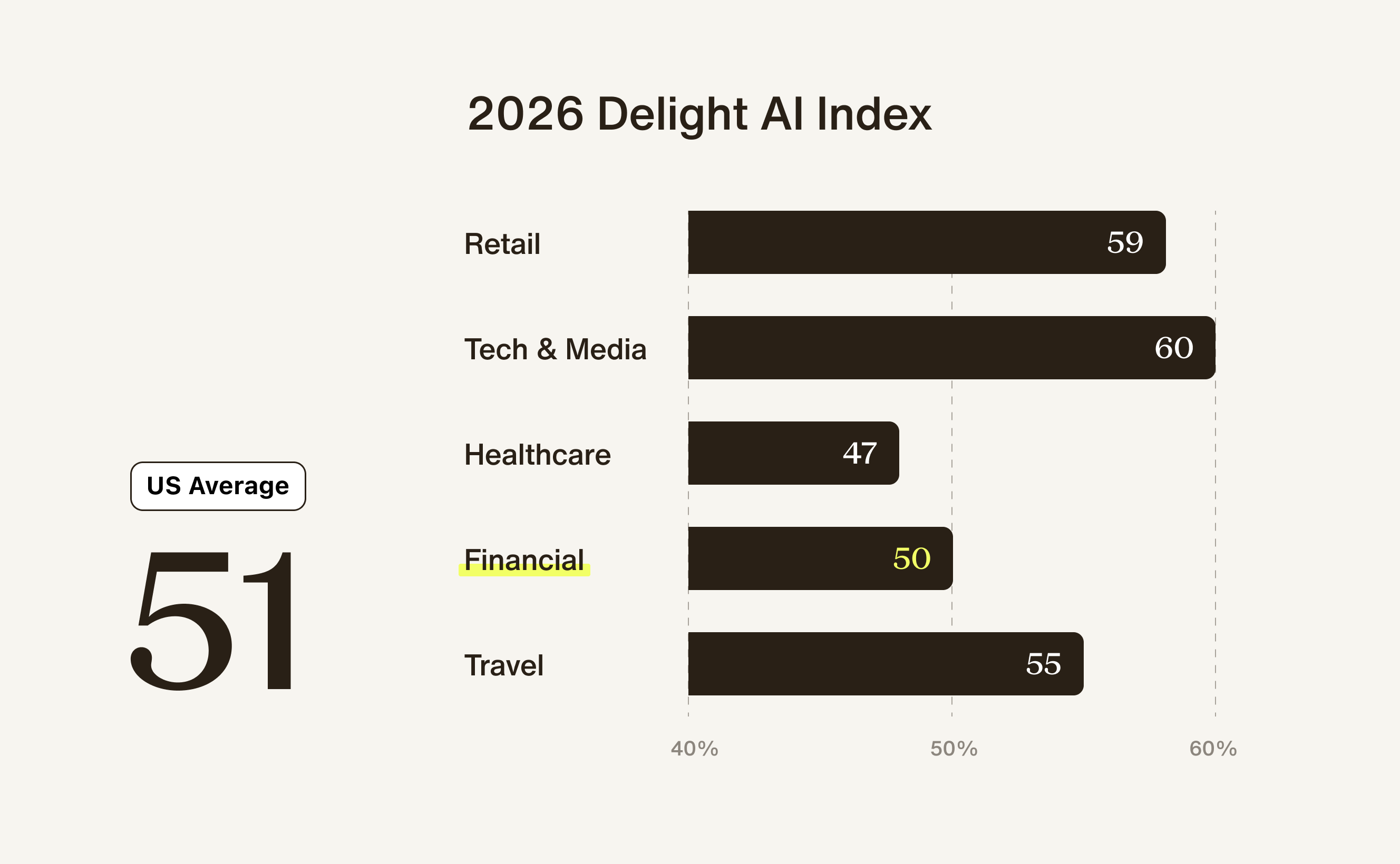
The gap between Financial Services and Retail is nine points. Nine points earned on the difference between low-stakes errors (a wrong product recommendation) and high-stakes ones (a disputed charge that affects someone's credit). The path to closing that gap runs through AI that feels controlled, correctable, and transparent.
Balance checks are the easy part
Consumers have sorted their financial service interactions into a clear hierarchy based on how much is at stake when something goes wrong. At the informational end, AI appetite is real. At the transactional end, it drops sharply.
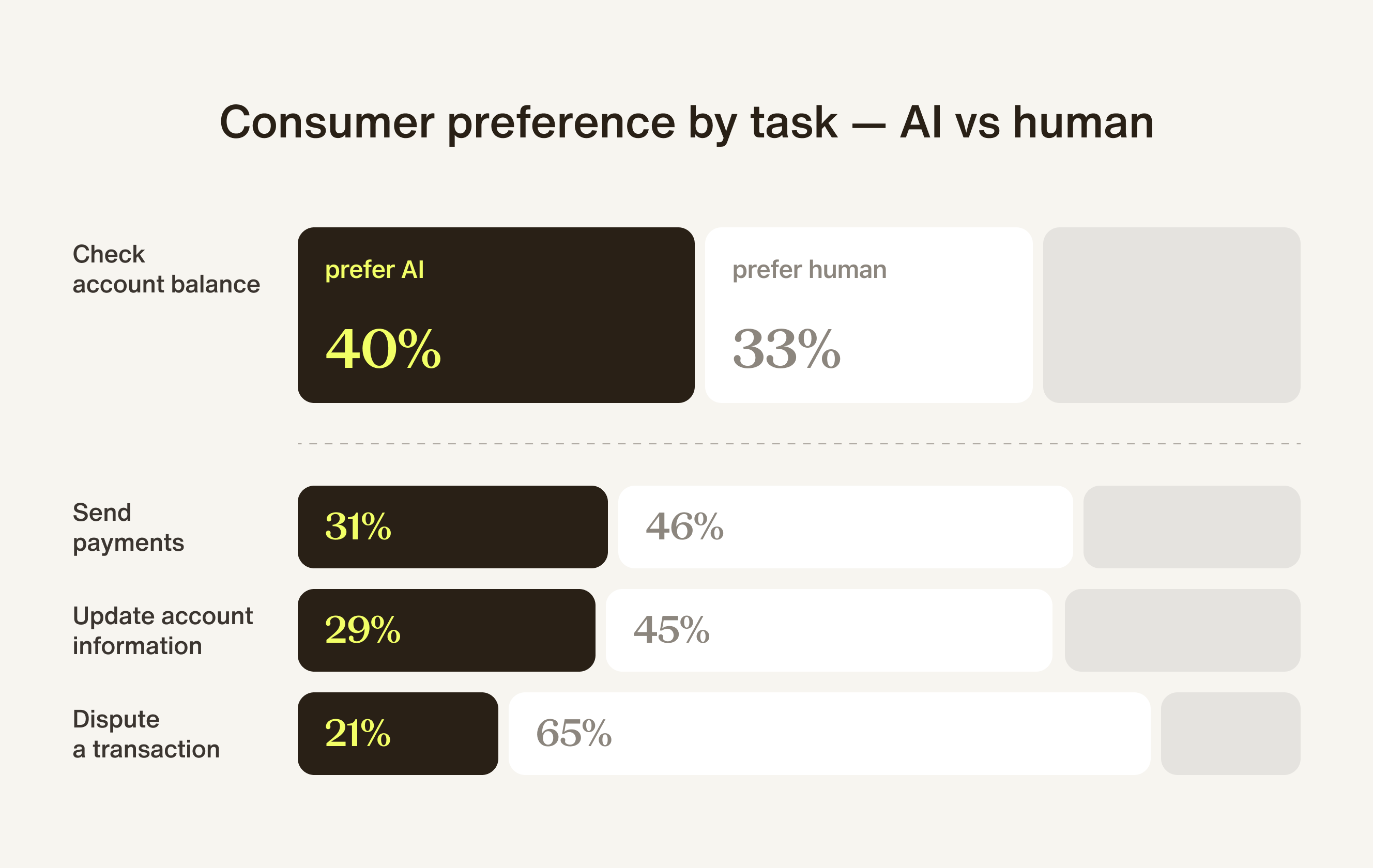
40% of consumers already prefer AI for account balance inquiries. That's a meaningful AI appetite in a cautious industry, and it represents a real deployment window. The moment money moves, the picture changes fast. 65% want a human for transaction disputes — the highest human preference for any task in the entire financial services dataset, tied only with healthcare's most sensitive interactions.
Consumers are being specific about where they want AI. Balances, transaction history, and coverage summaries are where AI can perform without the weight of high-stakes consequences. That's the foundation. The transactional layer comes later, as reliability is demonstrated and trust accumulates.
An AI error here isn't an inconvenience
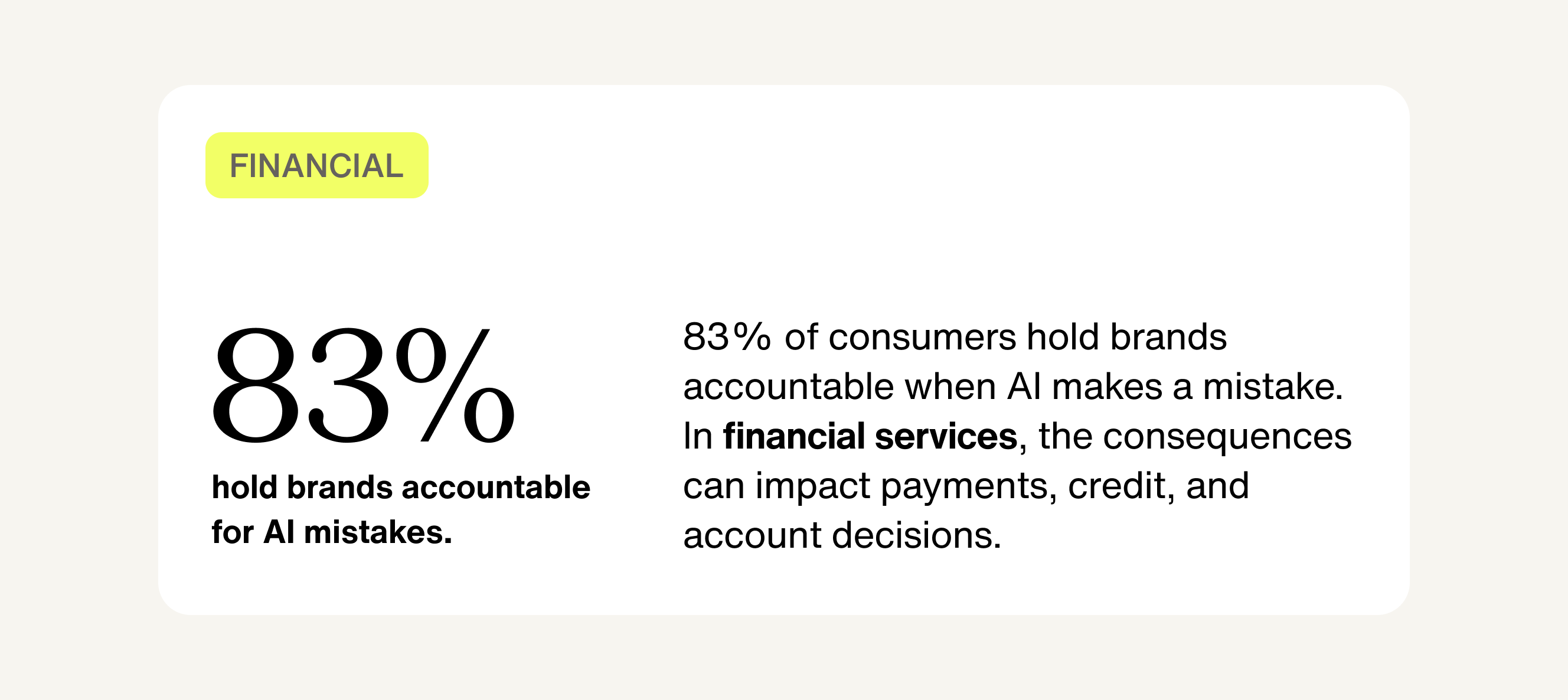
Financial AI errors aren't abstractions. A wrong balance display leads to an overdraft. A failed transfer leads to a missed payment. Incorrect account information leads to locked access. Consumers know this. When something has already gone wrong in a financial account, 65% want a human who has both the authority and the judgment to make it right.
64% of consumers expect AI to outperform human representatives. In financial services, that expectation has real teeth. It means AI needs to be more accurate than the average call center agent, more consistent than the average branch employee, and more reliable than any other channel a consumer uses to manage their money.
The single biggest trust lever
When consumers were asked what would most increase their trust in AI handling financial service interactions, the answer was consistent and specific.
64% of women say the ability to correct mistakes or reverse decisions would increase their trust in financial AI most. Among men, that number is 49%. Reversibility is the trust mechanism.
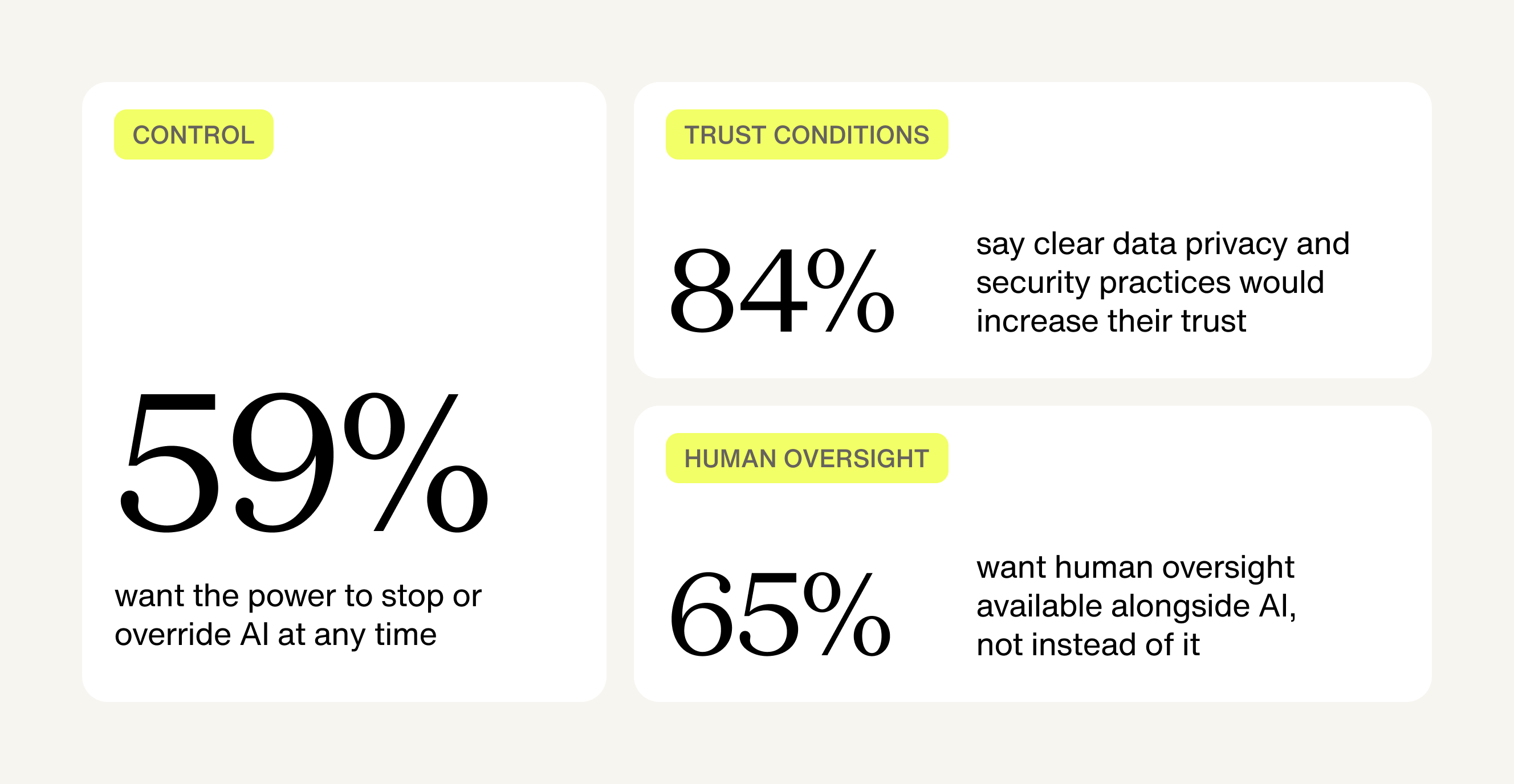
The design implication is direct. AI in financial services needs to be auditable, correctable, and clearly bounded in what it can do autonomously. SOC 2 and ISO 27001 compliance set the floor. The institutions that go beyond compliance to make those safeguards visible — in the product, in the interaction, in the confirmation screens — will build the trust that converts skeptical consumers into consistent AI users.
54% of all consumers expect to feel comfortable with fully autonomous AI within the next year. Financial services has more ground to cover than most industries to get there. The brands that use that time to demonstrate reversibility and accuracy will be ahead when the expectation matures.
The widest generational gap in the entire dataset
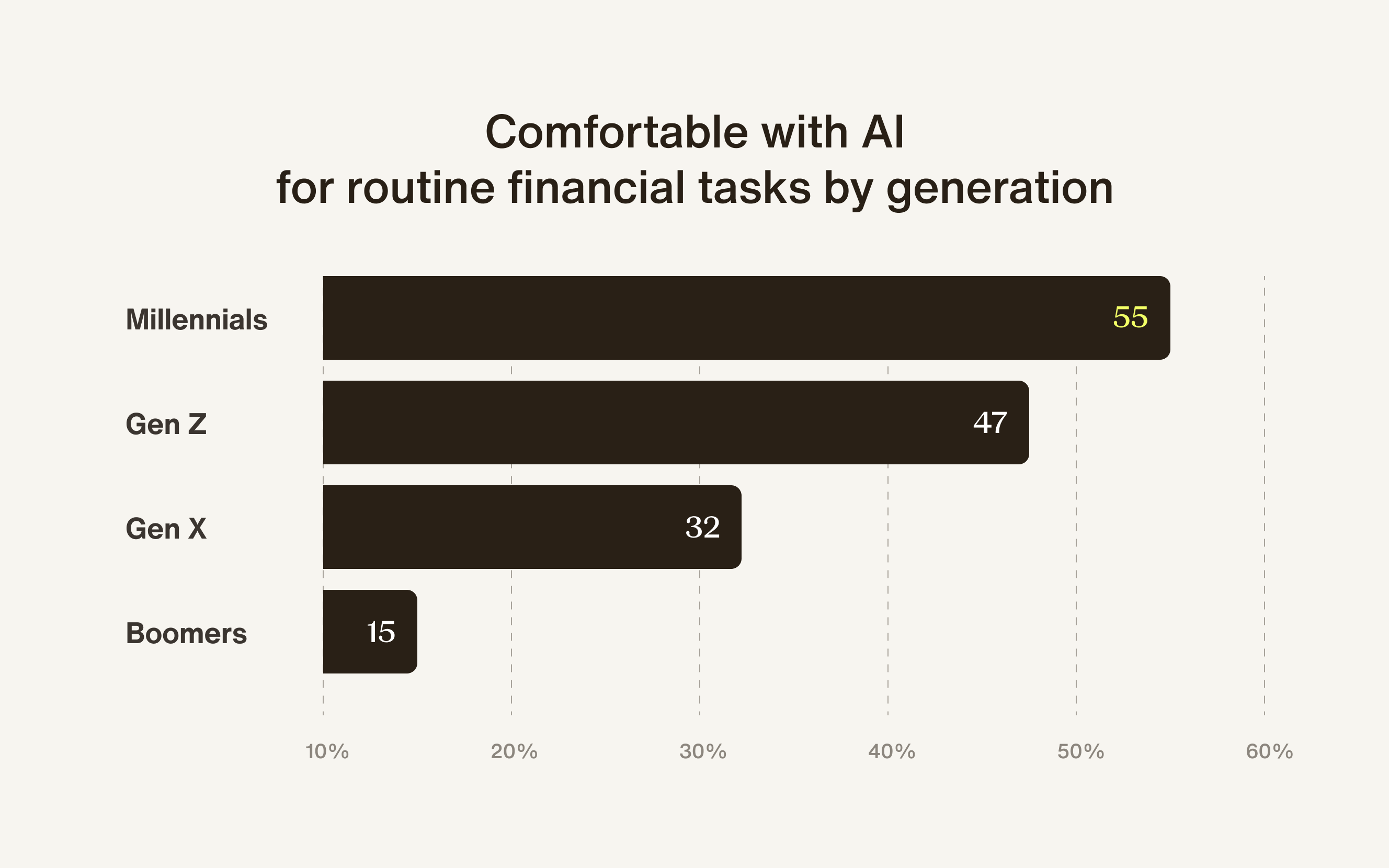
No industry in the 2026 Delight AI Index shows a wider generational split on AI readiness than Financial Services. The gap between Millennials and Boomers here is 40 points. That number has direct implications for who financial brands are actually designing AI for — and who they may be inadvertently leaving behind.
Millennials at 55% comfortable with AI for routine financial tasks represent a real, deployable audience that is actively underserved by current financial AI experiences. Boomers at 15% represent the industry's most challenging design problem — and its highest-stakes one.
The pattern holds for gender as well. 24% of women say they do not plan to rely on AI for customer service in financial contexts, compared to 14% of men. Designing AI that earns their trust is a core revenue question.
Three moves that put you ahead
1. Start with the informational layer.
Account balances, transaction history, benefit summaries, and coverage lookups are where consumers already have AI appetite in financial services. Deploy AI here first, measure accuracy rigorously, and build a reliability track record before extending into anything transactional. Every successful informational interaction adds to the trust budget that eventually funds more autonomous AI capabilities.
2. Make reversibility the product, not the footnote.
57% of consumers rank reversibility and correction capability as their top trust driver in AI, placing it above both accuracy and transparency. Build AI with clear correction, review, and reversal workflows baked in, and surface them where consumers can see them before they need them. This is what converts skeptical Boomers and women from AI avoiders to AI users. The institutions closing the trust gap fastest are moving beyond a clean handoff model. Platforms where AI drafts the action and a human reviews and confirms deliver the reversibility consumers need without sacrificing the speed that makes AI worthwhile.
3. Go beyond compliance to communication.
SOC 2, ISO 27001, and ISO 42001 compliance set the security and AI governance floor. 84% of consumers say transparent data practices would increase their trust in AI. Having the certifications gets you to the starting line. Communicating them clearly, at the moments consumers are deciding whether to engage, is where trust actually accumulates. Surface data safeguards in the product, in the interaction flow, and in confirmation screens. Consumers who understand how their financial data is protected are measurably more likely to trust the AI using it.
Financial Services scored 50. The average means the opportunity to lead is wide open. Every point above it is earned through AI that's accurate, correctable, and honest about what it can and can't do. The institutions building that track record now will hold the relationships that matter most when the industry moves.