Every freight broker knows the rhythm. A load goes out. A few hours pass. Someone picks up the phone, dials the carrier, asks where the truck is. The carrier calls the driver. The driver calls back. The broker updates the TMS. Repeat. All day. Every day.
That workflow has a name: the check call. And for an industry that moves hundreds of billions in freight annually, it remains stubbornly, almost defiantly, analog.
That is starting to change. AI voice agents are entering freight operations not as a novelty, but as a genuine operational upgrade. Here is what check calls are, why they persist, and what it looks like when automation actually works.
What is a check call in trucking?
A check call is a status update request, made by a freight broker to a carrier or driver, to confirm the location and progress of a load in transit. It covers the basics: Where is the truck? What is the ETA? Has pickup happened? Are there any exceptions?
The term comes from the practice of physically calling, as in picking up a phone and dialing. Even as the industry has adopted tracking platforms, ELDs, and visibility tools, the phone call has persisted as the standard confirmation mechanism. Voice is still how freight gets its ground truth.
Check calls happen at every major stage of a shipment: pickup confirmation, in-transit status updates, delivery ETA, exception notification, and proof of delivery. For a busy brokerage managing hundreds of active loads, that adds up fast.
Why freight still runs on voice calls
If you are wondering why a multi-trillion-dollar industry still relies on phone calls, the answer is trust — or more precisely, the lack of it in automated data feeds.
TMS systems, load boards, and visibility platforms provide data. But that data is only as current as the last manual update, the last app ping, or the last ELD sync. When a broker needs to know if a driver is actually at the pickup dock, or if an exception is real or a data lag, they call. The call confirms what the system says, or surfaces what the system missed.
This is not a technology failure. It is a trust gap that technology alone has not yet closed. Carriers vary in their adoption of tracking tools. Drivers do not always update apps. And brokers, whose reputation lives and dies on accurate shipment visibility, cannot afford to find out at delivery that something went wrong three states ago.
Voice calls remain the dominant channel in freight precisely because they bypass the gaps that automated feeds leave open.
AI voice agents are now being built to close this gap at scale, giving brokers the ground-truth confirmation they need without the manual overhead of placing every call.
See how delight.ai closes the freight visibility gap as a logistics solution →
The cost of reactive check calls
The standard check call model is reactive: a broker waits, then calls. This creates a structural problem that compounds across a full book of business.
When brokers are the ones initiating, they are dependent on carrier availability. Drivers are driving. Dispatchers are managing multiple assets. The callback loop can take minutes. Multiply that by dozens of active loads and the math becomes clear: a meaningful share of every operations person's day is spent chasing updates that should surface automatically.
The burden runs in both directions. Carriers field a steady stream of inbound calls from brokers across every load on their board. For smaller carriers and owner-operators, this is interruption-as-workflow. It pulls attention from the road, from dispatch decisions, from the job itself.
The model is simply wrong for the scale of modern freight operations. The phone call was designed for one-to-one communication. Freight brokerage is one-to-many, and the reactive model does not scale.
The shift: from reactive to proactive
Here is where AI changes the equation — and it is worth being precise about how.
The dominant model in AI freight automation is not to make the check call faster. It is to invert the model entirely: instead of the broker calling the carrier to ask for an update, the AI agent sends the update automatically when something happens.
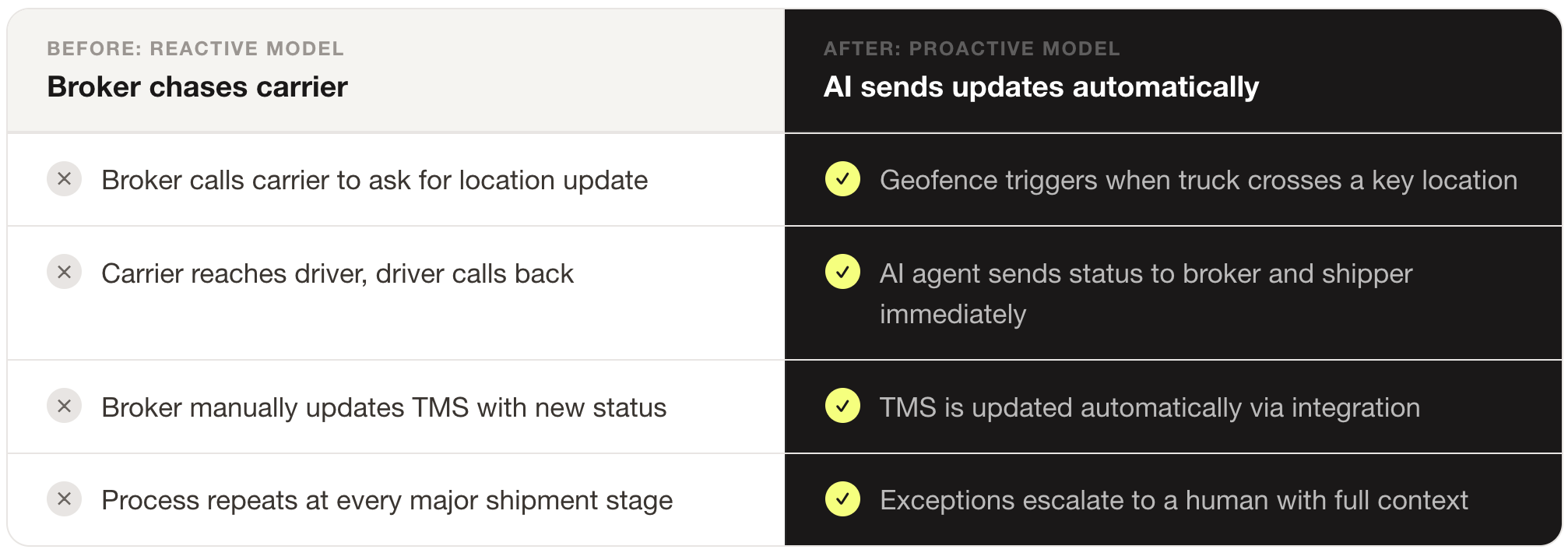
Geofencing makes this possible. When a driver enters or exits a defined zone — a pickup facility, a delivery address, a major waypoint — the AI agent detects the event and sends a status update to the broker, the shipper, or both. The check call never has to happen because the information is already on its way.
This is not a marginal improvement. It is a different operating model. The broker goes from waiting and chasing to monitoring and intervening only when something needs a human decision.
The same inversion applies to inbound call volume. AI voice agents can now resolve many routine inbound calls from carriers — including shipment status requests, ETA confirmations, and exception reports — without a human transfer. When the agent has access to TMS data, it can answer the question, log the update, and close the loop autonomously. This is the same pattern delight.ai applies across field service operations, where AI coordinates between multiple parties in real time without waiting for a human to route each call.
Discover how delight.ai automates logistics operations end-to-end →
Voice and text, simultaneously
The reactive-to-proactive shift is one part of the model. The other part is channel — and this is where most freight automation leaves something on the table.
Replacing the phone call with a faster phone call is not the same as running voice and text at the same time. When a geofence event fires, the AI does not choose between channels. It sends a proactive text to the broker and shipper while simultaneously staying live on voice for drivers or carriers to report exceptions. Both channels run in parallel, triggered by the same event, resolved without waiting on each other.
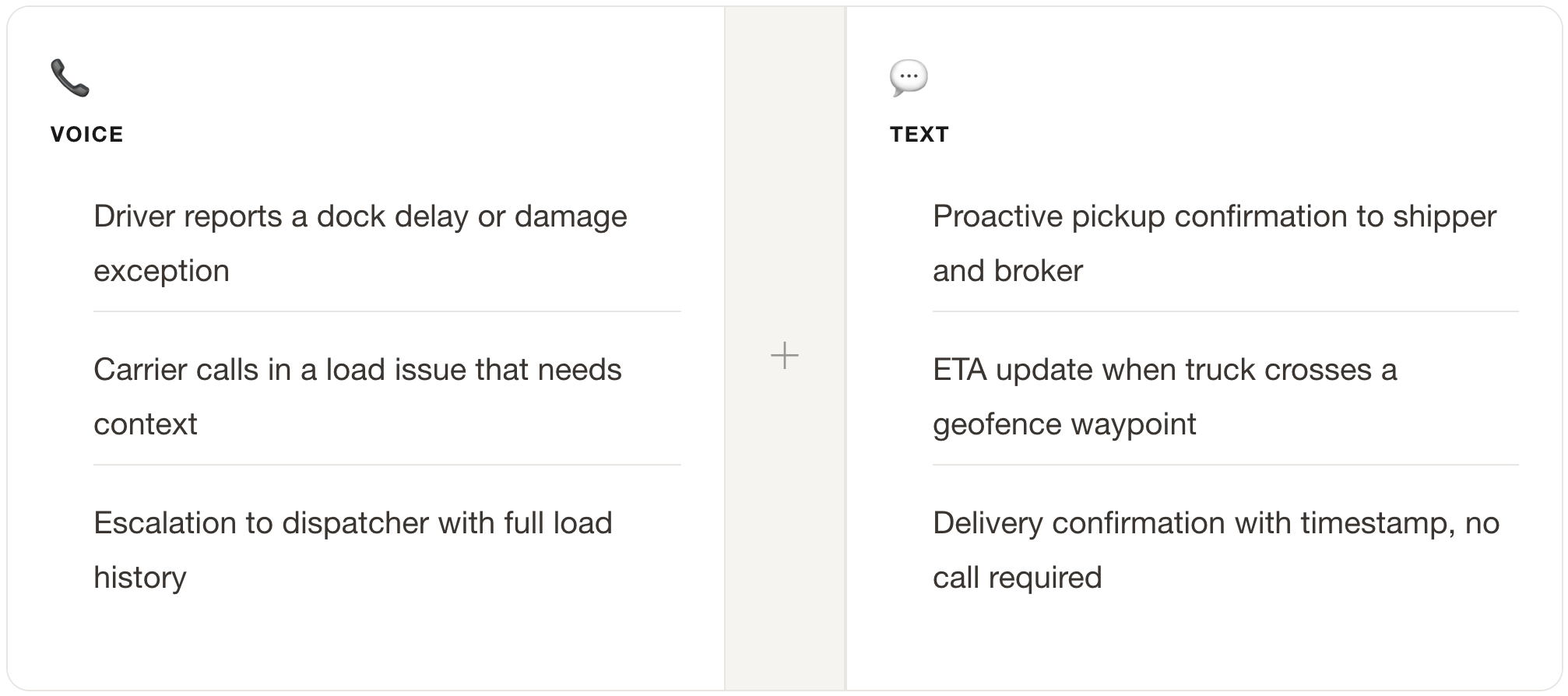
This is how operations actually scale. A dispatcher running 80 active loads cannot place 80 status calls simultaneously. The AI pushes proactive texts in parallel while staying live on voice for any load that needs a human conversation. The routine confirmation never blocks the exception path.
What AI check call automation actually handles
Being honest about capabilities matters here, because vendor claims in this space have gotten ahead of the technology.
What AI handles well today
- Outbound proactive status updates triggered by geofence events — no broker action required
- Inbound carrier calls for standard shipment status and ETA — resolved without human transfer
- Exception intake: accepting and logging delay or issue reports from drivers and carriers
- Escalation routing: surfacing calls that need a human decision without making the caller wait on hold
What requires integration depth to work
- Accurate status updates depend on TMS access. An agent without load data cannot answer load questions. Integration quality determines capability quality.
- Exception resolution beyond intake — negotiating solutions, rebooking capacity — still requires human judgment in most cases.
The honest pitch is not that AI eliminates check calls entirely. It is that AI handles the high-volume, low-complexity calls that consume most of the time, so the team can focus on the exceptions that actually require judgment.
This is the same principle behind AI agent design across every high-volume customer operation: automate the predictable, elevate the complex.
What to look for in a solution
If you are evaluating AI check call automation for your brokerage, the questions that matter most are not about AI model capability. They are about integration and deployment.
- TMS integration: Does the platform connect to your TMS natively? Without load data, the agent cannot answer load questions. Ask specifically which TMS platforms are supported and how the data sync works.
- Outbound proactive capability: Can the platform send automated updates triggered by geofence events, not just respond to inbound calls? The proactive model is where the operational leverage lives.
- Carrier coverage: How does the platform handle carriers who are not using tracking apps or ELDs? The solution should have a voice fallback that works even when data feeds are absent.
- Escalation handling: What happens when the AI cannot resolve a call? A good system escalates cleanly to a human with full context, not a cold transfer.
- Scale readiness: Mid-market brokerages growing toward higher load volumes need a platform built for concurrency. This is a core consideration across logistics and any operation where AI is handling customer-facing calls at volume.
Is your brokerage ready for AI voice automation? Take the delight.ai readiness assessment — 5 minutes, no sales call required. Take the assessment →
How delight.ai approaches freight voice automation
Delight.ai is a voice AI platform built for operations that run on high call volumes, high stakes, and tight SLAs. The logistics use case sits naturally inside that scope: freight brokerages that field hundreds of carrier and shipper calls daily, across a mix of status checks, exception reports, and booking activity.
The Delight approach prioritizes TMS integration depth and proactive outreach over call deflection alone. The goal is not just to handle inbound volume. It is to get ahead of it, by surfacing updates before anyone has to ask.
The same architecture that powers field service coordination across multi-party job sites applies here: an AI agent that holds context across the full lifecycle of a shipment, escalates with full context when a human needs to step in, and integrates with the systems your team already runs.
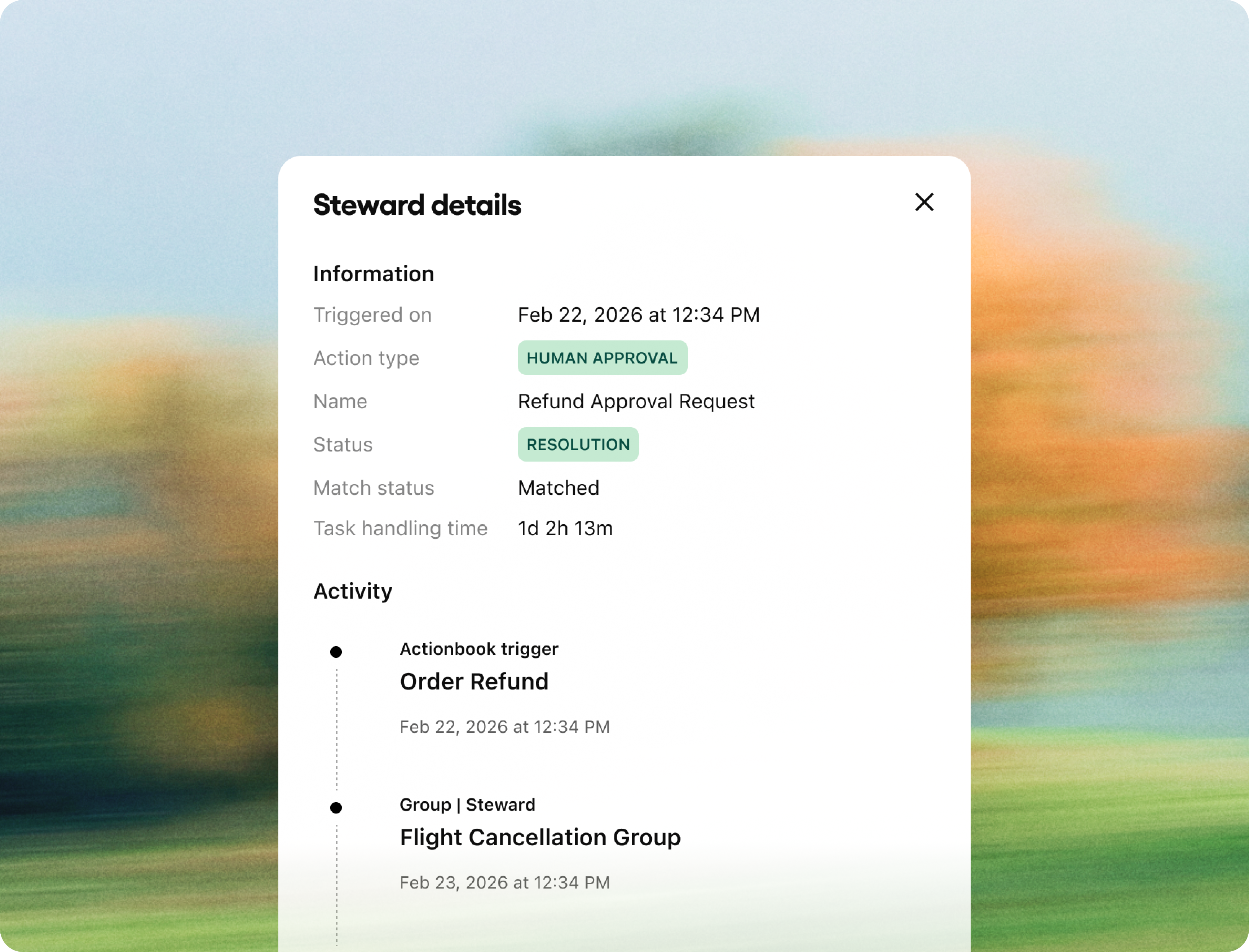
The trust layer matters too. Shippers and brokers need confidence that AI is acting within defined guardrails — not freelancing on load decisions. Trust OS is delight.ai's operating system for AI governance: it sets the approval thresholds, escalation rules, and audit trails that let teams deploy AI at scale without losing control of the exception cases that require human judgment.
For mid-market brokerages managing growth, the operational math is clear: headcount cannot scale as fast as load volume. AI voice automation is how you grow the book without growing the ops team at the same rate.
The bottom line
Check calls are not going away because carriers are lazy or because technology has failed. They persist because they solve a real trust problem in freight visibility. What AI changes is not whether that problem exists. It is who, or what, has to solve it on every load, every day.
The brokerages moving fastest right now are not the ones with the most dispatchers. They are the ones that have figured out which calls need a human and which ones do not. AI is how you draw that line.
If you are running a freight brokerage and your team is still dialing carriers for routine status updates, that is time that could be running proactively, automatically, and at a scale no headcount can match.
Ready to move from reactive to proactive? See how delight.ai handles freight voice automation at scale. See the logistics solution →
Related reading
- How delight.ai handles logistics voice automation end-to-end
- AI for field service operations: Coordinating parts, techs, and customers
- AI agents that read the room: How proactive outreach changes CX
- How retail brands are building trust with AI customer experience
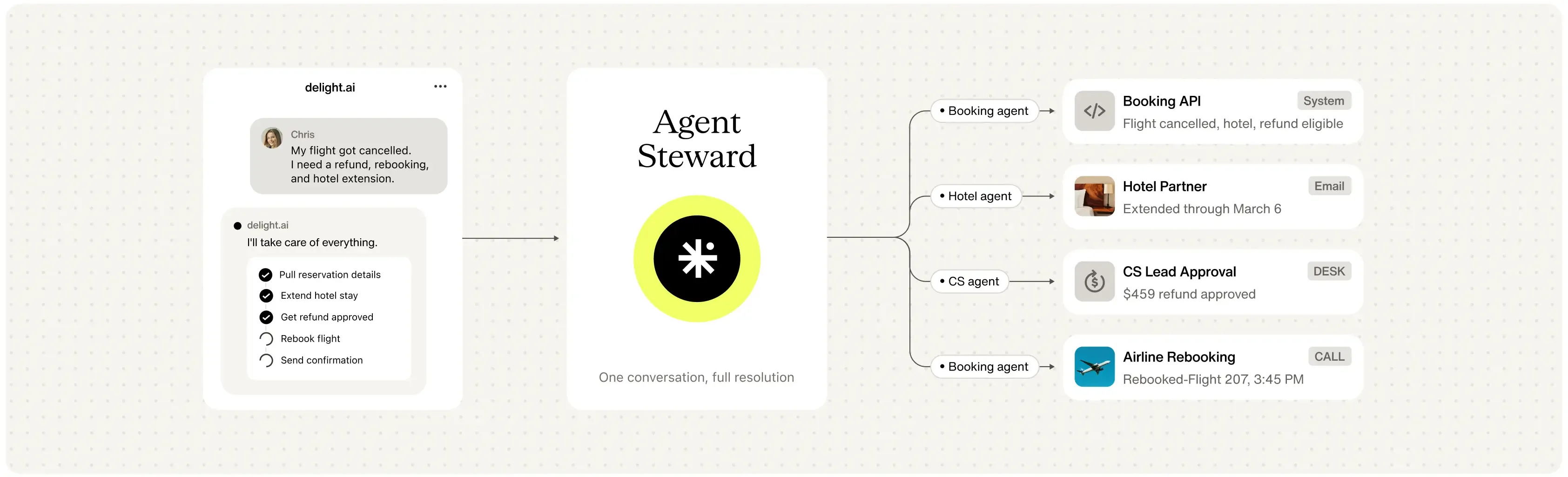
- Introducing Agent Steward: The first AI agent that owns customer issues end-to-end