
The moment between a user’s question and an agent’s answer is usually just a second or two. But in that time the user gets nothing back. No confirmation the agent understood. No sense of what’s happening. No signal for how long to wait. The typing indicator fills the space visually, but it doesn’t say anything. Whether the agent is writing a plain response or making an API call in the background to look something up, what users see looks identical. Three animated dots, then an answer.
That gap is getting longer. Newer reasoning models work through a problem before they respond rather than generating an answer immediately. That’s generally good news for quality. But the silence before a first response arrives gets longer with it, and the dots become an even weaker signal.
Trust OS 2.0’s Thinking Messages treat this as a design problem, not a latency one.
Waiting is fine. Not knowing what you’re waiting for isn’t.
There’s a reason a progress bar feels better than a spinner even when both take the same amount of time. Nielsen Norman Group’s research on wait states found that users are more satisfied and willing to wait longer when given a specific progress indicator versus a generic animation. The mechanism is the same whether you’re downloading a file or waiting on an API call: visible progress turns uncertainty into information, and that shift changes how people experience the time.
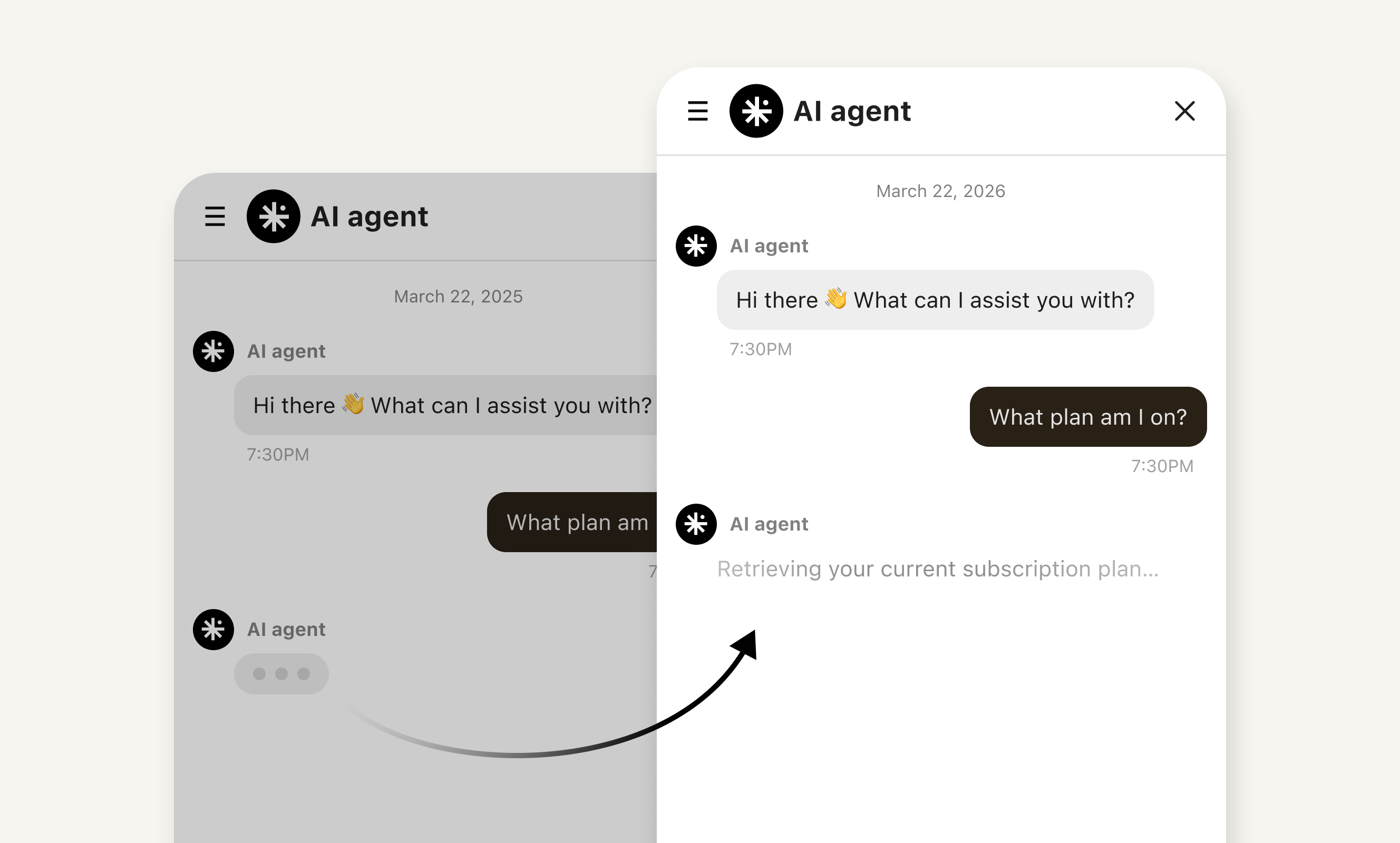
AI agents have the same dynamic. When a user asks “What plan am I on?” and sees the dots, they don’t know if the agent is pulling their account, misunderstanding the question, or stuck in a loop. By the time the answer comes, they’ve already tensed up a little. Across every tool call in every conversation, that accumulates into a real tax on the experience that has nothing to do with how good your agent actually is.
Thinking Messages don’t make tool calls faster. They make the wait feel shorter, because users know something specific is being done for them.
Specific beats generic every time
From where a user sits, the difference is immediate. Instead of three dots, they see something like “Retrieving your current subscription plan…” The wait is the same. What’s changed is that they know what it’s for.
That specificity is something builders set for each tool. Every tool gets its own message, written to describe what it actually does.
That specificity matters more than it sounds. “Checking your recent orders” is neutral and fast-sounding. “Processing your cancellation. This may take a moment.” does something different. It’s not filling silence; it’s setting expectations for something that actually matters to the person on the other end.
Thinking Messages is part of Trust OS, delight.ai’s operational layer for running AI agents in production.