Agentic AI overview
- Agentic AI is an autonomous, goal-driven AI system that can reason, plan, and perform multi-step actions in real-world environments with minimal human intervention.
- Unlike traditional AI that can only react, agentic AI systems take action—using external tools, memory, and real-time data to perform complex tasks and workflows end-to-end.
- By unifying reasoning, action, and learning into one system, agentic AI enables scalable, adaptive execution in dynamic environments across customer service, operations, and software systems.
What is agentic AI?
Agentic AI is an autonomous artificial intelligence (AI) system that can perceive its environment, reason through complex problems, and execute multi-step actions to achieve the goals set for it with little to no human intervention.
Agentic AI—also known as an AI agent—has a degree of autonomy. Unlike earlier foundation AI models that execute predefined tasks and only respond when prompted, agentic systems are goal-oriented and act independently in pursuit of the goals set for them.
They can:
- Interpret objectives and break broad goals into a sequence of smaller tasks
- Use external tools (like APIs or web searches) to pull data or trigger events in real time
- Execute complex workflows across systems and channels to perform tasks
- Evaluate context and adapt to users in real time
- Use memory to learn, adapting their decision-making based on past outcomes
How agentic AI is different
Agentic AI represents a fundamental shift in intelligent automation. It moves beyond “if-then” logic and scripted workflows into the realm of goal-oriented reasoning and cross-system execution.
Instead of merely following rigid rules, agentic systems evaluate the desired outcome, analyze the available information, and determine the optimal path to get there. This marks a shift from reactive automation to autonomous execution, where AI pursues results rather than following scripts—while still operating within human-defined guardrails.
1. Expanded scope of information and interaction
Earlier AI technologies operated within narrow datasets that were “frozen” in time at their last training date. Agentic AI breaks the boundaries of static data, and can interact with its environment in real-time.
This allows agentic AI systems to:
- Leverage live data from various systems (CRM, ERP) and external sources via APIs
- Orchestrate tasks across disparate platforms and channels (such as updating a billing record while also notifying a human employee via Slack)
- Eliminate siloes by acting as a unified intelligence layer that spans all digital platforms and channels, even physical IoT environments
2. Memory: The adaptive capability
Memory is the engine for AI personalization and continuous improvement. While previous AI treats each interaction as isolated, agentic AI uses both short-term and persistent (long-term) memory to retain and recall relevant information from past interactions.
This enables agentic systems to:
- Maintain continuity across conversations and actions (so customers never have to repeat information during support conversations)
- Learn from previous outcomes and refine future workflows to optimize performance
- Hyper-personalize experiences by synthesizing historical data and real-time context
3. AI architecture: Replacing models with omnichannel systems
Agentic AI also introduces a new way of building AI systems that significantly impacts their functionality and interoperability. While tools like ChatGPT are model-based applications, agentic AI is a coordinated system.
This means it can integrate multiple components—such as reasoning models, long-term memory, specialized tools, and business rules—to execute on more complex objectives.
Using this systemic approach, agentic AI serves as a bridge between fragmented platforms, uniting formerly siloed software into a single, connected ecosystem.
Agentic AI use cases
Agentic AI is built for environments where variables change, requiring judgment and adaptation before taking action. This includes:
- End-to-end process automation: Agents manage complex interactions and sequences across disparate systems, such as rebooking flights, offering tailored upsells, or managing onboarding.
- Intelligent resource orchestration: Automatically categorizing, prioritizing, and routing complex tasks or tickets to the right teams while preserving key context.
- Data-driven personalization: Tailoring internal or external recommendations and business solutions dynamically by synthesizing historical and real-time data.
- Autonomous content & knowledge management: Acting as a smart assistant or copilot, agents draft documentation, summarize meetings or calls, and generate follow-up communications.
- Complex financial operations: Automating the end-to-end process of Know Your Customer (KYC) verification or fraudulent transaction investigations.
- Hyper-personalized prospecting & lead generation: Agents identify leads, research recent company happenings across platforms, and draft tailored outreach across multiple channels simultaneously.
- Proactive omnichannel customer experience & support: By monitoring for anomalies across channels and systems—flight delays, delivery disruptions, or product issues—agents initiate corrective action before they impact the business or customers.
Agentic AI benefits
- Operational autonomy: Reduces manual effort for routine but multi-step tasks, such as refund processing in customer support.
- Scalable intelligence: Deploy expert-level logic across thousands of simultaneous interactions or processes.
- One source of truth: By operating across systems and continuously syncing live data, agents eliminate the silos that slow enterprise workflows.
- Real-time adaptability: Agents adjust their plan of action instantly when they encounter an error or new information.
- Non-linear scalability: Agentic workflows can scale complex operations without a linear increase in operating costs.
- Improved business outcomes: Greater accuracy, compliance, throughput, and customer satisfaction
How agentic AI works
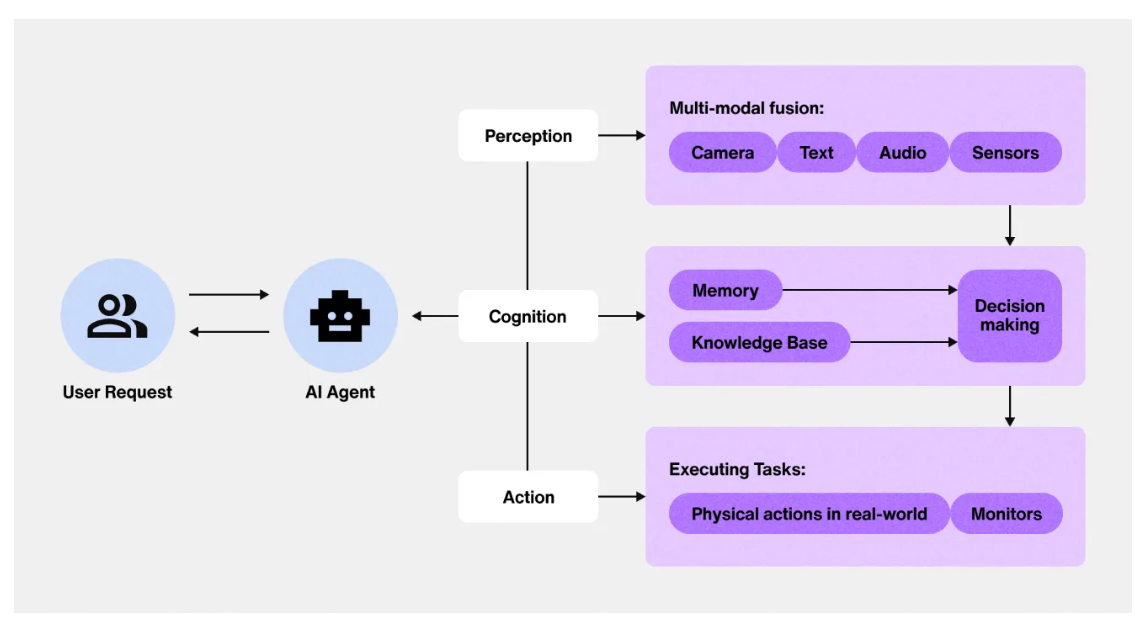
Agentic AI operates through a continuous cycle of Perception-Reasoning-Action (PRA)—much as humans do. Using large language models (LLMs) for reasoning, and machine learning (ML) for environmental interaction and adaptation, the AI agent breaks complex goals into a manageable sequence of tasks and executes until completion.
Known as an agentic workflow, this involves four steps:
- Perception (Input): The system gathers data from user prompts, real-time sensors, or connected software to inform its reasoning.
- Planning (Reasoning): The "brain" (usually a Large Language Model) breaks the goal into smaller, executable steps.
- Tool use: The agent decides which available tools (such as APIs, software, or search engines) are needed to complete the objective.
- Action: The AI agent executes the step and evaluates the result. If the result isn't what was expected, it replans and then tries a different approach until the goal is met.
Agentic AI example: The agentic workflow in customer experience
Imagine a customer contacts a retailer because their subscription was billed twice. In a non-agentic setup, a chatbot might explain how to request a refund. By contrast, agentic AI can fully resolve the problem on its own through the following steps:
- Reasoning: It identifies the duplicate billing error by accessing the billing database.
- Tool use: It calls the payment processor API to initiate a reversal.
- Cross-channel coordination: It sends a confirmation email while simultaneously updating the CRM notes, notifying human teams, and maintaining a single source of truth.
- Proactive retention: Recognizing friction in the scenario (using semantic understanding and sentiment analysis), the AI agent offers a loyalty discount on next month's service. It does this because it aligns with the broader business goal of customer retention—without being specifically "told" to do so in this case.
Key takeaways
Blending goal-oriented behavior, real-time connectivity, and system-level architecture—agentic AI marks a shift from generative AI (content creation) to functional AI (end-to-end task execution):
- From answers to actions: Agentic AI moves beyond generating text to executing complex workflows—such as automating entire customer service workflows—without manual intervention.
- Unified intelligence layer: Acting as connective tissue between siloed systems, agents enable a single source of truth and omnichannel continuity across all interactions.
- Autonomous but governed: While AI agents operate with a high degree of autonomy, they operate within defined rules and guardrails to ensure trust, compliance, and safety.
- Continuous improvement: Through integrated memory and self-refining logic, agentic AI becomes more accurate and personalized over time, adapting in real time to act in ways that meet both business goals and customer needs.