

In 2011, Marc Andreessen wrote that software is eating the world. He was right. Software ate retail, finance, logistics, media — and the vehicle that delivered it was SaaS.
Now agents are eating software.
Goldman Sachs projects the AI agent market will overtake SaaS TAM by 2030. Bain is modeling scenarios where AI doesn't just enhance SaaS but cannibalizes it entirely. Nadella already said the quiet part loud — SaaS apps are CRUD databases with business logic that will collapse. OpenAI launched an agent platform that sits on top of every system of record you already own.
The debate isn't theoretical anymore. The money is moving.
And yet the conversation still starts with the wrong question: Is SaaS dead?
The better question is: is this actually different, or is everyone just slapping a new “Agent as a Service” label on the same thing?
I think the shift is real — but only if you build for it. Because most of what's being called “agentic” right now is still SaaS with a language model duct-taped on top.
The distinction that matters
SaaS gave humans better tools. Agent as a Service — AaaS — replaces the task, not the tool.
That sounds like a semantic game. It isn't:
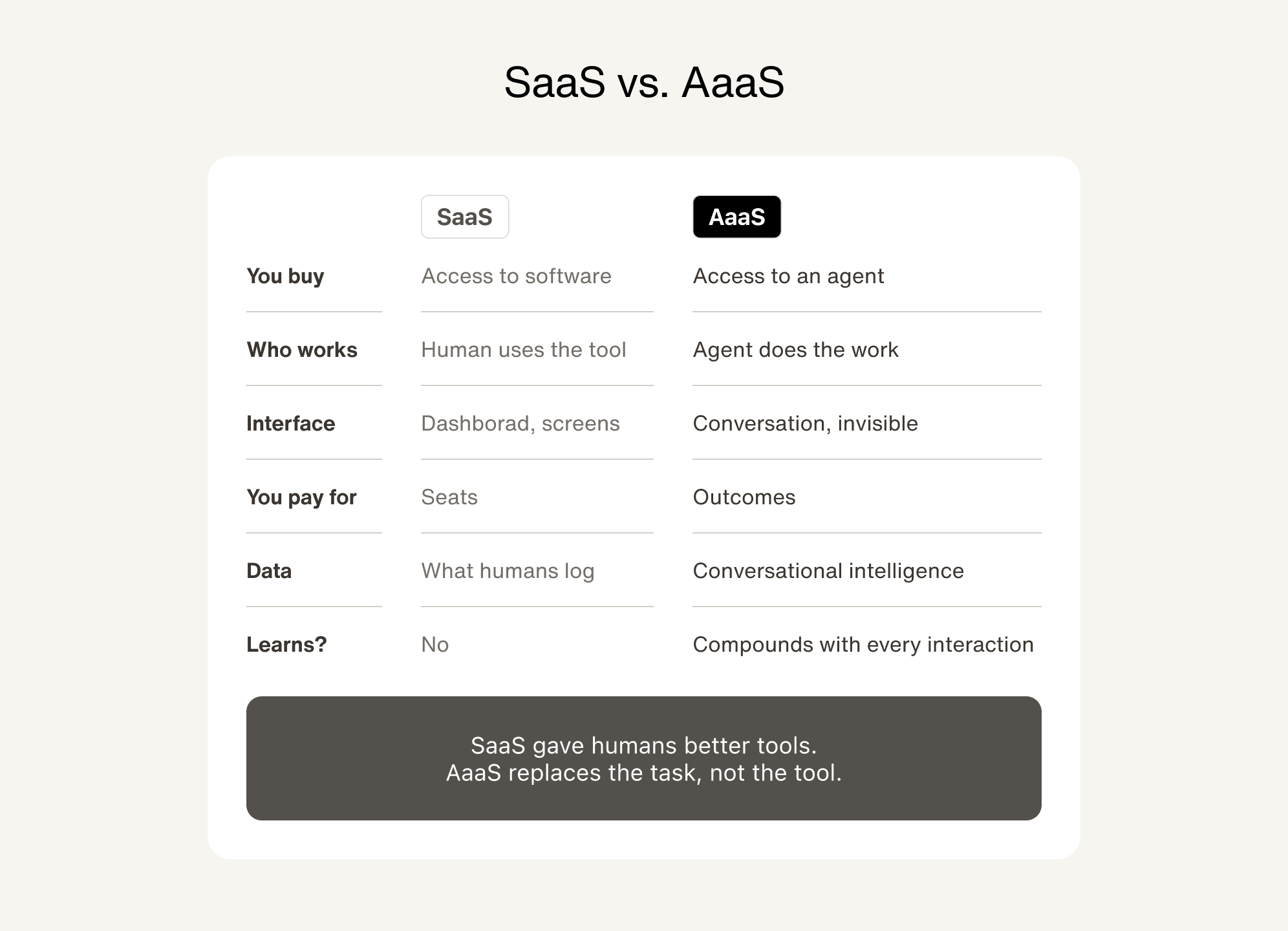
Every row in that table represents an architectural choice, not a marketing decision. Let me unpack the three that matter most.
The best agent experience is invisible
In SaaS, success means engagement — daily active users, time on platform, feature adoption. You want humans in the dashboard. The entire business model depends on it.
AaaS flips this completely.
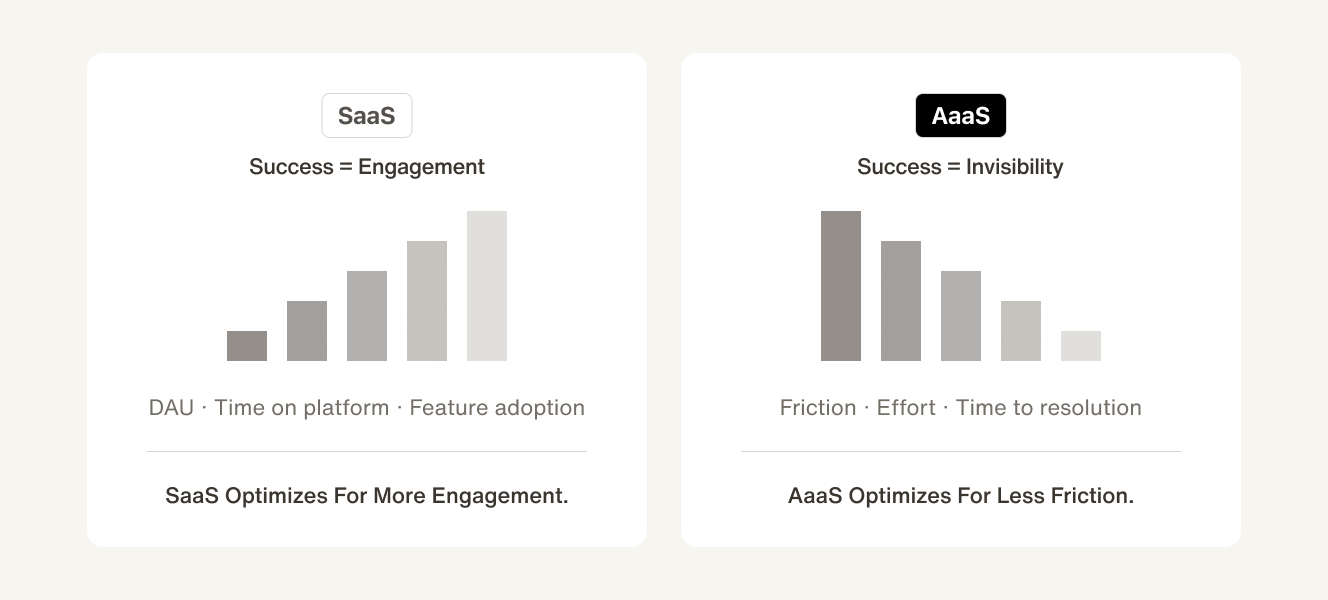
The best agent experience is one the customer barely notices. The problem got solved. The issue got resolved. The customer moved on with their day. Success is the absence of friction, not the presence of a product.
This is why SaaS companies struggle to become AaaS companies. Their entire product is the interface — the dashboard, the screens, the workflows humans navigate. Remove the interface and what's left? For most, the answer is: a database. Which is exactly Nadella's point.
Conversation intelligence: the data SaaS could never capture
In SaaS, data is what humans log — structured fields, dropdown selections, ticket categories. Someone has to open the CRM, type in notes, tag the ticket, close the loop. The data only exists because a human decided to create it.
In AaaS, data is what emerges from conversations. The customer didn't fill out a form saying "I'm frustrated and thinking about churning." They said "honestly I've been looking at other options." The customer didn't update their profile to say they moved. They mentioned it while troubleshooting their internet.
This is what I call conversation intelligence — net-new signal about your customers that no CRM field ever captured because no human ever logged it. Preferences. Frustrations. Intent signals. Life changes. All revealed in natural conversation, captured automatically.
Conversation intelligence is the memory that agents build. It's not a log. It's not a transcript. It's the accumulating understanding of who each customer is and what they actually need — the layer that makes every future interaction smarter than the last. It's the thesis behind AMP, our Agent Memory Platform — a living memory of each customer that captures these signals, compounds with every interaction, and turns them into personalized, contextual experiences across every channel.
Your CRM records what happened. Conversation intelligence captures why it matters.
Every CX leader I talk to has the same realization at the same moment: they've been building a system of record when what they actually needed was a system of understanding.
SaaS doesn’t compound
A SaaS tool is the same on day one thousand as it was on day one. It doesn't learn. It doesn't adapt. A customer who's been with you for ten years gets the same experience as one who signed up yesterday.
An agent that compounds is a fundamentally different economic object. The loyal customer gets proactive offers. The one who hates upsells never sees them. Not because someone built a segmentation rule — because the agent learned. That's the difference between a database and a relationship. A database sorts people into buckets. A relationship adapts in real time. We've been doing the first one and calling it the second for twenty years.
And this compounding has to work everywhere. Your customer starts on web chat, continues over SMS, calls in. In SaaS world, that's three tickets, three contexts, three times repeating the problem. A real agent maintains one continuous thread across every channel — same memory, same context. The customer never repeats themselves because the agent never forgot.
This isn't an integration challenge you solve with middleware. It's an architecture decision that has to be made on day one.
The gap between SaaS and AaaS
So if conversation intelligence is the data asset that makes agents compound — where does it actually live? This is where the current market gets interesting:
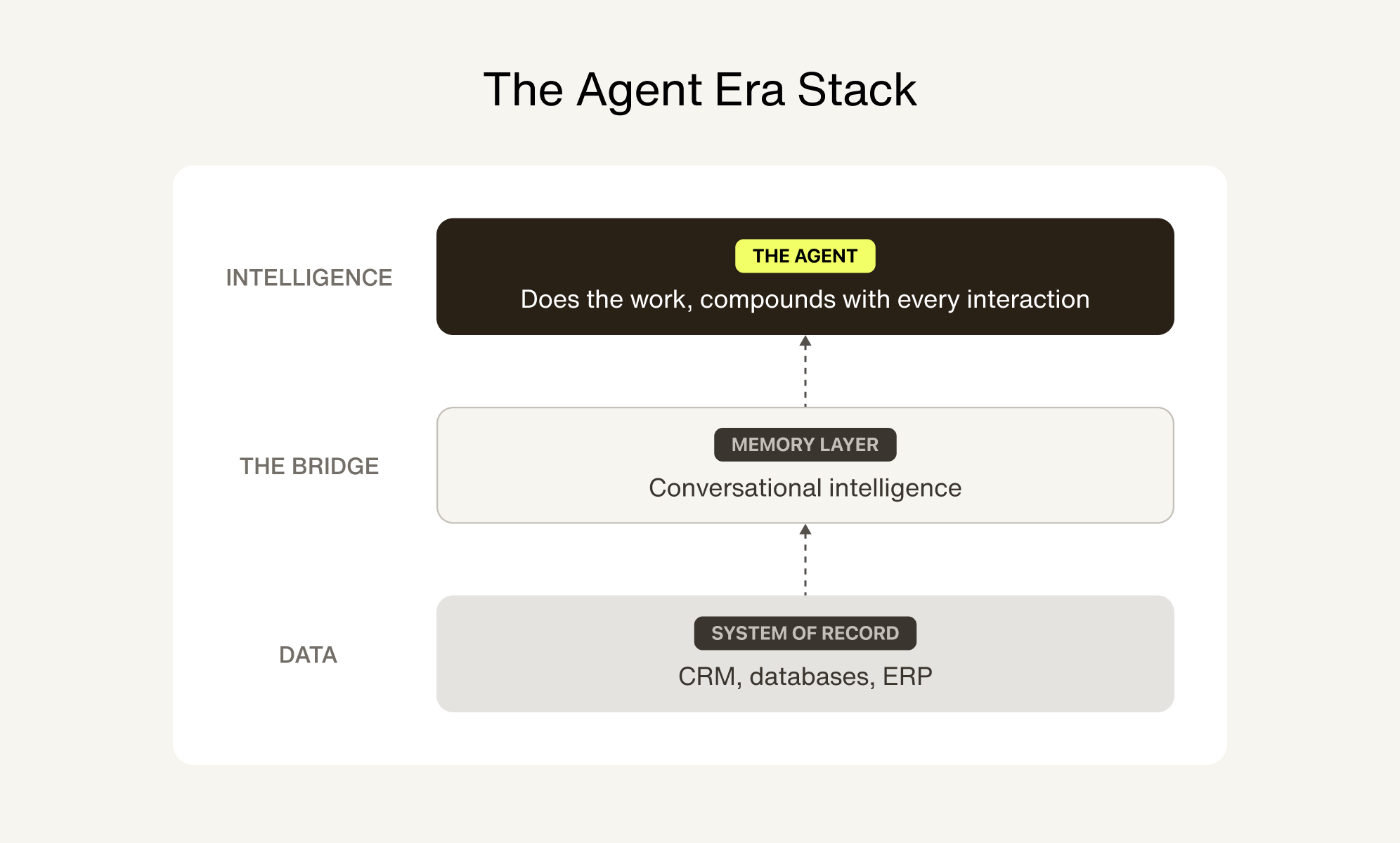
At the bottom, the system of record — Salesforce, your databases, your ERP. These don't die. They get more valuable, because agents need clean, authoritative data to act on.
At the top, the agent itself — the AI that does the work, interacts with customers, resolves issues, takes action. This is where OpenAI is playing. The agent platform layer.
But the middle is where the real shift happens: the memory layer. This is where conversation intelligence accumulates — every preference, frustration, and intent signal that emerged from agent conversations, persisted and compounding. Without this layer, the agent resets to zero every session. With it, every interaction makes the next one smarter.
Put simply: conversation intelligence is the memory. It's the bridge between SaaS and AaaS — the layer that converts a static tool into an agent that compounds.
That's the gap. And it's the gap that determines whether you're building real AaaS or just SaaS with better autocomplete. Control the memory, and you control the intelligence that makes every other layer more valuable.
Trust makes memory deployable
An agent with compounding memory is powerful. It's also — without the right infrastructure — dangerous.
When Gap's AI went viral for discussing Nazi Germany instead of selling jeans, the root cause was someone who "inadvertently misconfigured" the guardrails. One toggle. The lesson was clear: an agent without trust infrastructure is a liability, not a service.
And the more capable the agent becomes — the more it remembers, the more autonomously it acts — the higher the stakes get. Memory makes trust non-negotiable.
The more conversation intelligence your agent accumulates, the more trust infrastructure you need. They scale together or they break together.
What this means for you
The AaaS market is projected to grow from $5.1 billion to $47.1 billion by 2030. Everyone is building agents. But the growth won't distribute evenly — it will concentrate in the companies that built the architecture from the ground up. Memory and trust, not as roadmap items, but as the foundation.
Software ate the world. Agents are eating software. But not all agents are created equal — and the architecture underneath is what separates the ones that compound from the ones that plateau.
The companies that define the next era of enterprise software won't be the ones with the best demo. They'll be the ones who built memory and trust into the foundation — not as features, but as architecture.
The rest will look like agents on the surface. Underneath, they'll still be SaaS.