

There's a weird thing that happens in big companies. They create departments to fix problems they caused themselves. Then those departments become permanent, and everyone forgets the problem was self-inflicted.
In 1961, Toyota gave every assembly line worker a cord called the andon. Pull it, and the entire line stops. It was the opposite of how American factories worked — where quality was someone else's job. You built the car. A separate department inspected it. If the inspector missed something, the customer found it.
Toyota's argument was simple: if you need a department to inspect quality at the end, your process is broken. Fix the process. Within a decade, the quality inspection department — a fixture of manufacturing for a century — started to disappear. Not because quality stopped mattering. Because the architecture made the department unnecessary. Quality got built into every step.
The same pattern played out in software. Security used to be a separate team that audited code after it was written. Then DevSecOps embedded security into the build pipeline — automated scanning, policy-as-code, vulnerabilities caught before deployment. The security checkpoint didn't disappear because security stopped mattering. It disappeared because the infrastructure handled it.
In both cases, a department existed because the underlying process was broken. Fix the process, the department becomes unnecessary. Not the mission. The department.
Now think about customer experience.
The $22 billion patch
CX as a corporate function is pretty recent. It didn't exist before the mid-2000s. It emerged when companies got big enough that no one team owned the customer anymore. Marketing acquired you. Sales closed you. Product built for you. Support cleaned up after you. You were four different people in four different databases, and nobody noticed because nobody was looking at the whole picture.
So companies hired someone to look at the whole picture. The CX team. Their job: stitch the customer's experience back together after the org chart tore it apart.
And then came the tools.
- Ticketing to route you from one department to the next.
- Surveys to ask how you felt about each handoff.
- Journey maps to visualize the path you took through the company's internal structure.
- Escalation workflows to decide whose problem you were.
- Voice-of-customer programs to reassemble what the org chart broke apart.
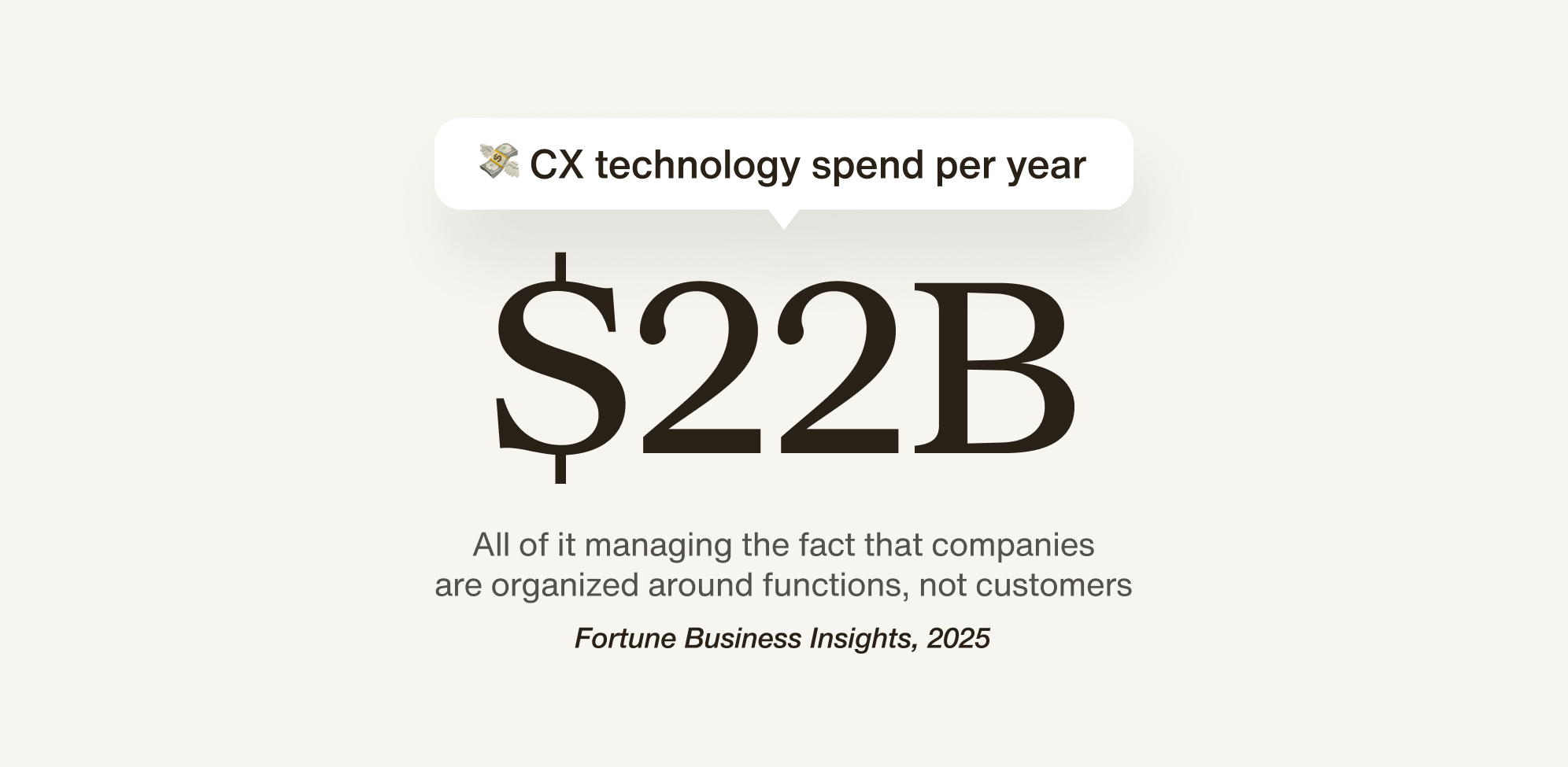
The American Customer Satisfaction Index hasn't moved since 2017. Eight years and hundreds of billions of dollars, and the number is flat. Medallia recently found that 66% of CX leaders think their experience improved. Only 17% of customers agree. That's not a gap you close with better survey tools. That's a gap between managing symptoms and fixing the disease.
You can't sand down your org chart
Companies always ship their org chart. A company with four siloed departments produces a four-seamed customer experience. The CX team tries to sand down the seams, but the seams are structural.
An AI agent with persistent memory does something different. It doesn't sand down the seams. It sits in front of them.
The departments still exist. Marketing, sales, product, support — all still there, still using different tools with different KPIs. But the customer never sees any of that. They see one agent that knows who they are, remembers their last conversation, and picks up where it left off three months later.
The org chart is still there. The customer just doesn't experience it anymore.
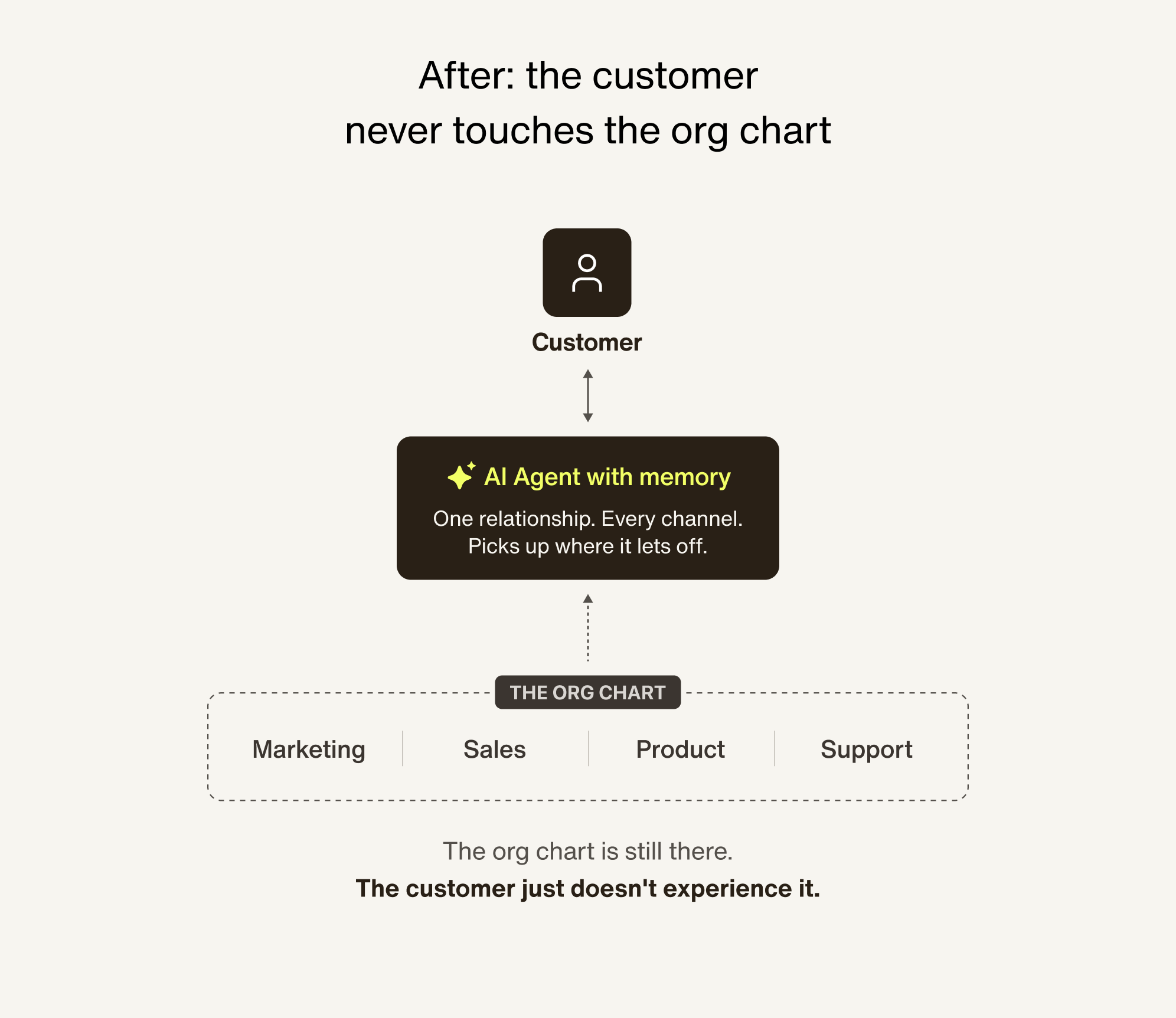
This is the same architectural move Toyota made. The assembly line didn't change. Workers still specialized. But the customer stopped receiving a product shaped by how the factory was organized, because quality was no longer the last step — it was every step. The memory layer — compounding intelligence from every interaction across every channel — does the same thing for CX. Without memory, you have a chatbot in each department. Same seams, different interface. With memory, you have one relationship that transcends the org chart.
The tools that stop making sense
If the architecture changes, the tools built for the old architecture stop making sense. Not because they're bad tools. Because the problems they were designed to solve no longer exist.
- Ticketing makes sense when you need to route customers between departments. If there's one agent that owns the whole relationship, there's nothing to route.
- CSAT surveys make sense when you can't observe how the customer feels in real time. An agent with persistent memory can — it knows what frustrated them last time, what they asked about three months ago, what they're likely to need next.
- Customer journey mapping makes sense when no single team can see the customer's full path — because each department only owns one leg of it. A persistent agent holds the entire relationship in one memory. There's no fragmented journey to reconstruct.
- Escalation workflows make sense when you need to decide whose problem the customer is. One agent owns the whole relationship — there's no one to escalate to.
These tools don't get replaced by better versions of themselves. The problems they solve stop existing. It's like asking what happened to the telephone switchboard operator. The answer isn't "better switchboard operators." It's direct dialing. The routing got built into the infrastructure.
The pattern
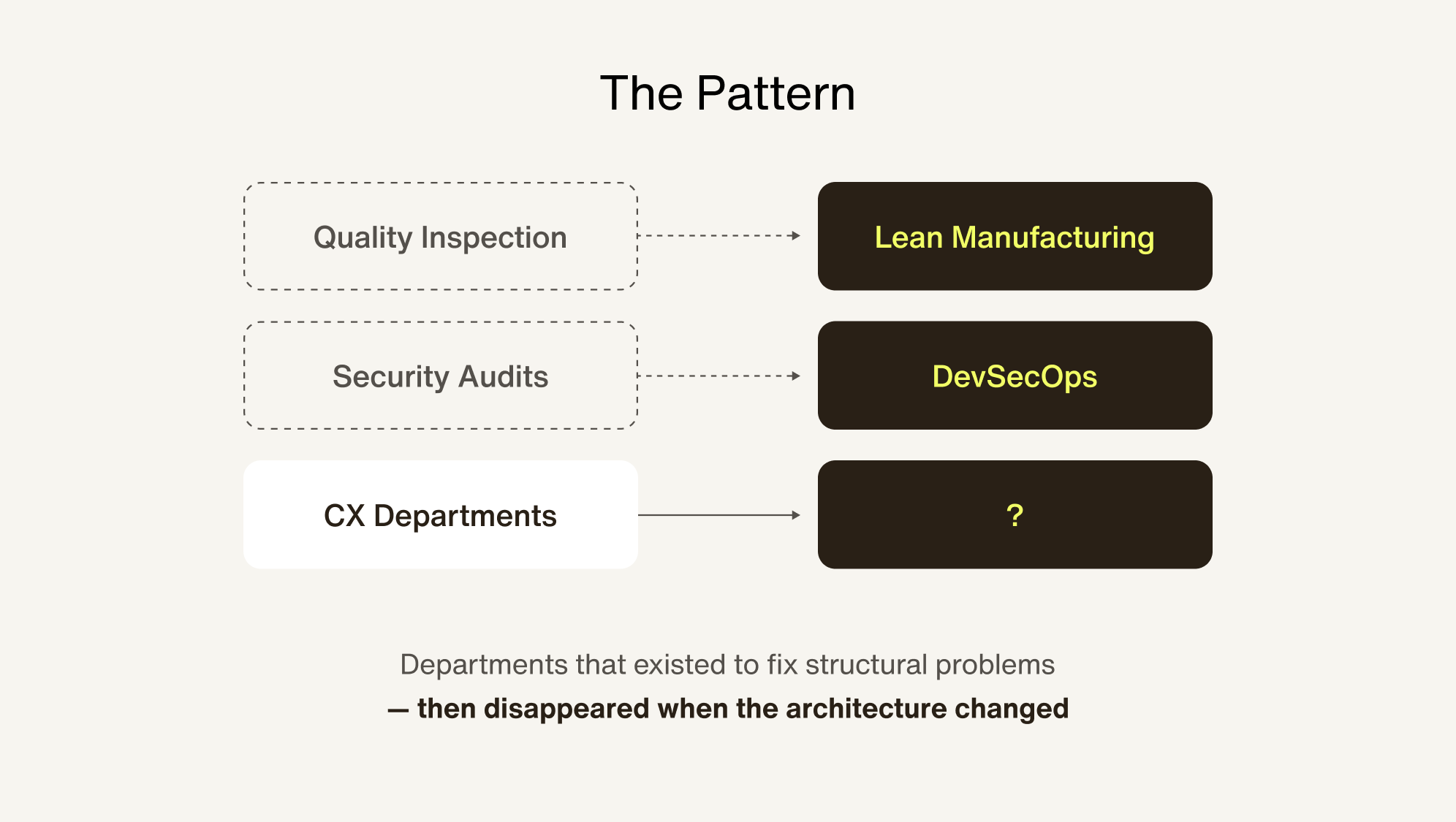
Any time a function exists mainly to coordinate between other functions, it's a candidate for architectural disruption. Not automation — automation just makes the coordination faster. Disruption means the coordination becomes unnecessary.
Quality inspection → lean manufacturing
Security audits → DevSecOps
Telephone operators → direct dialing
CX departments → persistent agents
Toyota built the andon cord into the assembly line. DevSecOps built scanning into the pipeline. A persistent agent — one that remembers who you are, what you need, and where you left off — builds CX into the infrastructure. The coordination that used to require a department now happens in the layer between the customer and the org chart.
The CX department doesn't get automated. It evolves. The quality inspector became the quality engineer. The security auditor became the security architect. The CX coordinator becomes the person who manages persistent agents — designing what the relationship should feel like, deciding what the agent remembers, tuning how it behaves across channels. That's not a lesser job. It's a better one.