If you're evaluating Fin AI alternatives, you've probably already seen what Intercom's AI agent does well. Fin resolves 50–67% of support conversations out of the box, deploys in under an hour, and ties cost directly to outcomes at $0.99 per resolution. For teams with straightforward support needs and predictable volume, it's a strong product.
But 3 things tend to push customer experience (CX) teams toward alternatives like the ones on this list.
- The invoice surprises. Per-resolution pricing sounds efficient until volume grows. At 5,000 monthly resolutions, Fin charges roughly $4,950 per month—before Intercom seat costs. CFOs start asking questions around month 3, once enough historical data reveals the pattern. If Intercom Fin AI pricing is what triggered your search, you're not alone.
- The complexity ceiling. Fin handles FAQ-style queries well. Multi-step workflows and context-dependent conversations are a different story—escalation guidance becomes unreliable as conversations get longer and more layered.
- The context resets. Fin can access Intercom customer data objects and past conversation logs, but it doesn't build a persistent understanding of each customer across separate sessions. It can pull up prior conversations, but returning customers often still repeat themselves—and your CX metrics reflect that friction.
If any of those sound familiar, here's how to evaluate what's out there—starting with the criteria that actually matter.
How to choose an AI customer service platform (what actually matters)
These 6 criteria reflect what buyers actually ask about in sales conversations and vendor demos.
1. Pricing model and total cost of ownership. Per-resolution, per-ticket, flat-rate, and per-seat models all behave differently at scale. The question isn't just "what does it cost today" but "what does it cost at 1,000, 3,000, and 5,000 monthly conversations?" Fin AI resolution pricing adds up fast—model it before you sign.
2. Resolution definition and measurement honesty. What counts as "resolved" varies dramatically. Fin counts an "assumed resolution" when a customer leaves without escalating—even if they gave up. Zendesk has auto-billed for resolutions teams disagreed with since January 2026. Before you compare resolution rates, make sure you're comparing the same thing. Also ask: does the AI resolve by answering questions, or can it take actions—process refunds, edit orders, update subscriptions?
3. Implementation speed and migration path. Some tools deploy in minutes; others take months to reach target performance. Know the difference between "time to go live" and "time to reach the resolution rate you need."
4. Integration depth with your existing stack. Does it connect to your helpdesk, CRM, and knowledge sources? "Integration" means different things—pulling data for context isn't the same as executing actions in your backend systems. Test integration depth in a proof-of-concept, not on a vendor's word. Teams evaluating AI customer service solutions should be especially rigorous here.
5. Channel coverage. Chat, email, voice, social, and messaging. Most AI agents are chat-first. If phone support matters, check whether voice is native or absent.
6. Human handoff and escalation quality. When the AI can't resolve, what transfers to the human agent? The full conversation context? A summary? Nothing? This determines whether handoff feels seamless or forces the customer to start over.
With those criteria in mind, let's compare the top Fin AI alternatives side by side. We picked the eight platforms below to span the range of teams actually evaluating Fin. That means free and pay-per-task tools for SMBs (Tidio, eesel AI, Freshdesk), voice-first and B2B-specific options (Ringly.io, Helply), and mid-market platforms with deeper AI and persistent memory (Zendesk AI, delight.ai).
We close with a look at the enterprise tier (Decagon, Sierra AI, Ada). Delight.ai is one of them; where a figure comes from a vendor's own claims, we say so.
Side-by-side comparison: 8 Fin AI alternatives at a glance
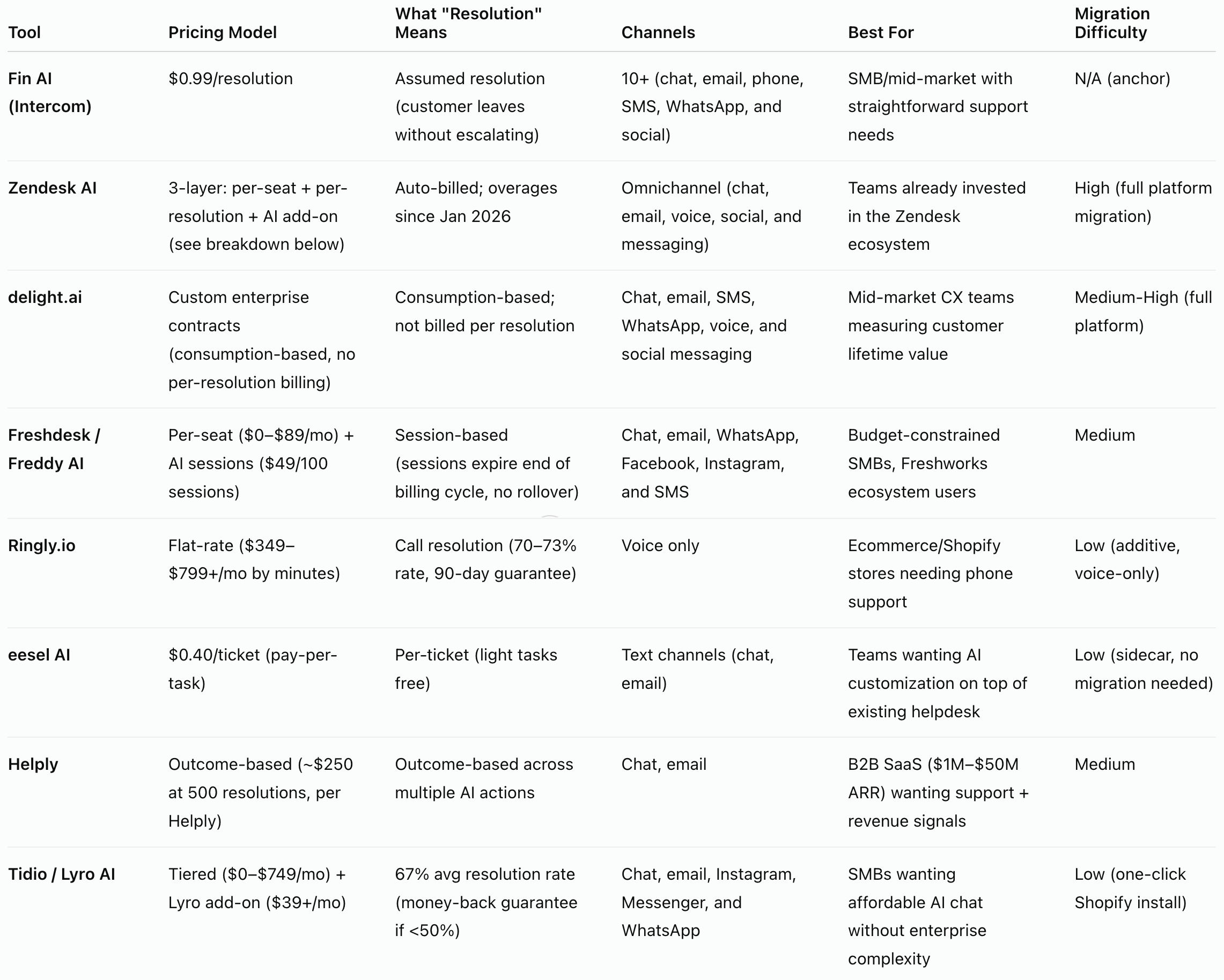
The tools with documented action execution include delight.ai (Actionbooks), Ringly.io (Shopify order processing), and Freshdesk (pre-built ecommerce integrations). eesel AI, Helply, and Tidio/Lyro are primarily knowledge-base responders. Zendesk's Forethought acquisition (March 2026) targets the action-execution gap, but the integration is early.
The alternatives: A closer look at each platform
Fin AI (Intercom)—the anchor you're evaluating against
Since every alternative on this list positions against Fin, it's worth reviewing what it does well to set the comparison baseline.
Resolution rates of 50–67% are documented across thousands of deployments. Fin Express Deploy gets teams live in under an hour with as few as 10 Help Center articles, and the $0.99/resolution model aligns cost with value at low conversation volumes.
Fin Apex 1.0 is Intercom's proprietary model, post-trained on customer service data—a serious investment in domain-specific AI. Intercom reports it outperforms GPT-5.4 on resolution benchmarks (73.1% vs 71.1%); the benchmark is Intercom's own design, though the results were reported by VentureBeat rather than independently re-run. Fin supports 10+ native channels including email, phone, SMS, WhatsApp, and social messaging.
The gaps mirror what drives most teams to this article: per-resolution costs that are hard to model before month 3, an "assumed resolution" definition that can overcount, and diminishing reliability in multi-step conversations. Fin Voice is also sales-gated—not available through self-serve.
Best for: Small and mid-size business (SMB)-to-mid-market teams with straightforward support needs, predictable conversation volume, and primarily standalone interactions where returning-customer context is less critical.
Zendesk AI—the ecosystem play for teams already invested
If you're weighing Fin AI vs Zendesk AI, the core distinction is architectural: where Fin is a standalone AI agent you bolt onto Intercom, Zendesk AI is the full-platform bet. If your team already runs on Zendesk Suite, adding AI within that ecosystem avoids the rip-and-replace conversation entirely.
Zendesk's AI draws on over 18 billion customer service interactions for training data, and the Forethought acquisition in March 2026—bringing 1 billion monthly interactions—strengthens autonomous resolution capabilities. Native voice AI agents shipped in October 2025. The marketplace connects to major CRM and ecommerce platforms, and enterprise compliance credentials check the boxes most procurement teams require.
Where it gets complicated is cost. Zendesk stacks 3 billing layers: per-seat licensing ($55–$169/agent/month), per-resolution AI charges ($1.30–$1.50 at base, up to $2.00 on overages), and an Advanced AI add-on ($50/agent/month). For a 20-agent team handling 3,000 tickets monthly, that lands at roughly $7,000–$10,000/month all-in. Billing unpredictability is a frequent G2 complaint—conversations tagged as "resolved" that teams disagree with, plus auto-billing for overages since January 2026.
The AI is also stronger at answering knowledge-base questions than at executing backend actions like refunds or order changes. Forethought targets that action-execution gap, but the integration is early.
Best for: Mid-market to enterprise teams already invested in the Zendesk ecosystem who want AI within their existing stack and can absorb the cost complexity.
Delight.ai—persistent memory across sessions, predictable pricing at scale
The core architectural difference here is memory. Delight.ai's Agent Memory Platform (AMP) maintains persistent conversational context across sessions and channels—a customer contacts you on chat Tuesday and follows up by email Friday, and the AI carries its understanding forward instead of starting from scratch. Enterprise-tier platforms like Decagon and Sierra AI (profiled below) offer their own cross-session context—Ada's reasoning engine is strong, though reviewers report context-loss issues—but all sit at a higher price point.
Agent Steward moves the AI agent platform from answering to acting—coordinating across systems and third parties to process refunds, rebook flights, or update subscriptions in a single workflow. A graduated autonomy model lets teams start with human approval on every action and expand autonomous resolution use case by use case.
Pricing uses consumption-based enterprise contracts without per-resolution billing, so there's no billing shock as volume scales. The trade-off is pricing visibility: delight.ai doesn't publish pricing tiers. Unlike Fin, Tidio, or eesel AI, you can't model costs before a sales conversation. That's a genuine advantage for teams that need predictability once committed, but could be a stumbling block for those who want to self-serve a comparison before engaging sales.
Trust OS enforces policies at the response level before the AI's output reaches the customer, and dev/prod environment separation with rollback and audit trails gives leadership visibility into exactly what the AI decided and why. The platform runs on Sendbird's decade-plus production infrastructure, with Voice AI available to all customers.
The gaps: delight.ai's integration ecosystem is narrower than what Zendesk or Salesforce-native platforms offer out of the box. And the memory architecture means ramp time is real—Hanssem progressed from 48% to 90% resolution over 5 months as AMP compounded context. Teams that need broad connectors today or peak performance in week 1 may find other platforms a better near-term fit.
Best for: Mid-market CX teams (1,000+ employees, 10K+ tickets/month) who measure success by customer lifetime value, need persistent context across interactions, and require governance controls.
Freshdesk / Freddy AI—the budget-friendly starting point
Where most platforms on this list charge per resolution or require a sales call, Freshdesk starts with a free tier that actually works. Pre-built ecommerce integrations with Shopify, Stripe, PayPal, and FedEx ship out of the box, and the broader Freshworks ecosystem (CRM, marketing, and IT) gives growing teams a unified stack without enterprise pricing. For teams looking for Fin AI alternatives that are cheaper to operate, Freshdesk is hard to beat on accessibility.
Freddy AI Copilot is genuinely useful for agent productivity—drafting replies, summarizing conversations, and running sentiment analysis. The autonomous Freddy AI Agent handles routine queries across chat, email, WhatsApp, and social channels.
The trade-off is AI depth. Freddy's resolution quality is generally reported as lower than Fin or dedicated AI agent platforms, and session-based pricing for the AI Agent can surprise teams—sessions expire at the end of each billing cycle with no rollover, so costs scale non-linearly as volume increases. For complex enterprise workflows, Freshdesk hits a ceiling faster than purpose-built AI platforms.
Best for: SMBs and growing teams under budget constraints, especially those already in the Freshworks ecosystem. If affordability matters more than AI sophistication, Freshdesk is a legitimate choice.
Ringly.io—AI phone support built for ecommerce
No other tool on this list covers what Ringly does: voice-first AI support for online stores.
The AI phone agent answers calls around the clock, looks up Shopify order information in real time, and processes returns and exchanges without human intervention. A 70–73% call resolution rate is backed by a 90-day guarantee—if resolution drops below 65%, you get a refund. Native Shopify integration means the AI works from live order data, not stale exports, and setup takes under an hour with no-code configuration.
The limitation is scope. Voice only—no chat, no email, no social messaging. If phone support is one channel among many, you still need a separate solution for everything else, and at $349/month minimum for voice-only, the per-channel cost is relatively high.
Best for: Ecommerce and Shopify stores where phone support is a significant channel—particularly when serving older demographics or handling high-value orders. This is a complement to your text-based support tool, not a full Fin replacement.
eesel AI—the customizable sidecar for your existing helpdesk
Rather than replacing your helpdesk, eesel AI layers a cheaper, more customizable AI agent on top of it—which means a fundamentally different buying decision than most tools here.
The standout is prompt-level customization. G2 reviewers cite this as the #1 reason they switched from Fin—eesel lets you control exactly how the AI responds, not just set a persona and hope for the best. You can test AI performance against historical tickets before going live, which reduces deployment risk significantly. It plugs into Intercom, Zendesk, and Freshdesk, so you keep your existing helpdesk and add AI without migration.
Transparent pay-per-task pricing ($0.40 per support ticket, with light tasks free) makes cost modeling straightforward. But the sidecar model means double-platform costs—you still pay for your underlying helpdesk subscription plus eesel on top. There's no voice channel support, and the G2 review sample is small relative to their claimed customer base.
Best for: Teams wanting hands-on control over AI behavior without ripping out their existing helpdesk. If you want to test AI support with low commitment and high customization, eesel is the lowest-friction option on this list.
Helply—support AI that doubles as a revenue signal tool
Helply targets a gap most AI support platforms ignore: the intelligence buried in support conversations. For business-to-business (B2B) companies in the $1M–$50M annual recurring revenue (ARR) range, that positioning is compelling.
The cost comparison stands out: according to Helply's own data, the platform costs roughly $250 at 500 monthly AI-resolved issues versus Fin's approximately $495 at the same volume. A free helpdesk with unlimited seats removes the per-agent cost layer entirely. Beyond resolution, Helply describes churn detection, upsell identification, and competitor monitoring features on its website—though no independent reviews verify these capabilities yet.
The gaps are straightforward: Helply is a newer brand with less enterprise track record than Zendesk or Intercom, it targets B2B specifically (making it a poor fit for ecommerce), and integration depth along with exact AI resolution capabilities remain unverified by third parties.
Best for: B2B SaaS companies wanting support AI that also surfaces revenue signals—churn risk, upsell opportunities, and competitor mentions. The pricing story is attractive if the revenue-engine features deliver as described.
Tidio / Lyro AI—the fastest path to live
Need an AI support chatbot for ecommerce running today with minimal setup and zero upfront cost? Tidio gets you there.
The free plan delivers real value—50 conversations and a one-time allotment of 50 Lyro AI interactions at no cost. One-click Shopify install gets stores live in minutes, and Lyro's 67% average resolution rate comes with a money-back guarantee if it falls below 50%, which is unusual confidence from a vendor. The visual chatbot builder lets non-technical teams configure flows without code.
The ceiling shows up when interactions get complex. Lyro deflects routine questions more effectively than it fully resolves issues requiring backend actions—enterprise workflows aren't Tidio's design target. And the Lyro AI add-on ($39+/month on lower tiers) compounds with the base plan as volume grows, narrowing the cost advantage at scale.
Best for: Small to mid-size businesses wanting affordable AI chat support without enterprise complexity. If you need something working this week and your support queries are primarily informational, Tidio gets you there faster than anything else on this list.
Enterprise-tier AI customer service platforms: Decagon, Sierra AI, and Ada
The 8 alternatives above cover the range most mid-market teams evaluating Fin will care about. But if you're researching AI customer service agent alternatives at the enterprise level, three platforms operate at a different price point and procurement scale entirely.
Decagon has landed strong enterprise logos—Duolingo reports 80% deflection. Its Agent Operating Procedures (AOPs) let non-technical CX teams configure complex AI behaviors in natural language, and Decagon layers on top of existing helpdesks (Zendesk, Salesforce, Intercom, and Kustomer) via API. Pricing isn't public, but third-party data suggests contracts range from ~$95K to $400K+/year depending on volume and complexity—a significant jump from the mid-market tools above. The platform also lacks social media channel support.
Sierra AI ($15.8B valuation, $150M+ ARR) positions its agents as autonomous employees that take real backend actions across systems, with significant enterprise adoption. The Agent Data Platform provides persistent memory across sessions. For mid-market teams, the barrier is primarily financial: first-year costs are estimated at $200K–$350K+ including professional services. G2 reviewers have also flagged integration friction and a data dispersion issue where bot conversations live in Sierra while human conversations remain in the original helpdesk.
Ada (founded 2016) sits closer to mid-market price points, with first-year costs estimated anywhere from $30K to $250K+ depending on volume. The platform integrates with 13+ helpdesks—the broadest connector library in this landscape. The caution: Ada charges $1–$3.50 per resolution, creating the same billing unpredictability that drives teams away from Fin. Its Trustpilot rating (1.8–1.9/5) contrasts sharply with a 4.6/5 G2 score—worth investigating during demos. Implementation timelines of 8–16 weeks are longer than Ada's marketing suggests.
For mid-market teams, the key trade-off with these enterprise platforms is capability depth versus implementation cost and timeline. If your needs and budget go beyond the mid-market alternatives profiled above, Decagon, Sierra AI, and Ada belong on your evaluation shortlist.
How to choose the right Fin AI alternative for your team
With this many Fin AI alternatives on the market, the right tool depends on your team's profile. Here's a decision framework:
- SMB with low volume and simple queries—Tidio (free tier) or stay with Fin if you're already on Intercom
- Budget-constrained team wanting an AI layer on your existing helpdesk—eesel AI or Freshdesk
- B2B SaaS wanting support + revenue signals—Helply
- Ecommerce/Shopify needing phone support—Ringly.io
- Mid-market team outgrowing Fin (billing shock, context resets, complexity ceiling)—delight.ai
- Enterprise team invested in Zendesk ecosystem—Zendesk AI, but model total cost carefully before committing
- Enterprise team with $100K+ budget and Fortune 500 scale—Decagon, Sierra AI, or Ada, depending on integration needs and implementation appetite
5 questions to ask in every vendor demo
- How does pricing scale at my conversation volume? Model it at 1,000, 3,000, and 5,000 monthly interactions.
- What counts as a "resolution" in the contract? Get it in writing.
- How does the AI handle returning customers who have contacted us before?
- What governance controls exist? Can I see exactly what the AI decided and why?
- What does migration look like, and what should I expect in the first 30, 60, and 90 days?
On migration: sidecar tools like eesel AI require no migration—they layer on top of your existing helpdesk. Full-platform switches take more effort. See the FAQ below for a practical migration breakdown.
Ready to see how persistent memory changes your support experience? Explore the delight.ai AI agent or request a demo to evaluate AMP, Trust OS, and predictable enterprise pricing against your team's specific requirements.