The narrative around artificial intelligence has moved decisively from theoretical potential to practical application. The following resource maps the shift from AI innovation to AI integration across the global workforce. As enterprises and nations alike scale their digital infrastructure, global AI adoption is accelerating at varying speeds depending on regional priorities and structural investments.
Key takeaways
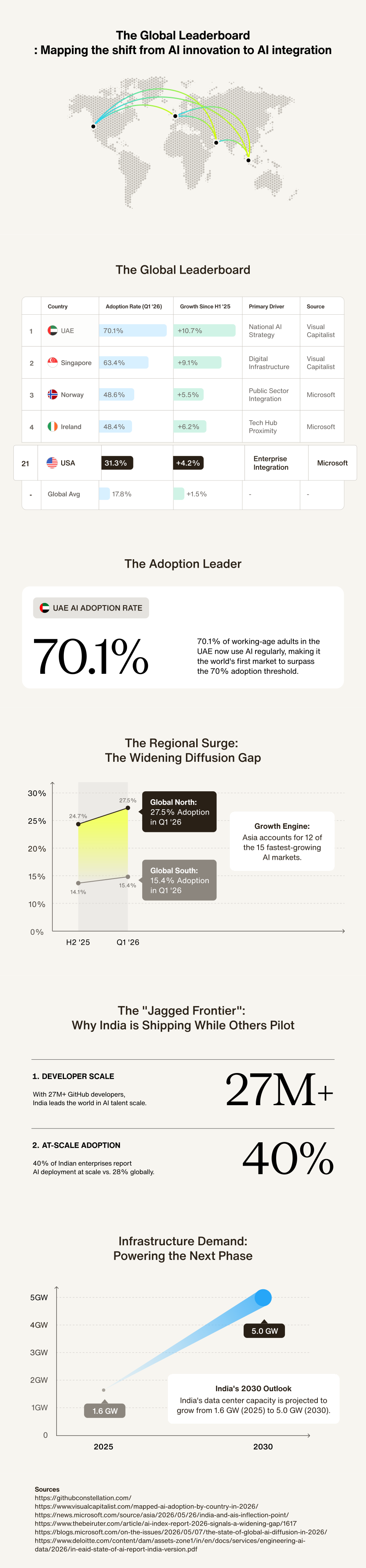
- The United Arab Emirates has officially crossed the 70% adoption threshold among its working-age population, leading the globe in regular AI use.
- The global average for working-age AI adoption has reached 17.8%, up 1.5% in just the first quarter of 2026.
- A "diffusion gap" is widening between the Global North (27.5% adoption) and the Global South (15.4%), though Asian markets are driving the fastest growth.
- India is outpacing global enterprise adoption averages, with 40% of its enterprises reporting full-scale AI integration.
- The United States currently ranks 21st globally, an unexpected low, prioritizing deep enterprise integration over widespread public-sector rollout.
The new global leaderboard: Strategy over scale
The pace at which countries integrate artificial intelligence is largely determined by their strategic drivers. The United Arab Emirates currently leads the world, boasting a 70.1% adoption rate among working-age adults as of Q1 2026, up 10.7% since the first half of 2025. This growth is largely fueled by a cohesive national AI strategy. Close behind is Singapore with a 63.4% adoption rate, driven primarily by robust digital infrastructure investments
European nations like Norway (48.6%) and Ireland (48.4%) follow, relying heavily on public sector integration and proximity to major tech hubs, respectively. In contrast, the United States has a 31.3% adoption rate, ranking 21st globally. This position highlights a U.S. focus on complex enterprise integration over ubiquitous consumer use. On a broader scale, 17.8% of the world's working-age population now uses AI regularly, driven largely by GenAI Ubiquity.
The widening diffusion gap
While global averages show steady upward movement, the disparity between regions is becoming more pronounced. In Q1 2026, the Global North reached a 27.5% adoption rate, up from 24.7% in the second half of 2025. Meanwhile, the Global South has an adoption rate of 15.4%, a smaller proportional increase from 14.1% during the same period.
However, regional momentum tells a different story. Asia is currently functioning as the primary growth engine for the technology, accounting for 12 of the 15 fastest-growing AI markets worldwide. This surge suggests that emerging economies with heavy tech investments are rapidly closing the execution gap.
Scaling execution: India's enterprise advantage
The transition from pilot programs to full-scale deployment represents the hardest hurdle in corporate AI strategy. India has emerged as a clear leader in this area, demonstrating what a "jagged frontier" looks like when developer scale meets enterprise execution.
India currently boasts over 27 million developers on GitHub, representing the world's largest developer community. This massive talent pool directly translates into business outcomes. Today, 40% of Indian enterprises report "full AI use" at scale, compared to a global average of just 28%. To support this aggressive expansion, India's data center capacity is projected to surge from 1.6 gigawatts in 2025 to 5.0 gigawatts by 2030.
Methodology
The data presented in this index reflect the Q1 2026 landscape of global artificial intelligence adoption. The primary benchmark for the 70% threshold is based on the Microsoft Q1 2026 Diffusion Report, which measures active users (minimum of 90 minutes per month) among the working-age population (ages 15–64). Additional data points regarding enterprise usage and regional infrastructure growth were synthesized from Visual Capitalist, Deloitte, and GitHub Constellation.
About delight.ai
Delight.ai provides an enterprise-grade, branded AI concierge that helps businesses deliver deeply personalized, human-like customer experiences at scale. By combining persistent memory, omnichannel continuity, and enterprise trust, delight.ai ensures that every customer feels seen and remembered. As the global shift from AI innovation to AI integration accelerates, delight.ai equips mid-market and enterprise brands with the tools necessary to turn customer engagement into a powerful, revenue-driving advantage.
Sources
- https://githubconstellation.com/
- https://www.visualcapitalist.com/mapped-ai-adoption-by-country-in-2026/
- https://news.microsoft.com/source/asia/2026/05/26/india-and-ais-inflection-point/
- https://www.thebeiruter.com/article/ai-index-report-2026-signals-a-widening-gap/1617
- https://blogs.microsoft.com/on-the-issues/2026/05/07/the-state-of-global-ai-diffusion-in-2026/
- https://www.deloitte.com/content/dam/assets-zone1/in/en/docs/services/engineering-ai-data/2026/in-eaid-state-of-ai-report-india-version.pdf