71% of U.S. consumers used AI-powered customer service in the past year. Travel scored 55 out of 100 in the 2026 Delight AI Index, four points above the national average and squarely in the middle of the five industries measured. Guests are already using AI for travel — and many describe the routine interactions as fast, frictionless, and accurate.
But that's not the full picture. Travel is also the industry where the gap between AI appetite and AI resistance is widest of any vertical in the Index. Guests have strong, context-specific preferences about when AI should be in the room — and when it absolutely should not.
The data draws a clear line. On one side: the predictable, informational moments that define most travel touchpoints. On the other: the crisis moments that define travel brands forever. The AI strategy that earns loyalty in travel isn't the one that deploys the most AI. It's the one that knows exactly where each belongs.
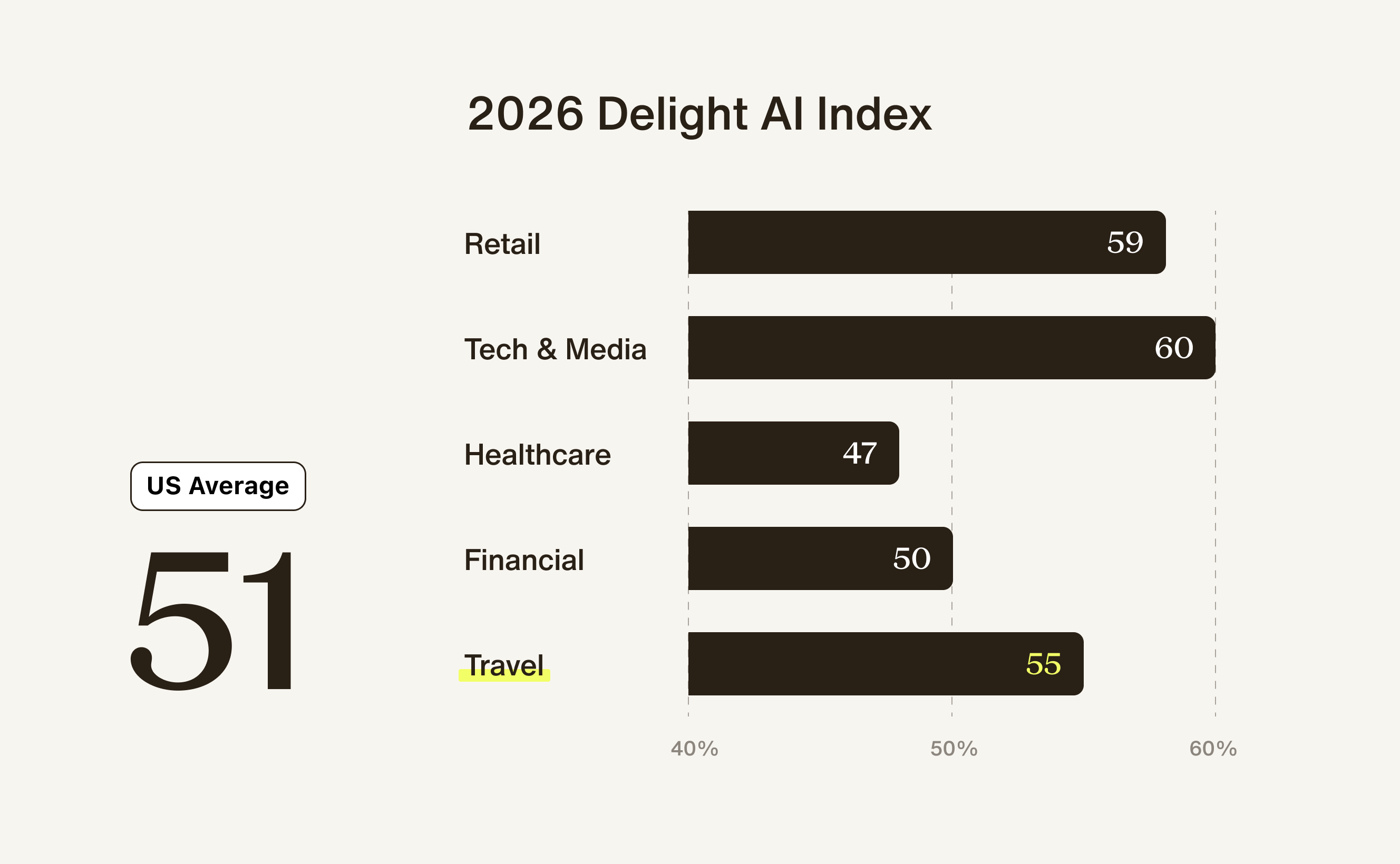
The five points between Travel and Retail are not a ceiling. They're a gap that closes with better handoff design. The brands that crack that design problem will pull ahead of an industry still deploying AI broadly without thinking carefully about when to hand off to a human.
The split between routine and crisis
Travel shows one of the sharpest splits in guest preference across tasks in the entire Index. Guests are genuinely AI-forward for routine interactions. They want humans for emergencies. That's not ambivalence — it's context-sensitivity, and it's the clearest preference signal in the data.
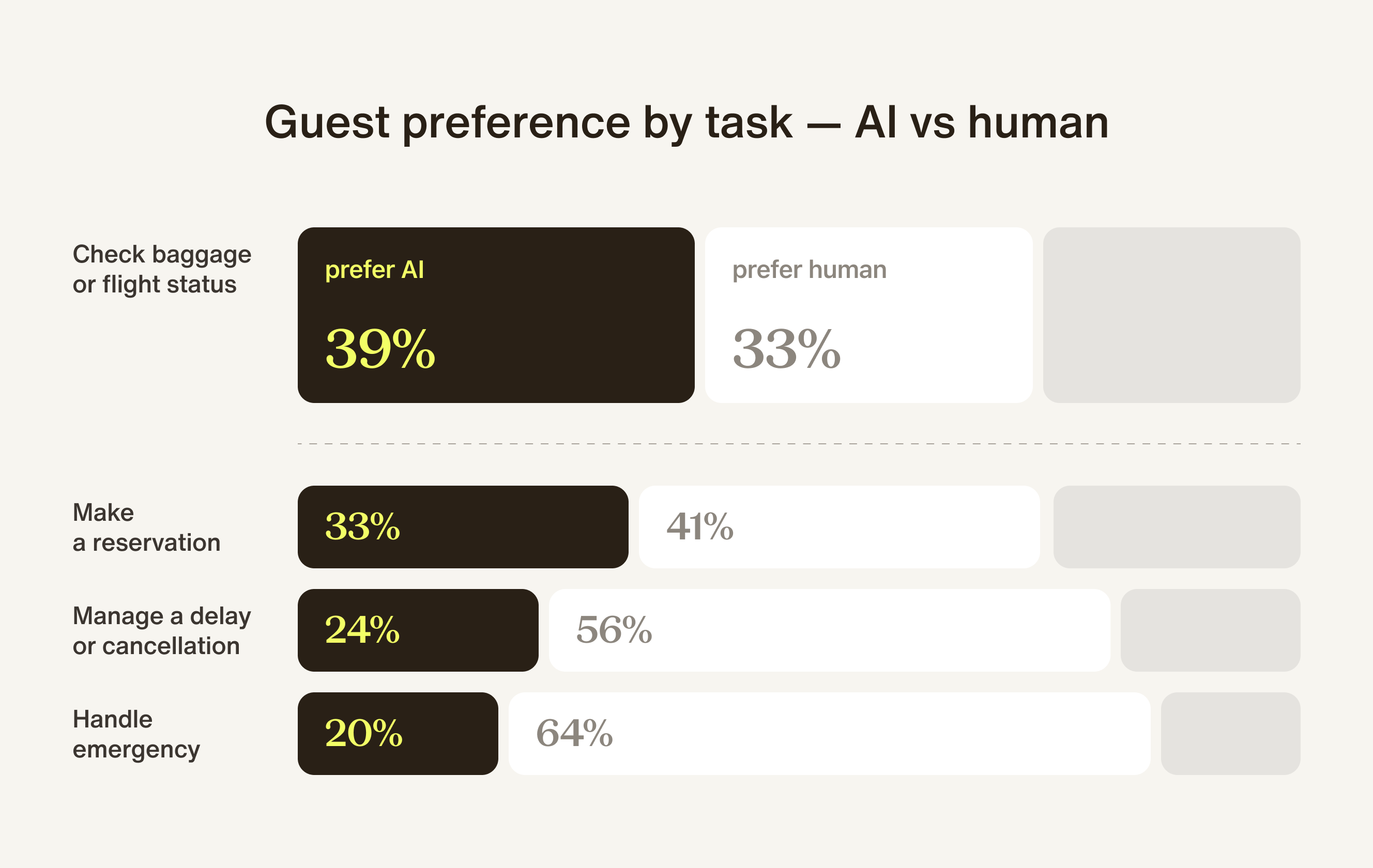
39% of guests prefer AI for baggage and flight status. 64% prefer a human for a missed connection emergency. That spread — from the most AI-preferred task to the most human-preferred one — defines the travel AI design problem more than any aggregate score does.
The emergency use case explains why. A missed connection isn't one problem. It's a cascade: a flight rebooking, a hotel, meal credits, a rental car, missed meetings, and a guest who is stressed, exhausted, and needs someone to own the entire situation end-to-end. 64% of guests want a human at that moment. The AI that fails to recognize this and tries to handle it alone is not just failing the interaction. It's damaging the brand.
Travel brands should be aggressive with AI for status checks, confirmations, and basic reservations, and equally deliberate about designing the moment when AI steps aside.
AI speaks for your brand at every moment
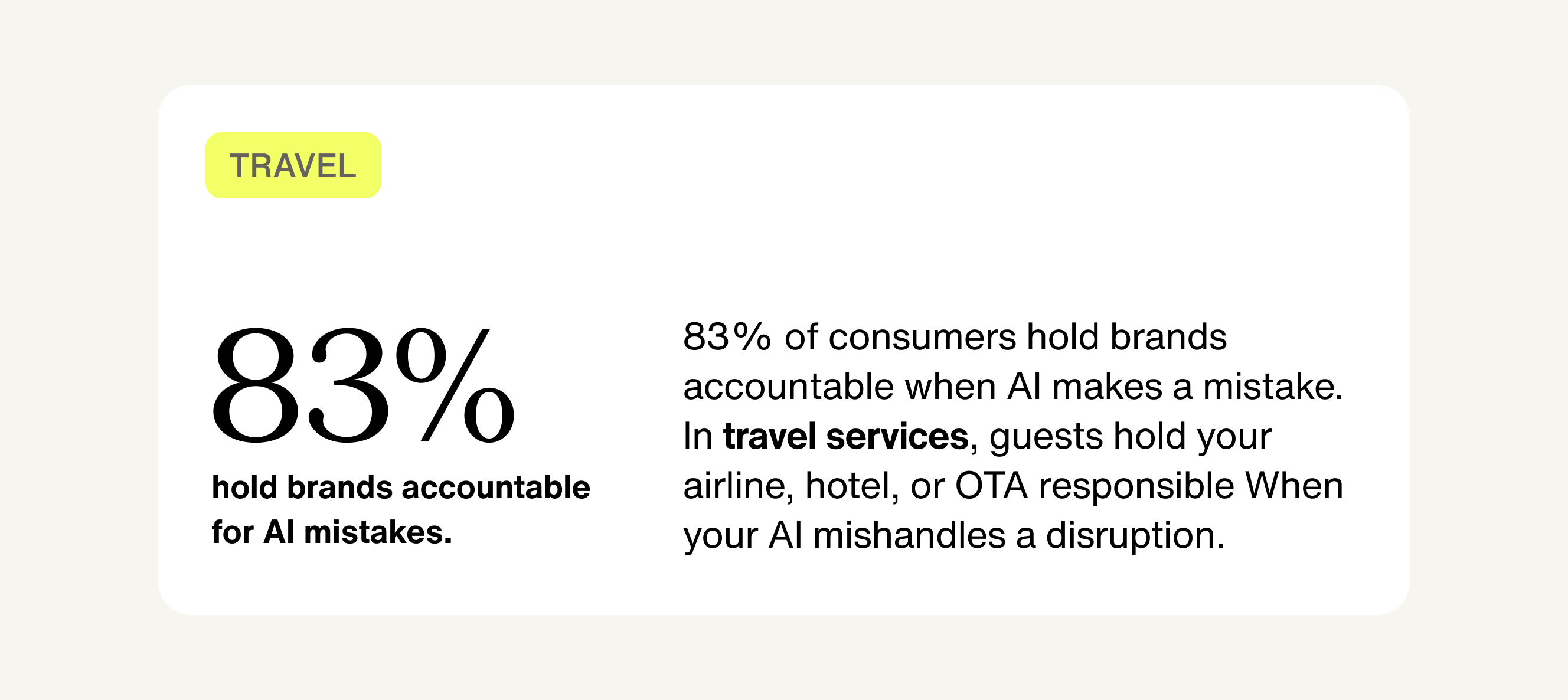
Guests don't separate the AI experience from the brand delivering it. A smooth AI check-in earns brand credit. A mishandled rebooking at 2am earns brand blame. 64% of consumers expect AI to outperform a human rep. In travel, where disruptions are real, immediate, and expensive, failing to clear that bar doesn't just lose the interaction. It loses the guest.
The Emotional Resonance pillar of the Index, which measures whether AI interactions feel meaningful rather than merely transactional, scores 46 nationally compared to Brand Alignment at 57. That 11-point gap is the largest in the Index. Travel brands that invest in making AI interactions feel genuinely responsive — not just fast — will close that gap and build the loyalty that drives repeat bookings.
The bar is lower than the disruption suggests
When guests were asked what would genuinely delight them in an AI-powered travel interaction, the answer wasn't more sophisticated routing or faster response times. It was memory.
70% say they'd feel more delighted if AI simply remembered their prior interactions so they didn't have to repeat themselves. No re-entering loyalty numbers. No re-explaining the situation. Memory is the easiest win in travel AI right now.
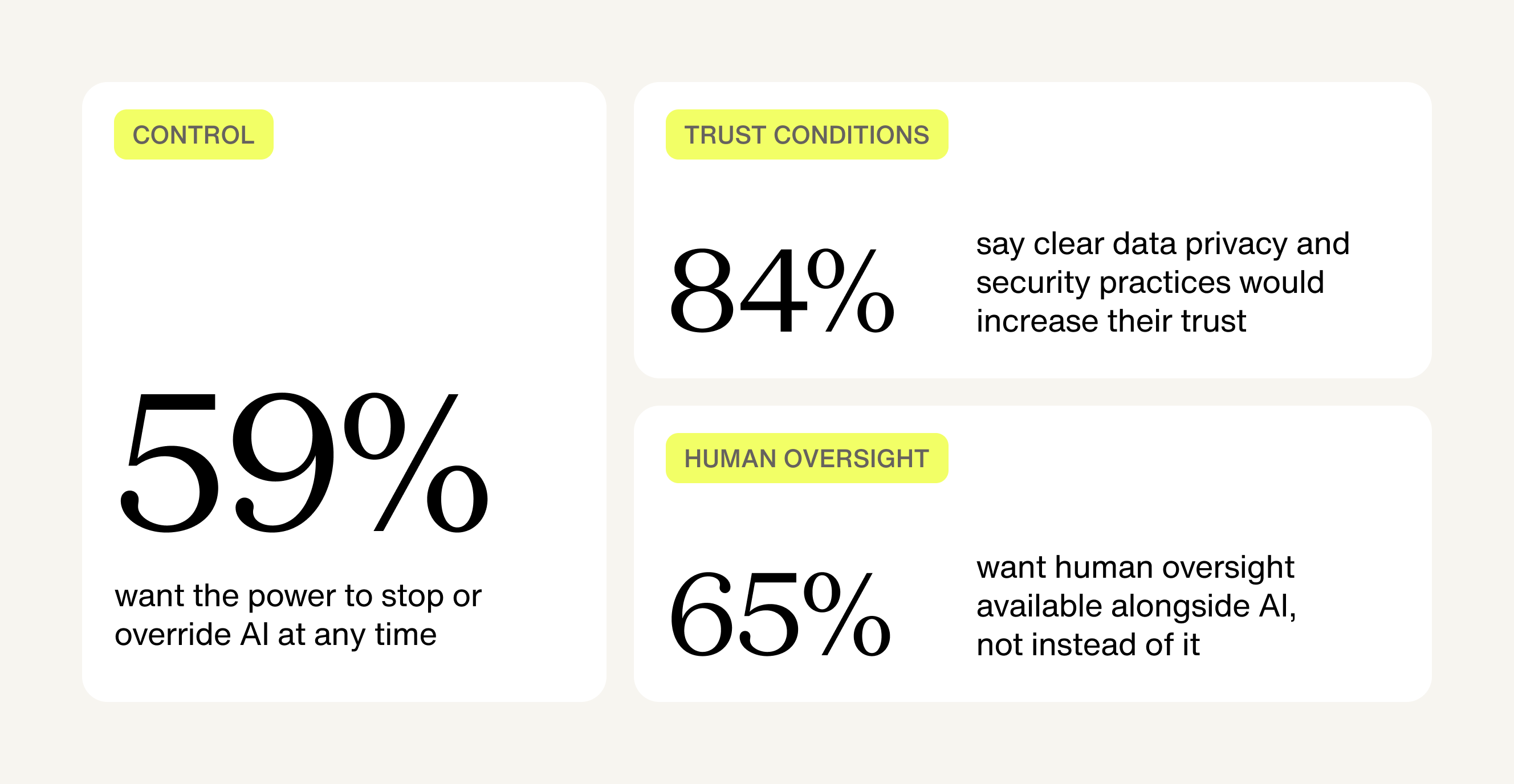
These are achievable product decisions, not capability gaps. Long-term conversational memory. Transparent data handling. A clear, visible path to a human when stakes escalate. Guests who experience all three will trust AI more broadly — including in the disruption moments where trust matters most.
54% of all consumers expect to feel comfortable with fully autonomous AI within the next year. In travel, where AI already handles the easy interactions well, the window to extend that trust into higher-stakes moments is open. The brands that earn it now will be the ones guests book by default.
The guests most ready for AI are your highest-value ones
The generational picture in travel AI mirrors the broader Index pattern — with one important difference. The gap between Millennials and Boomers in travel is wider than in retail, and the implication for loyalty program strategy is significant.
Millennials are at peak travel spend and at peak AI readiness. 57% are comfortable with AI handling routine travel tasks independently. Boomers, at 27%, are less than half that. Both groups are frequent travelers. The AI experience that works for one will frustrate the other without deliberate design choices.
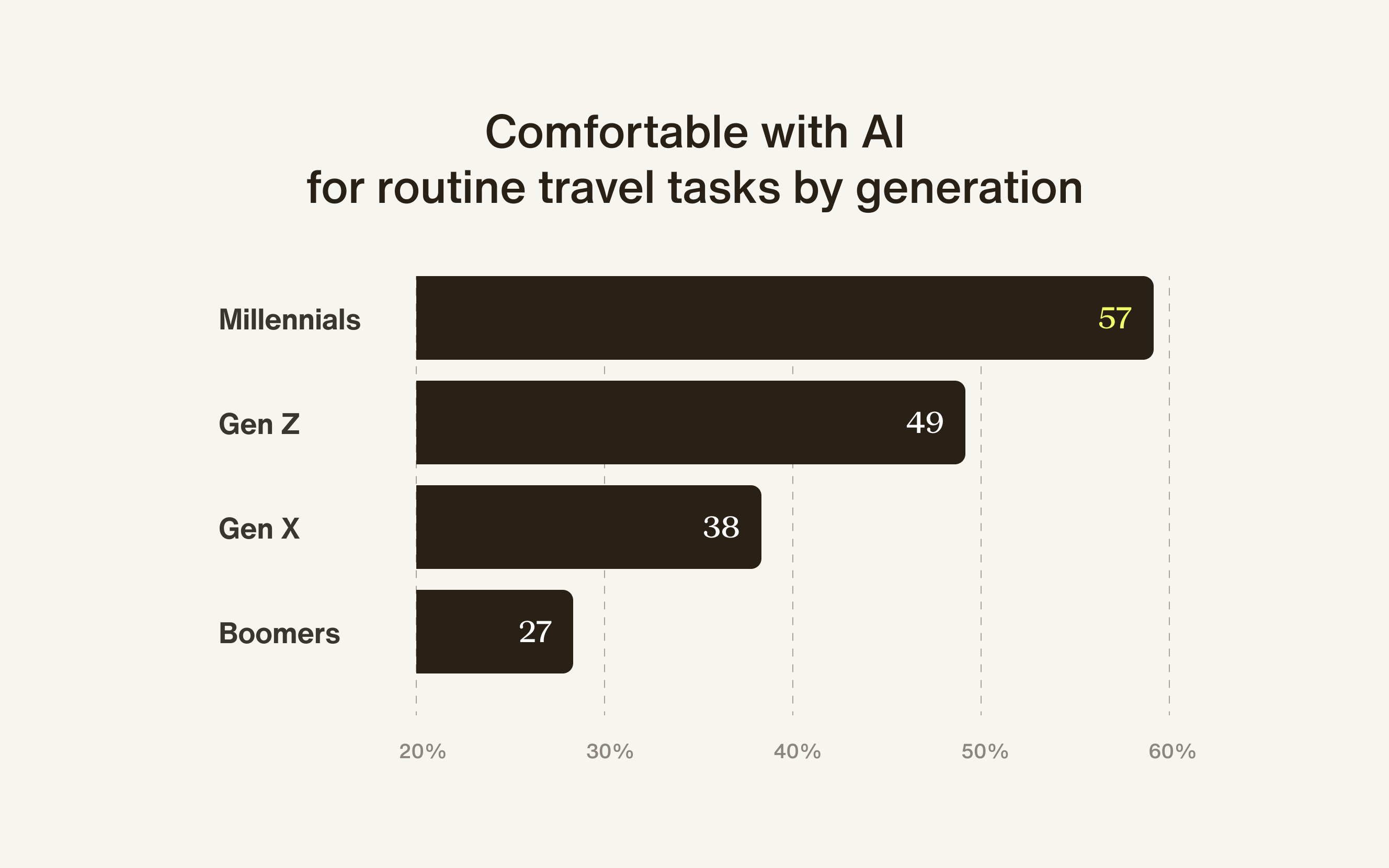
The clearest design implication from the segment data: don't build one AI experience and hope it fits all guests. Millennials want speed and autonomy. Boomers want visibility and control. The architecture that serves both is the one with real AI capability on the front end and real human access on the back end.
Three moves that put you ahead
1. Build AI trust before disruption tests it.
Start with the touchpoints where guests already have AI appetite: reservation confirmations, check-in status, loyalty balance inquiries, property questions, itinerary details. Whether the guest is booking a hotel, renting a car, or managing a flight, these routine interactions are where AI can perform consistently and predictably. Every successful one deposits trust that can be spent when disruptions hit. Guests who trust AI for the easy stuff are more forgiving and more willing to accept AI assistance when things go wrong.
2. Design the handoff as deliberately as the deployment.
64% of guests want a human when a trip goes seriously wrong — a booking that can't be recovered by self-service, a disruption that cascades into multiple problems, a moment where someone needs to own the full situation end-to-end. How the handoff triggers, what it communicates, and what information it carries to the human matters as much as every AI interaction that preceded it.
A seamless handoff is not a sign that AI failed. It's a sign the brand designed the experience correctly. The most effective brands are moving beyond a clean AI-to-human switch entirely. Look for platforms that let AI and humans work in parallel, with AI surfacing context and options in real time while a human owns the relationship and drives the resolution. The guest never feels transferred. Just supported.
3. Surface data practices before the journey starts.
Travel brands hold sensitive guest data: itineraries, payment information, loyalty history, passport details. 84% of guests say clear data privacy and security practices would increase their trust in AI. That trust is built before the first AI interaction, not during it. Communicate your data safeguards at account creation, in the app, and in the pre-trip confirmations guests already open and read. Guests who understand how their information is protected are more willing to let AI use it well.
Travel scored 55. The opportunity isn't in the score. It's in the spread between the routine touchpoints guests are happy to hand to AI and the high-stakes disruptions where they want a human who owns the situation completely. The brands that master both ends of that range, with AI that delights in the routine and humans who own the emergency, will be the ones guests return to regardless of price.