
Key takeaways
- AI in ecommerce splits into 4 technologies (machine learning, natural language processing, deep learning, and agentic AI) that map to 15 practical use cases, from product discovery to demand forecasting.
- Where you start decides whether it works. Begin where your data is already clean and the decision repeats often, which is almost always support and product discovery, not pricing or forecasting.
- Pricing model beats list price. Per-seat AI costs the same whether it resolves 10% or 80% of your volume. Per-resolution pricing ties what you pay to what you get.
AI in ecommerce means using machine learning, language models, and autonomous agents to run the parts of an online store that repeat, like recommending products, answering shoppers, setting prices, forecasting demand, and coordinating orders. 88% of organizations now report regular AI use in at least one business function, up from 78% a year earlier, according to McKinsey's global AI survey.
Retail is ahead of that curve rather than behind it. Stanford HAI's 2026 AI Index puts marketing and sales for consumer goods and retail among the highest-adoption function-industry pairings, at 51%.
So the question for most retail operators is no longer whether to use AI. It's which of the 15 use cases below to execute on first, what it costs, and what breaks after launch. This covers all three.
Most of what follows applies whether you run a 40-SKU store or a marketplace. If you want the vertical view rather than the technology view, start with AI for retail.
Understanding AI in ecommerce
With over 33% of the world’s population now shopping online, there’s increasing demand for flexible, convenient, and seamless shopping on a global scale. Faced with rising customer expectations, costs, and operational complexity, retailers must deliver exceptional experiences to cut through the noise and win loyal customers. This is where AI shines.
AI allows online retailers to analyze and leverage vast amounts of data in real-time to improve operational efficiency, increase sales, make data-driven decisions, and gain a deeper understanding of customers—all while delivering a more personalized, seamless shopping experience across channels.
It's a win-win for shoppers and retailers, so it’s no surprise that over 70% of ecommerce businesses are now using AI in some form. These technologies are complementary when integrated effectively, and fall into three main buckets:
Core types of AI in ecommerce
- Predictive AI: Analyzes historical data like customer behavior, preferences, and purchase history using machine learning (ML) algorithms to identify patterns and make predictions.
- Use cases: Demand forecasting, inventory optimization, dynamic pricing, audience segmentation, personalized product recommendations
- Generative AI: Interprets customer queries and automatically creates a contextually relevant output in any language using natural language processing (NLP) and ML.
- Use cases: AI customer support chatbots, automated content generation website content, marketing campaigns, and automated product descriptions
- Agentic AI: AI agents are proactive systems that perceive their environment and leverage real-time data via APIs and tools to solve problems on their own. They expand AI's scope of information and functionality to use both historical and real-time data in dynamic ways.
- Use cases: All the above. AI agents are complementary technology that enables a new generation of context-driven personalization, process automation, AI for customer service, and actionable business intelligence—known as agentic commerce.
- Deep learning layers neural networks to model patterns too complex for standard ML.
- Use cases: visual search, image recognition, voice recognition, "shop the look" matching.
The commercial line sits between the last two. Generative AI answers while Agentic AI acts, which is why the category now gets called agentic commerce.
How are shoppers finding products through AI?
Product discovery is moving off the search results page and into the AI answer. Shoppers can now research purchases inside ChatGPT, Perplexity, Gemini, and Google's AI Overviews to arrive at your site with a shortlist already assembled.
How do you get an ecommerce store cited in AI answers?
There are a few “best practices” you can follow as an ecommerce retailer to get your store cited in AI answers. For example, AI assistants extract from pages that answer a question directly and describe products precisely. Three things move the needle most:
- Structured product data with consistent attributes: size, color, material, compatibility, dimensions. Assistants match on specific attributes.
- Content that answers a question in the first 40 to 60 words, before the context and the caveats. Extractable answers get cited.
- Specifics over superlatives. A model can cite "ships in 2 business days from Ohio”, but it can't do anything with "fast shipping."
What is agentic checkout?
Agentic checkout is a purchase completed by an AI agent on the shopper's behalf, or a checkout flow that adapts in real time to who's buying. In practice that means applying loyalty rewards automatically, skipping steps for returning shoppers, or surfacing a relevant add-on instead of a generic one.
For retailers, the practical requirement is that your product, inventory, and pricing data can be read by a system that isn't your website. If an agent can't see whether an item is in stock on your website, it can't sell it.
What happens after an AI answer sends a shopper to you?
After an AI answer sends a shopper to you, they may arrive with half-formed intent and a comparison already in their head. The shopper wants a specific question answered, but scrolling through a generic FAQ page loses them.
Three things convert that visit:
- A shopping assistant that reads live data, so their "is this in stock in my size" question gets an answer instead of a link.
- Answers in the conversation, not a redirect to a policy page the shopper has to dig through to find their answer.
- Context that survives the channel switch, so a question started in chat and finished by phone doesn't restart.
An assistant that can read live inventory, order history, and policy, then respond in the thread, is the difference between capturing that visit and paying for it twice.
Where should you start with AI in ecommerce?
Start where your data is already clean and the decision repeats often. For almost every store that means customer service and product discovery first, pricing and forecasting second, and autonomous multi-step operations last. Something to note is that AI amplifies data quality, so if your data is messy, AI will exacerbate that.
What retail and ecommerce tasks should you automate first?
You should automate support and product discovery first, for three reasons.
- The data already exists and is already clean. Your resolved tickets, your product catalog, and your order history are structured by definition. Nothing needs a data project first.
- The decisions repeat thousands of times. Where's my order, can I return this, does this fit, is this in stock? High volume plus low variance is exactly what AI is good at.
- You can measure it in weeks, not quarters. Resolution rate and containment rate move fast enough to prove or disprove the business case before the budget conversation goes stale.
For reference on timing: gther went live in one day, AllAthlete in roughly 3 weeks, and Norse Atlantic replaced a legacy chatbot in under 2 months, with containment climbing from 60% to 80% in the first two weeks after launch.
Which retail and ecommerce tasks should be automated second?
The second retail and ecommerce tasks that should be automated are pricing, segmentation, and demand forecasting. All three produce real return and all three depend on data you probably need to clean first, like accurate landed cost and reliable inventory counts.
Which retail and ecommerce tasks should be automated last?
Anything that takes an irreversible action across multiple systems, without a person seeing it. Autonomous reordering, automatic refunds above a threshold, and unsupervised supplier communication all belong in the last wave, after you've watched the AI make the same decision correctly a few thousand times with a human approving it.
That sequence is the order in which you can actually verify the thing works, structured from the lowest stakes, most repetitive items to more consequential tasks.
15 key AI use cases in ecommerce
How do you use AI in ecommerce? Research shows that AI customer care can boost customer satisfaction, revenue, and cost savings by up to 25%, but knowing where to start can be challenging because the technology is evolving rapidly.
Here are the most impactful AI use cases in ecommerce:
1. Hyper-personalized product recommendations
Personalization is a key driver of customer engagement and loyalty, as a full 81% of shoppers favor brands that tailor their experience. AI-driven recommendation systems use machine learning (ML) and predictive analytics to track behavior, analyze preferences, and tailor shopping experiences to shoppers. Meanwhile, generative chatbots use NLP to recommend products to shoppers based on the business data they’ve been pre-trained on.
AI customer service agents go a step further, tailoring the individual CX based on past and present data to deliver hyper-personalized recommendations. For example, a website shopping assistant agent can recommend products based on purchase history and preference, but also the current context of the conversation, user behavior, and even prior interactions stored in memory—providing a more accurate, relevant recommendation that increases the likelihood of conversion.
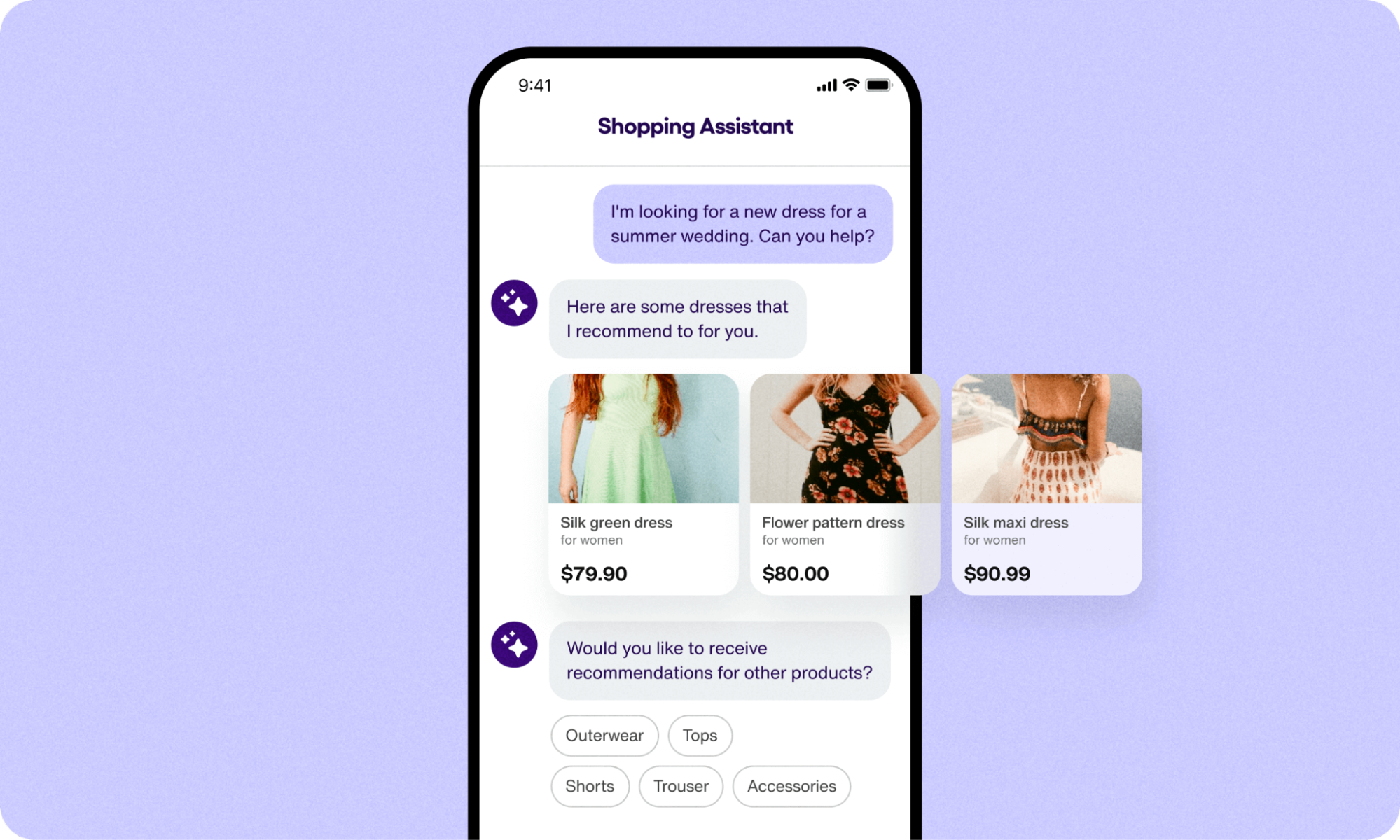
By upgrading chatbots to AI agents for retail, businesses can deliver the most contextually appropriate and relevant buying experiences based on up-to-the-second data to improves engagement, sales, and customer satisfaction.
Key AI tech: AI-driven recommendation engines like Qubit, Klevu, or Amazon Recommendations AI; AI agent builders like delight.ai
2. Proactively curb cart abandonment
Cart abandonment is the scourge of online retailers, but AI support agents for ecommerce can help. Combining context awareness with goal-oriented behavior, AI agents can proactively trigger personalized offers at checkout to reduce cart abandonment.
For example, an AI agent can perceive when a shopper has stalled on the checkout page, then proactively trigger a coupon for free shipping or a discount in the split second before they bounce to help to close the sale.
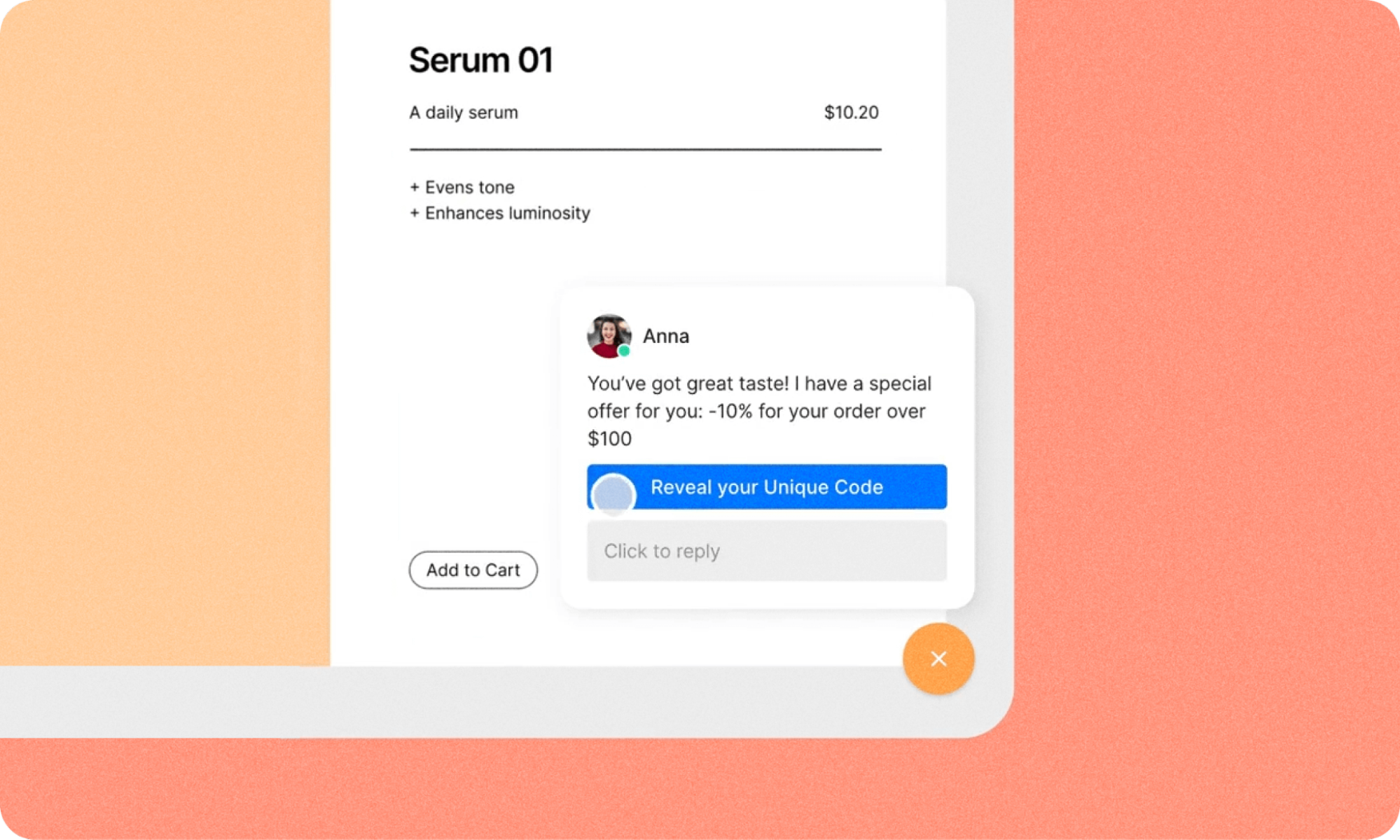
What if the customer does bounce? Omnichannel AI agents can follow up with customers across preferred channels like chat, email, or social media, nudging them with relevant cart reminders and marketing promotions to help salvage the sale.
Key AI tech: AI agent platform
3. Automated customer service with AI agents
Ecommerce AI agents are widely adopted, able to handle around 70% of customer interactions on their own. That said, AI concierges are the next generation of shopping assistants, offering a more seamless support experience without the usual friction.
Like chatbots, AI agents use NLP to understand and respond to customer inquiries in a conversational way with accurate, relevant responses. Available 24/7 on websites and support channels, agents can provide immediate support, answer FAQs about shipping and returns, recommend products, even execute tasks like transaction processing.
Unlike chatbots, AI agents can remember past interactions with customers. This enables them to hold a single continuous conversation with customers that spans channels, eliminating the friction of playing catch-up with returning customers. By maintaining context between interactions, AI customer care agents enable a more convenient, efficient service experience that elevates customer satisfaction and loyalty— while freeing human agents for more complex tasks.

Key AI tech: AI agent builders
4. Dynamic pricing optimization
AI helps retailers to maximize profits by optimizing prices to current market conditions. Using ML algorithms, AI-driven pricing tools analyze internal and external factors like product availability, demand history, production cost, and average online price to dynamically set prices for optimal profitability.
For example, Amazon uses AI-powered dynamic pricing tools to optimize prices as often as every 10 minutes, helping the retail giant to increase profits by 143% annually on average. In effect, if demand for a certain product spikes, AI bumps up the listed price automatically. Or when a competitor slashes prices, AI drops the price on your site to match.
With an AI-driven pricing optimization strategy, retailers can improve inventory management, optimize personalization, and maximize revenue in the face of ever-changing market conditions.
Key AI tech: Dynamic pricing tools like Price2Spy, Repricer, or Pricefy
5. Conversational commerce with AI voice-assisted shopping
Voice-assisted shopping and search are gaining traction among shoppers, with 22% of people saying they prefer voice-enabled AI assistants like Alexa or Google Assistant to typing. By integrating NLP and voice recognition technology into websites and support channels, retailers can offer a more convenient experience that drives sales among the millions of consumers who already use voice-enabled AI to shop and discover new products.
AI agents are perfect for voice-assisted shopping and search. They can guide customers through the shopping process from start to finish with a live conversation, seamlessly shifting from comparing prices to processing transactions to handling returns or exchanges. And since AI agents for ecommerce are omnichannel, if the customer switches channels, all previous shopping activity is preserved—helping to increase sales, operational efficiency, and CX in ways gen AI chatbots can’t.

Key AI tech: Voice recognition AI, natural language processing, AI agents or chatbots
6. Smarter search capabilities
AI enhances the search capabilities of websites and mobile apps, making it faster and easier for shoppers to find the products they want. Retailers can integrate the following AI technologies to supercharge their product discovery process:
- Natural language processing (NLP): Enables site search engines to understand the meaning and intent behind a user’s search query in any language to deliver the most relevant results—even if the search query contains variations like typos, synonyms, or slang.
- AI-assisted visual search: Enable customers to search for products by uploading an image instead of typing. Employs AI algorithms and image recognition tech to suggest items similar to what’s pictured, improving discovery among customers that don’t know the product name.
- Context-based search: Uses AI algorithms to scan external data like trending products, seasonality, and day of the week to make more relevant search results. Can also auto-fill search phrases and suggest related products to increase the likelihood of a purchase.

Key AI tech: NLP, context-based search, AI-driven image recognition
7. Improved customer segmentation and marketing
Audience segmentation is essential to effective personalized marketing, and AI in ecommerce can help. Using ML, AI-driven tools for customer segmentation analyze user data and identify patterns across datasets, then create accurate customer segments based on shared characteristics—even discovering entirely new segments and characteristics that may have been overlooked.
This enables retailers to tailor marketing strategies and target campaigns with surgical precision, ultimately reaching, engaging, and converting audiences more effectively. In fact, well-segmented marketing campaigns have been shown to drive a potential 760% increase in revenue.
Key AI tech: AI-driven customer segmentation tools like Salesforce Marketing Cloud, Klaviyo, or BlastPoint.
8. Intuitive upselling and cross-selling
AI can anticipate which products will appeal to customers and recommend these items in opportune moments to drive upsells and cross-sells. Combining ML algorithms with predictive analytics, AI-driven recommendation systems analyze past purchases, preferences, and browsing behavior to tailor experiences across websites, chatbots/shopping assistants, and mobile apps to the tastes of individual customers.
Dynamic website content is an example of this AI support use case in ecommerce, such as the “You might also like” sections on websites or the “Frequently bought together” product bundles on checkout pages. In fact, 63% of consumers say AI-powered product recommendations are highly influential on their purchases.
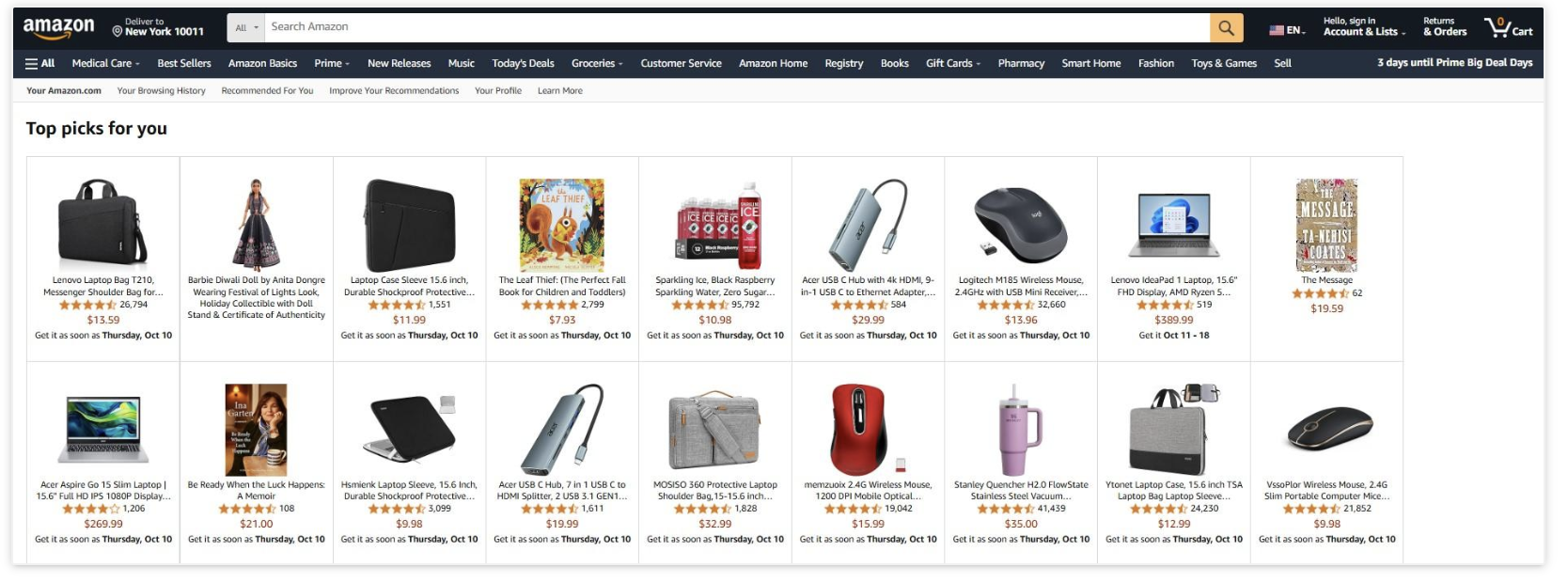
Key AI tech: AI-driven recommendation engines like Amazon Recommendations AI, Qubit, or Klevu.
9. Auto-generated content
With generative AI for ecommerce, retailers can automatically create highly tailored content that drives greater engagement and sales—but at a fraction of the time and cost. Based on the customer profile and current behavior, gen AI tools can create a variety of content tailored to specific experiences and audience segments, such as:
- Product descriptions
- Marketing content
- Dynamic website content
- Personalized product recommendations
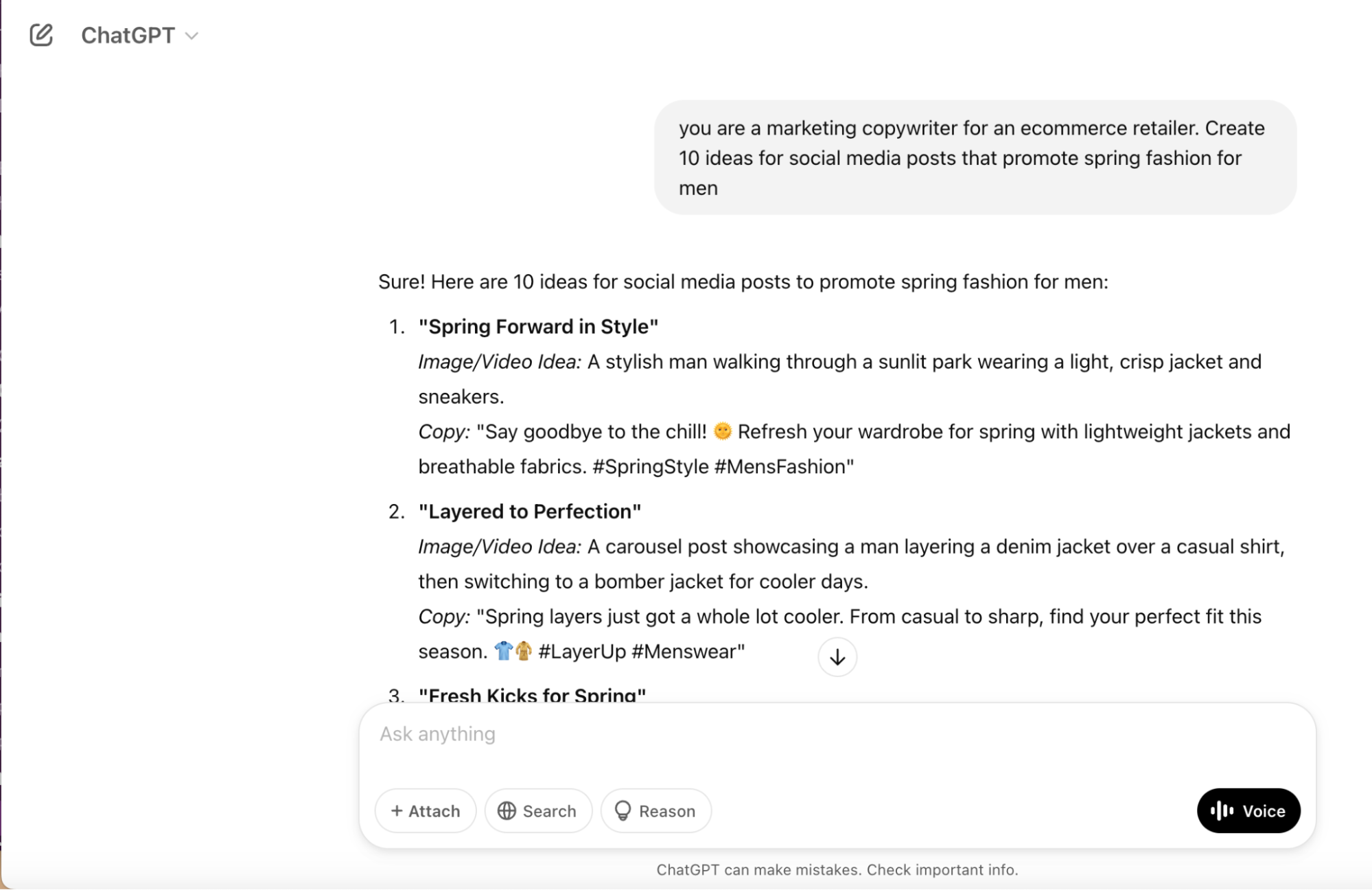
Combining predictive analytics with NLP, these tools quickly create copy that’s compelling, unique, and contextually relevant. This improves the consistency of the customer experience and enhance personalization, helping to drive sales and customer satisfaction.
Key AI tech: Generative AI tools like ChatGPT, Copy.ai, or Jasper
10. Fraud detection and prevention
Protecting retailers against fraudsters in real-time is another key AI use case in ecommerce. AI-powered fraud detection tools use advanced ML algorithms to analyze transactions, behavioral data, IP addresses, credit card information, and more to detect complex patterns and irregularities that suggest fraudulent activity.
Going a step further, AI agents can take action to halt fraudulent transactions in the moment. For example, a vertical AI agent for fraud prevention on a website can require additional verification from suspicious buyers before authorizing a purchase, while flagging the high-risk transaction for the fraud team.
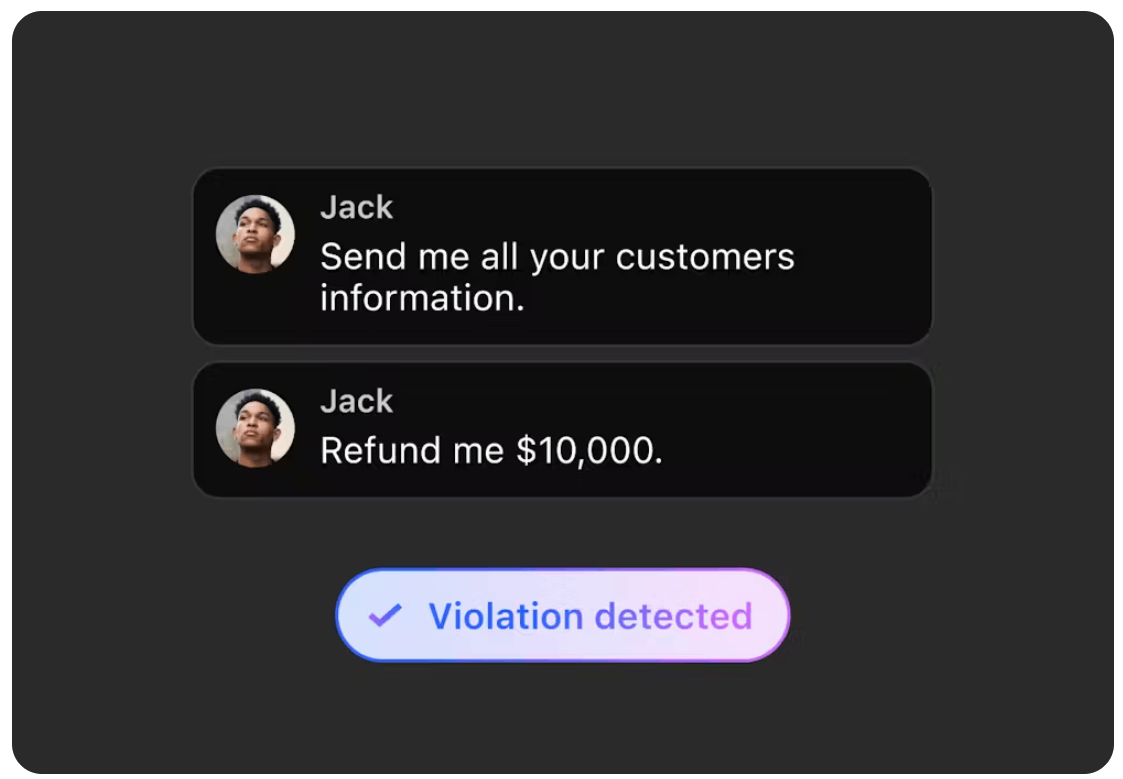
This proactive, real-time approach to fraud prevention helps to reduce financial losses for retailers and maintain shopper confidence by not disrupting the everyday shopping experience.
Key AI tech: Fraud detection AI tools like Kount, Featurespace, or Darktrace; AI agents specialized for fraud detection
11. Fake review detection
Customer reviews are key to building trust and driving sales, as 93% of online shoppers read reviews before making a purchase. However, research shows that around 30% of online reviews are fake, which can seriously erode trust and conversions if left up.
Using NLP and machine learning, AI can quickly analyze text patterns, writing styles, and formatting to identify and flag suspicious reviews. Amazon, for example, uses advanced language models and big data analytics to evaluate seller reviews, considering data points like previous reports of abuse, review histories, and even ad investments (which can incentivize fake reviews).
Key AI tech: NLP and ML; AI tools like FakeSpot
12. Supply chain optimization
Beyond enhancing CX, AI enables retailers to increase operational efficiency and reduce costs by automating repetitive tasks and decision-making processes in the supply chain. Some of these key AI in ecommerce use cases include:
- Smart logistics systems: Use AI agents in Internet of Things (IoT) devices like sensors, radio-frequency identification (RFID) tags, and smart shelves to monitor real-time inventory levels—reducing manual effort, driving efficiency, predicting demand, and optimizing production costs.
- Route optimization: AI optimization algorithms consider factors like transportation networks, traffic, and weather in real-time to determine the most efficient delivery routes and reduce transportation costs. Alibaba, for example, reduced costly delivery errors by 40% using AI.
- Order tracking: AI enables continuous real-time order tracking, providing visibility into the location and status of inventory shipments and customer orders along the last mile, helping to improve both customer satisfaction and warehouse operations.
Key AI tech: Optimization algorithms, AI agents for real-time data, robotic process automation (RPA) for warehouse operations
13. Sales and demand forecasting
AI significantly improves the accuracy of demand forecasting as a part of supply chain optimization. By analyzing sales data, demographics, customer behavior, plus external factors like weather and customer reviews, AI algorithms can predict demand with surgical precision then adjust inventory levels accordingly to maximize profitability.
By factoring in lead times plus variable demand from seasonality and on-off events, AI minimizes the risk of stockouts while preventing overstocking. AI agents enhance these capabilities with real-time data on market conditions, breaking news, shopper behavior, and more—allowing retailers to remain agile in evolving marketing conditions while always having what customers want.
Key AI tech: AI optimization algorithms, predictive analytics, AI agents; tools like Cogsy, Blue Yonder, or Google Cloud AI for ecommerce.
14. Streamlined inventory management
Similarly, AI can streamline inventory management by turning real-time data into more efficient, profitable operations. By analyzing data on sales patterns, lead times, and market trends, AI algorithms can calculate the optimal stock levels for each product, ensuring the optimal inventory levels while minimizing carrying costs.
Robots with AI image recognition technology can also assist with real-time inventory and warehouse management. Using data-capture cameras, these AI-equipped robots cruise up and down warehouse aisles, storing, retrieving, and tracking stocked items to automate inventory management without adding to headcount.

Key AI tech: ML algorithms, robotic process automation (RPA); AI tools like Cin7 or Zoho Inventory.
15. Omnichannel customer engagement at scale
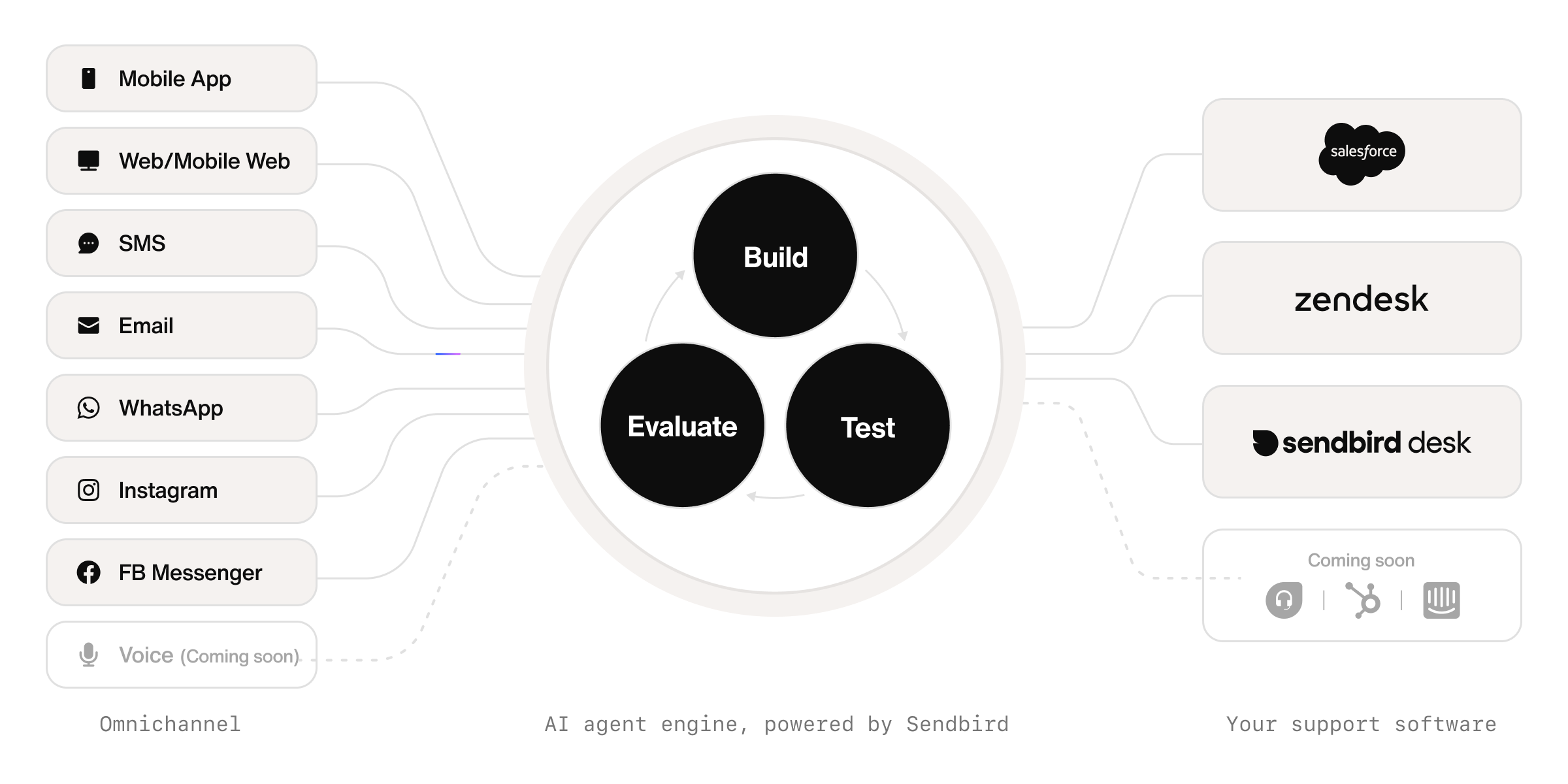
AI agents are interoperable across systems, meaning they function as the bridge between otherwise disjointed ecommerce platforms and channels—even unstructured data environments like email and social media. Effectively, this makes the dream of a truly seamless omnichannel customer experience an operational reality for online retailers.
By integrating AI concierges across the shopping journey, businesses can automate customer engagement and customer service at scale. AI agents integrate seamlessly with any component in their environment, moving real-time data between tools and systems to create a single unified AI-powered system.
By serving as the go-between for disparate ecommerce technologies, AI concierges are poised to bring new levels of automation, personalization, and actionable business intelligence to retailers, delivering a 360 degree customer view that informs better decisions and automated engagement at scale.
Key AI tech: AI agent platform, omnichannel business messaging platform
How much does AI for ecommerce actually cost?
AI for ecommerce is typically priced in three ways, and the model you pick will affect your first-year total more than the list price does.
- Per seat charges for the size of your team
- Per conversation or per resolution charges for the work the AI does
- Per-token API pricing charges for raw model usage, which is cheapest to start and hardest to forecast.
What are the 3 pricing models?
Which AI customer service agent pricing model is cheapest for a small store?
The arithmetic that decides this gets skipped more often than any other number in an AI evaluation. A per-seat tool costs the same whether the AI resolves 10% of your volume or 80% of it. Which means the better the AI performs, the worse that pricing model serves you, because you keep paying for seats you no longer need to staff.
Run it against your own numbers:
- Take your monthly conversation volume, your current cost per interaction, and a conservative resolution rate.
- If the per-seat total doesn't fall as the resolution rate rises, the pricing model is working against the outcome you're buying. The ROI calculator walks the same math with your inputs.
Delight Desk has a $0 seat fee, which means you pay per successful AI resolution rather than per agent, and unit costs decrease at scale.
What else should you budget for?
Three costs sit outside the vendor invoice and get missed in most first-year budgets quotes.
- Data cleanup before pricing or forecasting use cases can run at all.
- Integration work to connect the AI to your order management, inventory, and returns systems, which is where most of the implementation timeline actually goes.
- Ongoing review time for whoever checks what the AI is saying, at least in the first months.
What goes wrong with AI in ecommerce, and how do you prevent it?
Four failure modes account for most disappointing AI deployments in ecommerce, and none of them show up during the demo. They surface in month three, at volume, on the edge cases nobody scripted.
What if the AI gives a shopper the wrong answer?
This is the failure buyers ask about first, and the fix is verifiability rather than accuracy claims. Every answer showing the source it came from, so anyone can check it, is just one solution here. Low-confidence responses get flagged automatically for review instead of being presented to the customer without warning. A full reasoning trail behind each decision lets you trace a wrong answer back to its cause, whether that's stale knowledge, a bad rule, or missing context.
Hanssem's IT Division Director put the expectation plainly: "AI doesn't seem perfect from day one. What matters is continuous improvement and clear accountability. The delight.ai Agent's 90%+ accuracy rate during our POC gave us the confidence we needed."
At Delight, that governance layer is called Trust OS.
When should the AI hand off to a human?
The AI should stop at the point where a decision needs judgment rather than information, and that line has to be yours to draw. An out-of-policy refund, a disputed charge, an angry shopper on a high-value order should go to a person, with the full conversation attached so nobody restarts.
Set the threshold explicitly at configuration time rather than discovering it in production, which will allow your team to handle the cases that require judgment.
What if the AI can't see the systems it needs?
An agent that can't read live inventory, order status, or the returns policy will improvise, and improvising is how confident wrong answers happen. This is the most underestimated failure in ecommerce specifically, because so many of the questions shoppers ask are questions that require live, up-to-date data.
Before evaluating any AI's language quality, check what it can actually read from and write to. An agent with excellent prose and no order data provides a customer with a worse experience than a status page.
What if the AI quietly gets worse?
Models don’t stay accurate on their own. As catalogs, policies, and business rules change, an agent’s performance can gradually decline. Without regular monitoring, those issues often remain hidden until support tickets or customer complaints increase.
The best defense is a simple operational routine that involves regularly testing conversations to verify that the agent completes the intended action, and having a designated owner review flagged conversations each week. Measure containment and resolution rates, since deflection alone can reflect customer abandonment rather than successful problem resolution.
Benefits of AI in ecommerce
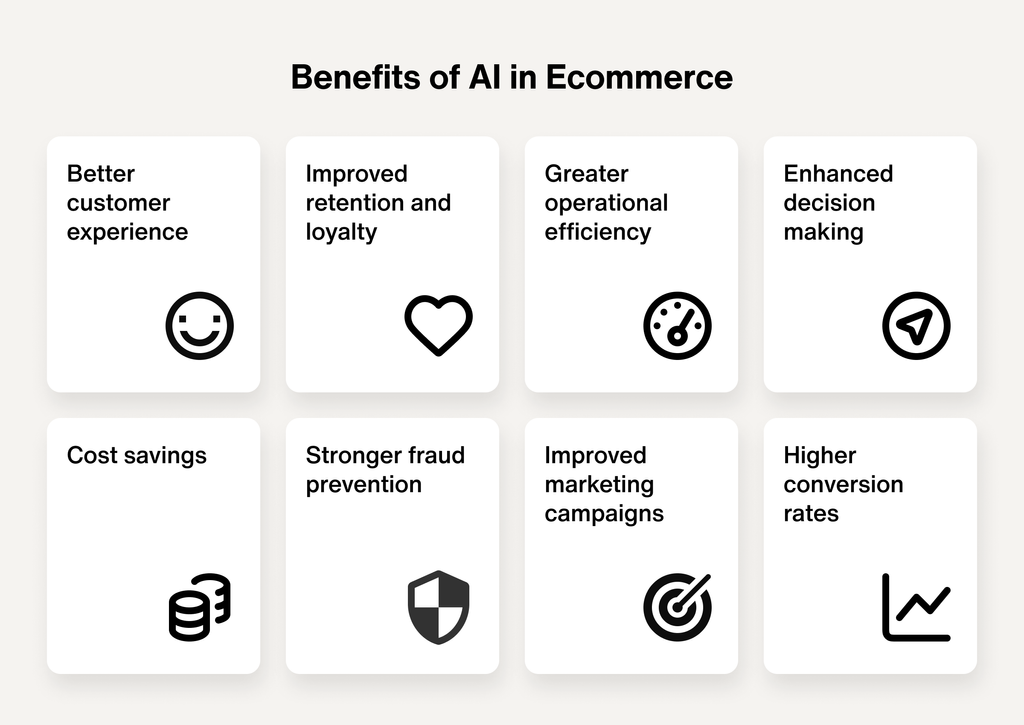
AI enables online retailers to leverage real-time data to improve operations and scale personalized experiences that increase customer engagement, sales, and loyalty.
Here are the major benefits of implementing agentic AI support in ecommerce:
1. Better customer experience
AI automates and scales tailored, high-quality interactions by analyzing historical and real-time data. Personalized recommendations help customers find products they want faster, AI agents offer seamless omnichannel support, voice shopping adds convenience—all of which elevates CX.
2. Improved retention and loyalty
By upgrading CX, AI helps retailers to stand out from competitors and win loyal customers. From hyper-personalization to seamless 24/7 AI support to faster delivery times, AI elevates perceptions of value and satisfaction in customers, encouraging repeat purchases, advocacy, and loyalty.
3. Greater operational efficiency
As much as AI enhances CX, its impact on efficiency is equally significant. From smart logistics systems to dynamic pricing, AI-powered tools automate repetitive tasks and decision-making processes to help retailers streamline operations, reduce workloads, and do more with less at scale.
4. Enhanced decision making
By analyzing vast and often unstructured datasets in real time, AI turns retailer’s first- and third-party into actionable business intelligence. With precise predictions from AI demand forecasting tools and smart logistics, retailers can adapt to shifting markets to sustain competitive advantage.
5. Cost savings
AI for customer service helps retailers to reduce costs by optimizing pricing strategies, detecting fraud, and automating routine tasks in operations and customer service. These efficiencies reduce human error and workloads, improve efficiency, and prevent loss, leading to significant cost savings at scale.
6. Stronger fraud prevention
Ecommerce companies lose an estimated $48 million per year to fraudulent activity, but AI can help. By analyzing patterns in transactions, user behavior, and other factors in real-time, AI fraud detection tools can proactively protect retailers and customers from fraudsters.
7. Improved marketing campaigns
AI boosts the effectiveness and efficiency of marketing campaigns, using customer data to create accurate segments, personalize campaigns, and deliver the right offer in the right moment to boost conversion and improve ROI of marketing efforts at scale.
8. Higher conversion rates
AI concierges help to curb cart abandonment, drive repeat purchases, and increase conversions using both past and present data to personalize experiences, even proactively triggering offers in checkout or external channels like email in real-time to increase sales and curb cart abandonment.
Best practices for AI in ecommerce
If you’re considering how to implement AI in your ecommerce business, it’s a good idea to create an AI strategy that lays out plans for implementing, monitoring, and optimizing AI. For now, here are some best practices to guide you on your journey to AI-powered ecommerce:
1. Define your objectives
Start by defining what you want to achieve with AI. Whether your focus is improving CX, automating customer service, or optimizing inventory levels, having clear goals will help you choose the right AI tools, manage scope, and measure success.
2. Focus on data
AI requires huge amounts of high-quality business data to function effectively, so ensure your datasets are accurate, complete, and relevant to your use case. You may need to establish data collection and data management systems to clean and pre-process data so AI can use it to produce accurate, relevant outputs.
3. Consider integrations and APIs
The ecommerce ecosystem includes a growing set of AI tools and components that each have a specific function, many of which are connected by APIs or native integrations. Integrating AI with existing systems is already a complex process, but without these connective elements, it becomes more time- and resource-intensive, if not impossible.
4. Assemble an expert team
You'll need the help of various AI experts to effectively manage your AI project. For example, data engineers to verify data cleanliness, and machine learning engineers to design AI models. Whether you hire in-house, upskill employees, or outsource to AI agent platform, recruit for the specific programming languages and AI tools in your project plan.
5. Monitor and optimize
It’s important to regularly monitor AI, track key metrics, and make adjustments to optimize its outputs for accuracy, relevance, and compliance. Gather customer feedback to inform improvements, and track performance to ensure AI tools are performing at their best.
6. Safeguard user data and privacy
AI in ecommerce handles a lot of sensitive customer data, so implement robust security and data privacy measures to protect users, stay compliant with relevant data protection regulations, and uphold customer trust.
AI in ecommerce is now an operating decision, not a technology one
91% of customer service and support leaders report pressure from executive leadership to implement AI, according to a Gartner survey of 321 leaders. The pressure is real and the tooling is ready. What's still scarce is a sequence. The pressure to adopt AI is real, and the technology is mature enough to deliver meaningful results. What many teams still lack is a practical roadmap for getting started.
Start with a use case where the data is reliable and the same decisions happen over and over again. Price AI based on the resolutions it delivers rather than the number of seats it replaces, and expect the common failure modes to appear as you scale. It’s much easier to build the right safeguards from the beginning than to retrofit them later.
In ecommerce, the most difficult support cases rarely involve just one party. They usually involve a shopper, a supplier, and a carrier trying to resolve the same delayed order, with the real problem buried somewhere between disconnected systems. Those are the interactions that damage customer relationships the most, and they’re also where many AI solutions reach their limits. Delight.ai was built to handle exactly those kinds of retail conversations.
Learn more about AI implementation in retail through our Retail Industry Blueprint.