

Key takeaways
- An AI customer service agent resolves requests end to end. It understands the request, pulls context from your systems, takes the action, and hands off to a person with the full history when it can't finish.
- Customers sort requests by stakes, not by channel. In retail, 49% prefer AI for checking order status, while 54% want a human to dispute a price (2026 Delight AI Index).
- Norse Atlantic Airways grew containment from 60% to 80% in two weeks after replacing a legacy chatbot with an AI agent.
Today's customers expect fast, accurate support at any hour, whether they're tracking an order or troubleshooting a complex issue. To keep up, more support teams are turning to AI customer service agents, and 91% of customer service leaders say executive leadership is pressing them to implement AI in 2026, according to Gartner.
Earlier AI tools mostly generated replies to common questions. Agentic AI goes further, because it can reason through a request and act across systems and channels until the issue is resolved. It's the idea behind Delight.ai's AI CX agent, one customer agent that handles both support and sales conversations.
What is an AI customer service agent?
An AI customer service agent is software that understands a customer's request in plain language, pulls the context it needs from your business systems, and takes action to resolve the request end to end. When a case needs judgment or falls outside its permissions, it hands the conversation to a person with the full history attached.
Large language models (LLMs) and natural language processing (NLP) let the agent read intent and tone, so "I was charged twice" and "my bill is wrong" land as the same problem. It works from your own knowledge base, policies, and past resolutions, which keeps answers specific to your business instead of the open web.
Teams also call this an AI customer support agent, and it's the core of most AI customer service software, which connects the agent to your channels, help desk, and human team. Unlike earlier generative AI tools that only answer when prompted, an AI agent can work across channels and systems, use real-time data, and finish multi-step tasks with little or no human help.
The benefits of using AI customer service agents include:
- Lower cost per resolution, because routine requests like order tracking no longer wait in a human queue.
- Faster, more personal service at scale, since the agent answers instantly with the customer's account and order history in view.
- Room to absorb volume spikes, so a holiday rush or a service outage doesn't turn into a multi-day backlog.
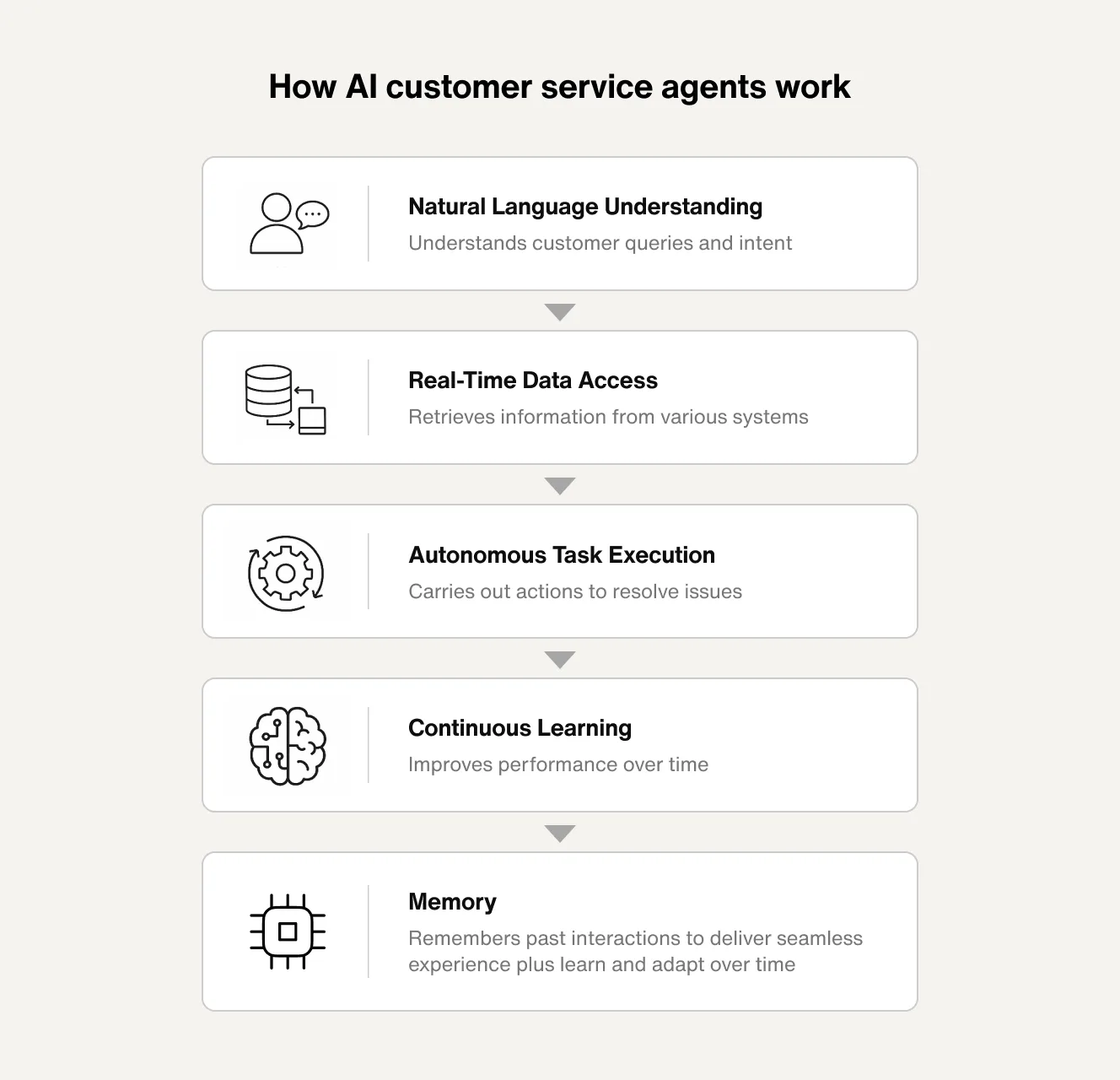
How does an AI customer service agent work?
The process runs in four steps. The agent understands the request, pulls context from your systems, takes the approved action, and then either confirms the resolution or hands the case to a person. Take a shopper who writes, "My table arrived with a cracked leg. Can I get a replacement?"
1. It understands the request
The agent reads the message for intent and tone. It recognizes a damaged-item replacement request, not a general return question, and notes that the customer is frustrated but calm.
2. It pulls context from your systems
Next, the agent looks up the order, the delivery date, and your damaged-goods policy. With a memory layer like Delight.ai's Agent Memory Platform (AMP), it also sees that the same shopper asked about delivery timing in chat last week, so the customer never has to repeat the order number.
3. It takes the action
The agent then follows a set of approved steps for damaged items. It confirms the order qualifies, asks for a photo, and creates the replacement order through your order system. A person on your team reviews those steps before the agent is allowed to use them.
4. It resolves the request or hands it off
If everything checks out, the agent confirms the replacement and the new delivery date in the same conversation. If the item is high-value or the shopper asks for a person, it hands off to a human agent with a summary of what it already checked, so the rep picks up where the agent left off instead of starting over.
How is an AI customer service agent different from a chatbot or agent assist?
A chatbot follows a script, an AI customer service agent resolves the request on its own, and agent assist (often called a copilot) helps a human rep resolve it faster. The table compares the three on what each one does when a customer reaches out.
The two work well together. The agent resolves routine requests, while agent assist speeds up the cases that should stay with a person.
How do Delight.ai customers use AI customer service agents?
Across Delight.ai deployments in software, marketplaces, retail, and travel, two patterns repeat. The agent checks who the customer is and what they already have before it replies, and when a person needs to step in, the conversation's context moves with it. The four examples below show what that looks like for different kinds of businesses.
An AI customer service agent handles a routine question in the video above.
Checking the account before answering (Mixpanel, B2B SaaS)
In product analytics, a short question like "How do I delete user data?" has a different right answer for every account. It depends on the customer's plan, their permissions, and how they've set up the product, and confirming all of that used to take a Mixpanel rep about 10 minutes before the real work began.
Mixpanel's AI agent now confirms who the user is and looks up their plan, role, and configuration first, so the reply fits that account. A user on a free plan who asks about an advanced feature hears what it would solve for them and which upgrade includes it. A customer whose plan includes Session Replay but who never turned it on gets setup help in the same conversation. For a software company, that turns routine support into product adoption and upgrade conversations instead of a cost center.
"We're not just answering faster. We're answering smarter," says Kathleen Matthews of Mixpanel's Global Support team. Read how Mixpanel did it.
Opening a case without making the customer repeat anything (hipages, marketplace)
hipages connects more than 33,000 tradies, Australia's term for tradespeople, with homeowners who need work done. When a tradie has a question about a lead, a charge, or a quiet homeowner, every minute spent waiting on support is a minute they aren't winning jobs.
Tradies reach the AI agent inside the same hipages app where they already message homeowners, and it answers everyday questions on the spot. If a tradie wants their account manager or the support team, the agent opens the case in Salesforce and routes it to the right person with the whole conversation attached. The tradie never leaves the app or explains the problem twice, and the support team skips the busywork of logging callback requests by hand.
"Our agents never ask for context anymore—because they already have it. That alone changed our entire support operation," says hipages CTO Jeremy Burton. Read the hipages story.
Handling shopping and service in one conversation (BJ's Wholesale Club, retail)
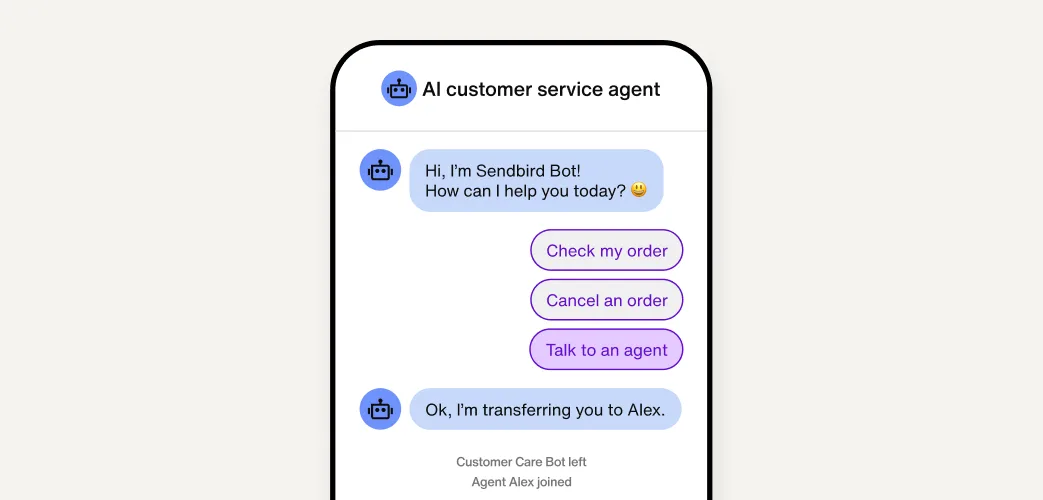
Most retailers split AI into separate bots for shopping, order support, and membership questions. Members don't think that way, and a well-handled service moment is often what convinces someone their membership is worth renewing.
BJ's Wholesale Club runs one AI agent, Bev, across BJs.com and the BJ's app. The same conversation can move from finding the right product and applying a coupon to checking a late order, starting a return, or sorting out a renewal question, and Bev hands off to a live agent with the context intact when a member needs a person. In BJ's early results, members who used Bev were more likely to buy than those who didn't.
"Whether a member is browsing for a grill, looking up club hours, or asking about a renewal, they're talking to the same Bev. That's how a real member-team member relationship is supposed to feel," says Scott Vandegrift, VP of Product at BJ's. See how BJ's built Bev.
In the clip above, an AI agent pulls order status from connected systems to answer a shopper right away.
Turning a service question into a sale (Norse Atlantic Airways, travel)
Airline support usually gets measured as a cost, but plenty of service questions are buying moments in disguise. A passenger asking about legroom may be ready to pay for a better seat, and a question about baggage limits can end with an added bag.
Norse Atlantic Airways replaced its legacy chatbot with an AI agent named Freya in under two months, and Freya now handles both kinds of moments in the same conversation. After launch, Delight.ai's Forward Deployment Team worked through Freya's conversation logs and reworked the step-by-step instructions Freya follows, called Actionbooks, which lifted containment from 60% to 80% in two weeks. Norse also created a new role on its support team, an AI agent manager who audits conversations and keeps tuning Freya.
"We are moving past the idea of 'support bots.' The future is one unified agent for sales and support—a single digital concierge that knows you, helps you, and travels with you," says Alf Lim, Chief Product Officer at Norse. Read the Norse Atlantic story.
In all four deployments, the value came from what the agent knew before it replied and what it passed along when a person took over. That's the part worth testing when you compare vendors.
Why do support teams use AI agents for customer service?
Beyond any single deployment, an AI agent changes how the whole support operation runs:
- Faster resolutions on routine work, like Lyft's customer care AI assistant built on Anthropic's Claude, which cut average customer service resolution time by 87%.
- Help before customers ask, such as a message offering password recovery after repeated failed logins.
- One record across every channel, so a customer who starts in chat and follows up by email never starts over.
- Faster answers on the cases reps keep, because agent assist drafts replies, summarizes history, and coaches new hires during live conversations.
- A help center that improves itself, as repeated unanswered questions get flagged with a draft article for review.
For the business, those changes mean support costs grow more slowly than conversation volume. Customers also get answers in the moments when they're deciding whether to buy again.
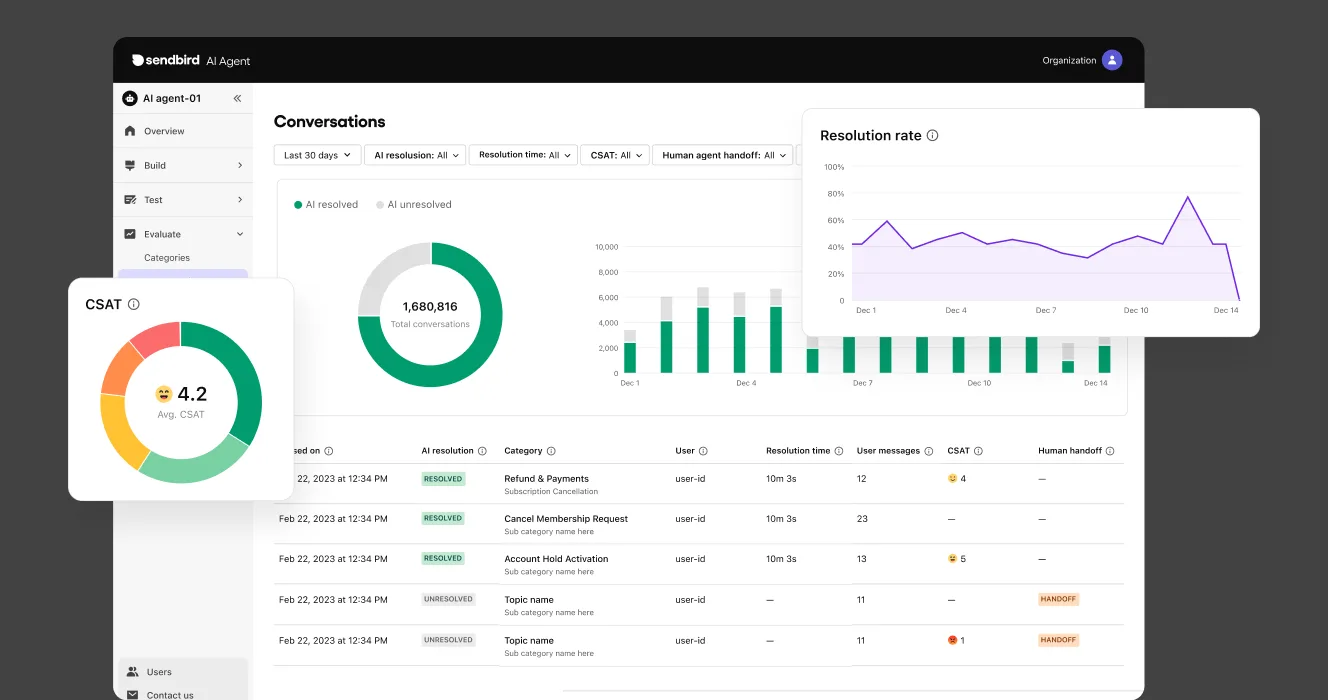
How do you build an AI agent for customer service?
Today's AI agents have moved past scripted chatbots. They can be customized to specific use cases, audiences, and workflows, and an effective one comes together in five steps.
1. Connect your knowledge base and customer data
AI agents need clean, complete information to give accurate help. That means your help center articles and policies, plus customer data like past interactions, preferences, and purchase history, all in one place the agent can read.
2. Turn resolved tickets into step-by-step instructions
Once your knowledge base is in place, the next step is turning past resolutions into instructions the agent can follow, so it can book, fix, order, update, and resolve requests. Your resolved-ticket history is the best starting point, because it already shows how your team handles each type of request.
On Delight.ai, these instructions are Actionbooks. Teams can draft them from their own ticket history, edit them without engineering help, and review every one before it goes live.
The video above shows how to use Delight.ai's AI agent builder to create workflow logic that automates multi-step AI workflows.
3. Add memory
Agentic AI uses memory to remember past conversations and outcomes. That lets the agent tailor future conversations, avoid asking the same questions twice, and improve over time.
4. Test in stages, then deploy with graduated autonomy
Before a new workflow goes live, it helps to test it against realistic conversations. The most useful tests check whether the agent understood the intent and completed the right action, rather than whether it matched exact wording, so small phrasing changes don't break them.
From there, changes can move through separate testing and production environments and roll out to a small share of customers first. Autonomy should grow the same way. An agent might start by handling order-status questions alone and take on refunds only after it proves accurate on the simpler work.
5. Keep optimizing
AI agents need ongoing monitoring and tuning to stay accurate. That means feedback loops from customers and reps, real-time monitoring, and updates as your policies change.
The strongest setups turn real production failures into proposed fixes automatically, with a person approving anything financial or compliance-related before it changes how the agent behaves.
Learn more: 8 steps to build an AI agent
What do customers want an AI agent to handle?
Customers decide by how much is at stake. In the 2026 Delight AI Index, a survey of 1,000 U.S. adults, people were glad to hand routine lookups to AI but wanted a person once money, a dispute, or a disrupted trip was involved.
The table shows how preference flips within the same industry as the stakes of a request go up.
For support teams, the lesson is that routine lookups suit an AI agent, while requests involving money, a dispute, or a disrupted trip need clear handoff rules and approval gates.
Control builds trust too. When the Index asked what would increase trust in AI customer service, respondents ranked these factors:
- Data privacy and security safeguards (84%)
- Human oversight (65%)
- The power to stop or override the AI at any time (59%)
- Approving AI actions before they happen (57%)
- Correcting mistakes and reversing decisions (47%)
Those controls are what Trust OS, Delight.ai's governance and observability layer, is built around. Three of its features map directly to the list above:
- Deactivate AI pauses every automated response instantly without deleting configuration, so a team can stop an agent without starting over.
- Version Control compares any two versions side by side and reverts to a previous working version in one step.
- Selective Deployment shows a visual diff of every change before it goes live, so teams choose exactly what gets promoted.
Accuracy still comes first. These controls are what make it safe to let an AI agent take actions like refunds.
How do you know if your company needs an AI customer service agent?
Your company is likely ready for an AI customer service agent when much of your volume is routine requests with documented answers, customers expect help outside business hours, and your systems can share order or account data through integrations. If most of your cases are complex disputes, start with agent assist instead.
Common signs a company is ready include:
- Reps answer the same handful of questions all day, like order status, password resets, and return policies.
- Volume spikes outrun hiring, so a seasonal rush means long waits until new reps are trained.
- Customers reach out after hours, in other time zones or on weekends when no one is staffed.
- Your answers already live somewhere, in a help center, macros, or resolved tickets the agent can learn from.
If your documentation is thin or out of date, fix that first, because an AI agent is only as accurate as what it's trained on. Gartner predicts that by 2029, agentic AI will autonomously resolve 80% of common customer service issues without human intervention, so the teams that get their knowledge in order now will be ready to use it.
Once the signs line up, the next step is choosing a vendor, and a demo rarely shows how an agent handles failure or handoff. Our guide on how to evaluate AI agents for customer service covers the checks to run before you sign. To see how a single agent can handle both support and sales, explore Delight.ai's customer agent.


