
You already know you need an AI receptionist. The question is what that actually means for a home service business, because the answer is very different from what it means for a law firm, a dental office, or a hair salon.
For most businesses, an AI front desk is a scheduling tool. It answers the phone, books the appointment, sends a confirmation, and the job is done. For HVAC companies, plumbers, electricians, pest control operators, and home warranty providers, the first call is maybe 20 percent of the work. The other 80 percent — coordinating a technician, managing a parts delay, following up on a warranty claim, keeping the customer informed across multiple days — happens entirely after the phone is answered, and most AI receptionists aren't built for any of it.
This distinction matters more than it used to because the AI receptionist market is growing fast, and most of what's being sold targets the simpler use case. If you buy a generic AI answering service for your HVAC or home warranty operation, you'll answer more calls and still lose jobs. The problem was never the unanswered call. It was everything that followed.
This guide covers what home service businesses actually need from an AI receptionist: where the standard tools fall short, what the full capability set looks like, how to evaluate vendors honestly, and what the right solution handles from the first ring to the five-star review.
Why the trades are the hardest use case for AI receptionists
Home services sits at an awkward intersection for AI. The call volume is high enough to justify automation, but the job complexity is high enough that simple automation creates new problems. Three things make this category harder than most.
Every job requires a technician, not just an answer
When a customer calls a hotel to change a reservation, the AI can resolve the whole interaction in one session. When a customer calls an HVAC company about a broken system in 95-degree heat, the resolution requires scheduling a real person, routing them to the right address, confirming their availability against your board, and managing the customer's expectations around a time window.
The AI receptionist isn't just taking a message. It's triggering a dispatch workflow that involves your field service platform, your tech roster, and your scheduling logic. That's a fundamentally different integration challenge.
Parts and coordination happen after the call ends
In a large portion of home service jobs, the first visit doesn't close the job. The technician diagnoses the issue and leaves. A part gets ordered. A second visit is required. The warranty adjuster needs to approve the repair. Each of these creates a new communication need that most AI receptionists have no ability to handle, because they're built for inbound calls, not ongoing job management. The result: your CSR team manually chases every open job to keep customers informed, and customers who don't hear anything call back or leave.
Warranty operations add a third party to every interaction
For home warranty operators, the coordination surface is even wider. A single claim involves the homeowner, a dispatched contractor, a parts supplier, and the warranty administrator. Each party needs status updates on a different timeline and through different channels. The homeowner wants a text. The contractor needs a job update in the field service platform. The adjuster needs an approval request. None of this is a phone call, and none of it happens automatically without an AI agent that can track multi-party state across multiple days.

The economics are clear. Every missed call is a job that goes to a competitor. Every unanswered status question is a customer who calls back and consumes CSR time that could have been avoided with a proactive text. And every closed job that doesn't generate a review or a re-engagement is LTV left on the table.
See how HVAC and warranty operators automate the full job lifecycle with delight.ai →
What home service customers actually expect from AI
The bar for AI in home services isn't set by what's technically possible. It's set by what customers have already experienced from the best operators in the space. Once someone has received a proactive text telling them their technician is 20 minutes away, or a same-day message explaining a parts delay and offering a new window, they expect that from everyone. The companies that can't match it lose repeat business.
Across home services customers, the expectations break down like this:
- 24/7 availability is a baseline, not a differentiator. Customers assume they can book after hours. If they can't, they move on. The HVAC call that comes in at 9pm on a Friday is often worth more than the one that comes in Monday morning, because the customer has fewer options.
- Speed matters more than perfection at booking. A confirmed window sent within two minutes of a call beats a "we'll call you back" every time, even if the window is next-day. Customers want certainty.
- Proactive communication on delays is expected, not appreciated. Customers don't give you credit for telling them something changed. They penalize you for not telling them. A missed delay notification creates a callback and a CSAT hit; a proactive one prevents both.
- Follow-up after the job influences the review, not just the service. The review prompt sent four hours after job completion gets five times the response rate of one sent the next day. The AI that closes the loop also closes the review cycle.
- Channel preference varies by customer, not by company. Some customers want a call back. Most prefer a text. A few want email. The AI receptionist that can only do one of these is leaving communication on the table.
The AI that wins in home services is the one that can hold a job from the first call to the five-star review, without a human touching every step in between.
The five jobs your AI receptionist needs to own in home services
When evaluating AI for an HVAC company, a plumbing operation, or a home warranty provider, the question isn't whether the AI can answer the phone. Every AI receptionist can answer the phone. The question is what happens next. Here are the five capabilities that separate a phone bot from a genuine AI front desk for the trades.
1. Inbound call and multi-channel booking
The base requirement is real-time booking across every channel a customer might use: phone, SMS, and web. For home services, this means the AI needs to handle common inbound intents without a script: new service requests (urgent and non-urgent), reschedule requests, emergency dispatches, status check-ins, billing questions, and warranty inquiries.
It also needs to handle the way real customers actually speak, not just structured menu inputs. A customer who says "my AC is making a grinding sound and it's really hot in here" is communicating urgency and a symptom, not a service code.
The bar for voice quality in home services is high because the call volume is high and the stakes per call are high. The AI needs to handle accents, background noise, emotional customers, and interruptions without breaking down. If customers get frustrated during the booking call and hang up, you've spent money on a problem.
2. Tech scheduling and real-time dispatch confirmation
Booking a time window is not the same as confirming dispatch. An AI receptionist for home services needs to see technician availability in real time from your field service platform, assign the right tech based on skill set and service zone, and confirm the dispatch back to the customer with the tech's name and an accurate arrival window.
This requires a live integration with your field service software. ServiceTitan, Jobber, Housecall Pro, and FieldEdge all have API access, but the quality of the integration varies enormously between vendors. An AI that "integrates with ServiceTitan" via a nightly export is not the same as one that reads live board availability and writes confirmed appointments in real time.
3. Mid-job status management and proactive communication
Once a job is in progress, communication tends to break down. The technician is running behind because the previous job took longer. The part needed for the repair isn't on the truck. The customer has a two-hour window and they're watching the clock. Each of these is an inbound call that your CSR team handles manually, or that falls through and becomes a bad review.
The right AI agent monitors job status from the field service platform and proactively messages the customer when something changes. Not when asked: proactively, before the customer calls. The message that says "your technician is running 30 minutes behind and will now arrive between 2:00 and 4:00pm" prevents a callback and a frustrated customer. That same AI should handle the incoming "where is my technician?" question without routing to a human.
4. Parts delay and multi-visit coordination
Multi-visit jobs are the norm in HVAC, plumbing, and appliance repair. The technician diagnoses the issue, a part gets ordered, a second visit is scheduled. Each transition creates a communication requirement: the customer needs to know why the first visit didn't resolve the issue, when the part arrives, when the second visit is scheduled, and who to call if something changes.
This is where most AI receptionists disappear entirely. The call was answered. The booking was made. The job is now in the system. What happens between visit one and visit two is entirely manual, and in a high-volume operation, that gap generates a constant stream of status calls, rescheduling requests, and cancellations.
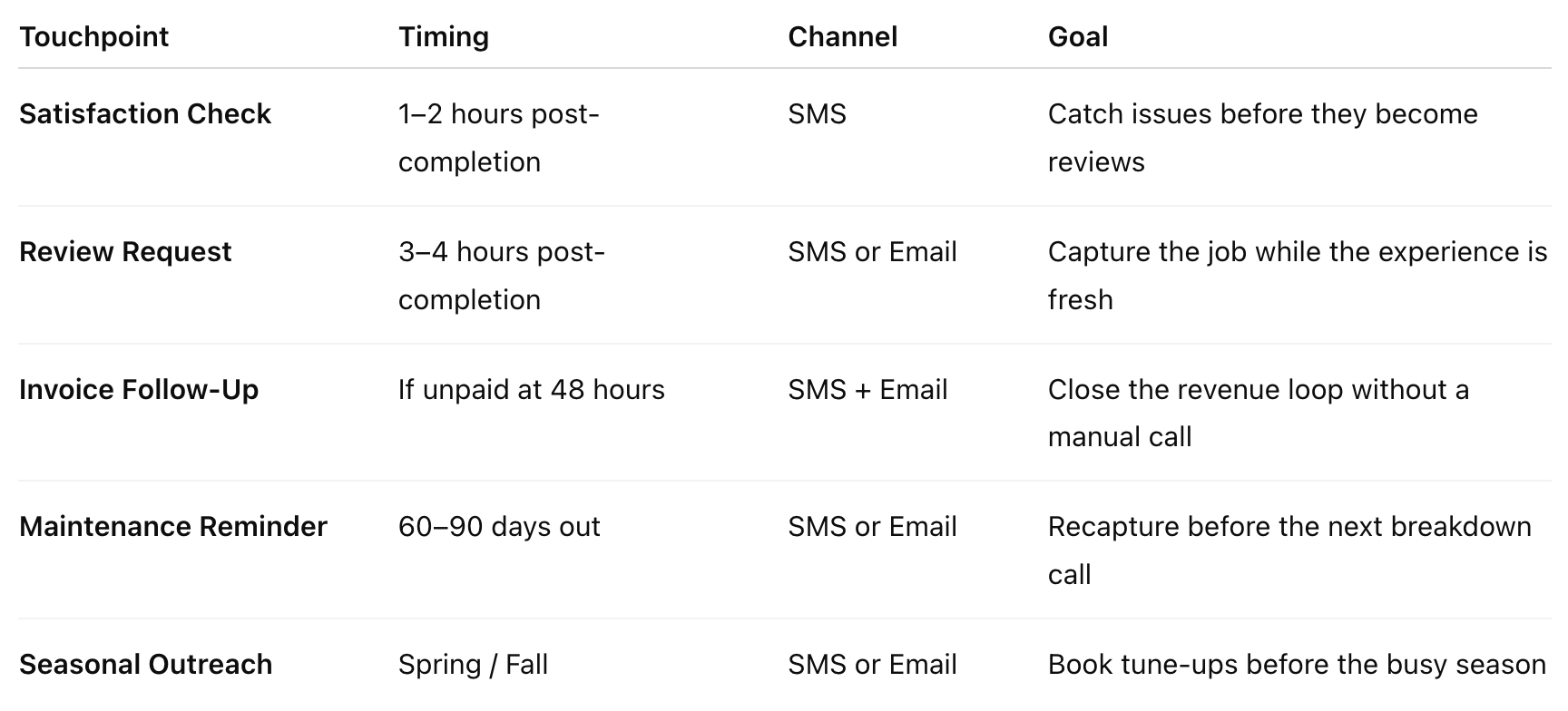
5. Post-job review capture and re-engagement
The job isn't done when the technician leaves. The job is done when the customer confirms satisfaction, the invoice is settled, and the relationship is positioned for the next service. Each of these has an automation opportunity.
Review requests sent within four hours of job completion consistently outperform any manual cadence. Re-engagement sequences, whether a seasonal maintenance reminder, a filter replacement alert, or a "how is your system running?" check-in, are where lifetime value compounds. A customer who booked one emergency HVAC repair and receives zero follow-up will call whoever answers the phone next time their system breaks. A customer who receives a maintenance reminder every six months is yours.
Go deeper
- Agent Steward: AI that takes full ownership from first message to final confirmation
- Voice AI Agent: Natural conversation, sub-250ms latency, built for high call volume
- Omnipresent AI for customer service: What it is, why it matters, and how to get started
Where generic AI receptionists fail for the trades
The AI receptionist category exists because the base problem is real: home service businesses miss a significant share of inbound calls, and every missed call is a missed job. But most solutions being marketed as AI receptionists share a common limitation: they treat the call as the unit of work. Once the call ends, the tool's job is done.
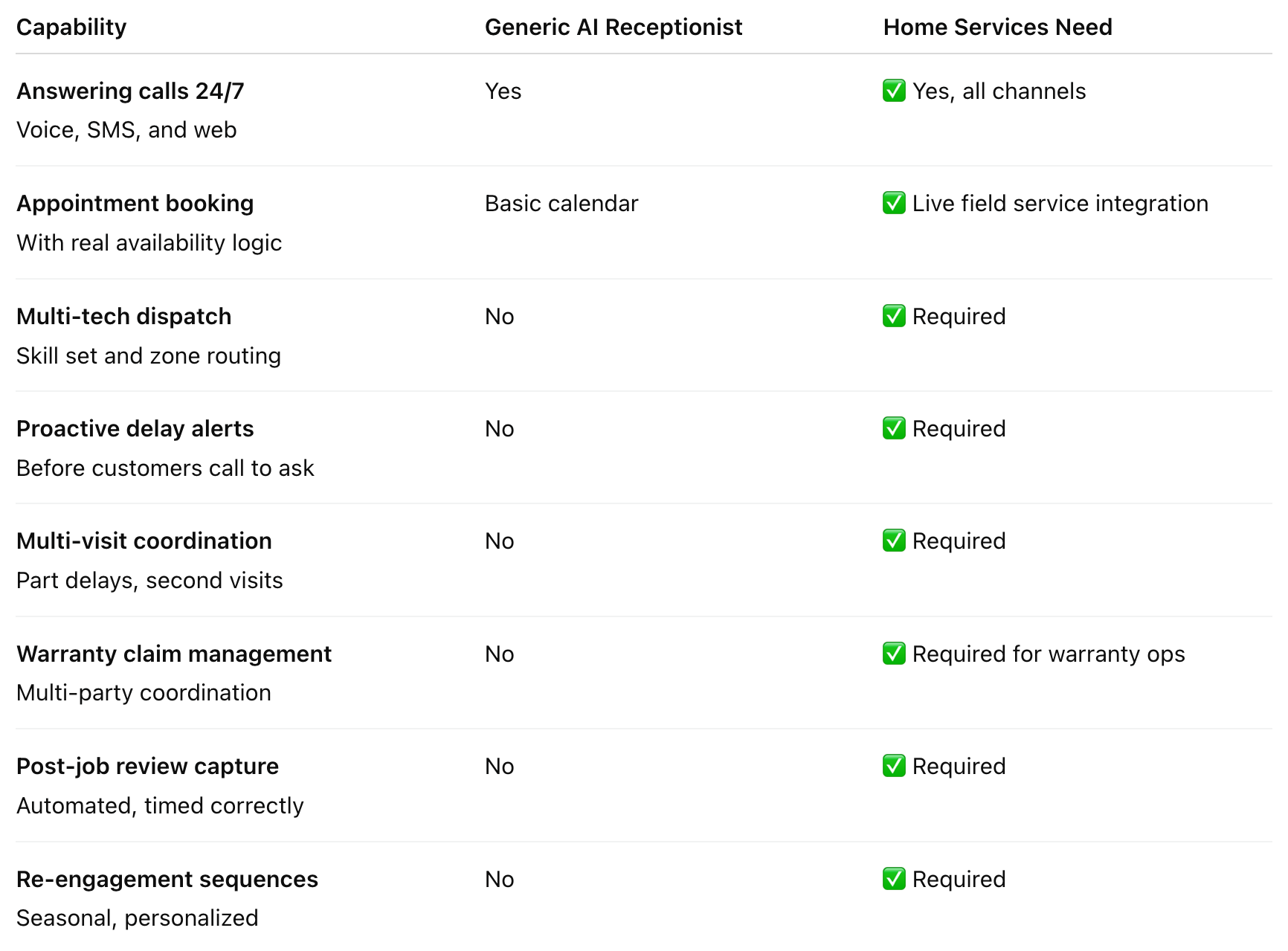
The gap between columns two and three isn't a minor feature difference. It's the difference between a tool that captures calls and a system that closes jobs. The companies with the highest repeat-booking rates in home services are almost always the ones whose AI covers the right side of that table.
See how Dr. Cool Services handles peak-season HVAC calls with zero hold time →
How to evaluate AI receptionists for home services: 8 questions
Most AI vendors will tell you they can handle home services. Here are the questions that separate real capability from marketing claims before you sign a contract.
1. Is the field service integration live or batch?
An AI that "integrates with ServiceTitan" via nightly data syncs cannot check real-time availability or confirm dispatch in a live booking conversation. Ask specifically: does the AI read live tech availability and write confirmed jobs to the platform in real time? If the answer involves any delay, you'll have double-bookings.
2. How does it handle emergency calls at 2am?
After-hours emergencies are the highest-value calls in home services and the ones most likely to go to competitors when not answered immediately. Ask for a demo of how the AI handles an urgent HVAC failure call at 2am, including escalation to an on-call tech.
3. Does it send proactive updates or only respond to inbound?
There's a meaningful gap between AI that answers "where is my tech?" and AI that texts the customer before they think to ask. Ask to see a live demo of a parts-delay scenario: what does the AI do when a tech logs a part order in ServiceTitan?
4. Can it hold context across multiple days and multiple visits?
Most AI receptionists reset context after every call. For a job that spans visit one, a parts delay, and visit two over three days, you need an AI with persistent memory. Ask: if the customer calls back on day three to check on their part, does the AI know who they are and where their job stands?
5. How does it handle an angry customer mid-job?
Parts delays and no-shows create frustrated customers. The AI will encounter them. Ask how escalation to a human works: does the AI brief the CSR on the full job context before the handoff, or does the customer start over?
6. Does the post-job follow-up sequence run automatically?
Review requests that require manual triggering don't get sent. Ask whether post-job follow-up fires automatically when a job is marked complete in the field service platform, and what the default timing and channel logic looks like.
7. What does oversight and control look like for your CSR team?
The AI is not a replacement for your CSR team. It's a force multiplier. Ask what your CSRs can see in real time: which AI conversations are open, which have been escalated, and where can they intervene if something goes wrong.
8. Can it coordinate warranty claims across multiple parties?
If you operate home warranty plans or work with warranty administrators, ask specifically about multi-party claim workflows. The AI needs to coordinate homeowner, contractor, and adjuster communications simultaneously, not sequentially.
Considerations before you sign anything
- Ask for a live demo using your actual field service platform, not a sandboxed environment
- Run a test call through the AI with an emergency scenario and time how long it takes to confirm dispatch
- Ask for references from home service operators at your call volume specifically, not just any customer
- Check whether the contract covers field service integration setup, or whether that's billed separately
- Confirm whether the post-job automation is included or an add-on module
Not sure where your operation stands on AI readiness? Take the 5-minute assessment →
Three ways home service AI fails in practice
The issues that sink AI receptionist deployments in home services are predictable. They fall into three categories, and all three can be screened for before you sign.
The phone bot that takes a message and stops
This is the most common failure mode. The AI answers the phone correctly, collects the customer's name and problem, and then either routes to a human or sends an email to the CSR queue. The customer heard a professional-sounding AI, waited for a callback, and called a competitor while waiting. The AI increased your call answer rate on paper while your conversion rate dropped. Answering is table stakes. What happens after is the product.
The scheduling tool that doesn't dispatch
The second failure mode is an AI that books appointments against a static calendar without connecting to real tech availability. The customer gets a confirmed window. The tech is already scheduled in ServiceTitan for the same window. Your CSR has to call the customer back to reschedule. The AI created work instead of reducing it. This happens whenever the integration between the AI and the field service platform is shallow or delayed.
The follow-up sequence that doesn't close the loop
The third failure is an AI that handles the booking correctly, manages the job correctly, and then goes silent after the tech marks the job complete. No review request. No re-engagement. No maintenance reminder. The customer's experience ends with a paid invoice, not a relationship. That customer will call whoever picks up the phone next time something breaks, which is usually your competitor.
How delight.ai approaches home services
Delight.ai is built for customer interactions that don't end at the first message. For home service businesses, that means Agent Steward operates across the full job lifecycle: inbound booking, dispatch confirmation, mid-job status, multi-visit coordination, warranty claim management, post-job follow-up, and re-engagement. Each stage is tracked, each transition is communicated proactively, and each closed job feeds automatically into the sequences that drive repeat revenue.
The platform integrates live with ServiceTitan and Jobber and connects across voice, SMS, and chat. When a customer calls after hours, the AI voice agent confirms dispatch against real tech availability and sends a confirmation within 90 seconds. When a job status changes in ServiceTitan, the AI sends an update to the customer before they think to call. When the job closes, the review request goes out automatically, and the maintenance reminder is queued for 90 days out.
For home warranty operators, the AI tracks all active claims simultaneously: homeowner communications, contractor dispatch confirmations, adjuster approvals, and parts order status. Agent memory retains the full context of every claim across every party, so when any party goes silent or a deadline is approaching, the AI follows up without waiting for a human to notice.
Trust OS sits underneath all of it. Every AI decision is visible to your team in real time. Escalation paths are configurable. Your CSRs can see every open conversation in Desk, intervene in any of them, and receive a full briefing when they take over from the AI. The AI handles the volume. Your team handles what the AI can't.
- Voice + SMS simultaneously: Confirmation, address, and appointment slot land in a text while the customer is still on the call. No spelling addresses twice. No dropped bookings from call fatigue.
- Booked directly to ServiceTitan and Jobber: Live availability read and confirmed job written in under 4 minutes. No manual entry. No double-bookings from delayed syncs.
- 24/7 across voice, SMS, and chat: After-hours emergencies, peak season overflow, and mid-job status checks all handled without adding headcount.
- Persistent job memory across every interaction: When the customer calls back on day three, the AI knows who they are, where their part is, and when the tech returns.
- Contractor reschedules and parts delays handled automatically: New window confirmed, homeowner updated with revised ETA, before they call in to ask.
- Lapsed customers re-engaged before a competitor gets there: Maintenance reminders, expiring service agreements, and unsold estimates followed up automatically, not when your CSR remembers.
- Trust OS oversight on every conversation: Your CSRs see every open case in Desk in real time, can intervene in one click, and receive a full briefing on handoff.
Ready to stop losing jobs between the booking and the bill? Talk to a home services specialist about your current job lifecycle. Book a demo →
The bottom line: The AI front desk that actually moves revenue
An AI receptionist for home services has to be more than a voice that answers the phone. The call is the entry point. The job is the unit of work. And the job spans calls, texts, parts orders, dispatch windows, and follow-ups across multiple parties over multiple days.
The businesses winning with AI in the trades are the ones that automate the full lifecycle: they answer more calls, dispatch faster, communicate proactively on every status change, coordinate multi-party warranty claims without manual chasing, and re-engage customers before those customers think to call a competitor.
That's what an AI front desk for home services looks like. Not a phone bot. An AI that owns the job from the first ring to the five-star review.