Key takeaways
- A CX engineer owns your customer experience AI agent after launch, keeping it accurate and improving as your products and policies change.
- The return on hiring a CX engineer shows up twice — in resolution rates that keep climbing month after month and in support conversations that end with a satisfied customer.
- Delight.ai's Trust OS gives a CX engineer full visibility and control over the AI agent, so they can improve it without filing engineering tickets.
A CX engineer is the person who owns your customer experience AI agent after it goes live. Once the agent is live, a CX engineer:
- Explains why resolution rates move
- Reads real conversations every week
- Keeps the agent's knowledge current
- Notices when a solved problem is also a sales opening
I opened my SF Tech Week talk with a support conversation that looks routine: A customer asks why their usage history only goes back 90 days. The AI agent explains the limit, and the ticket closes. What nobody mentions is that the next tier up keeps history indefinitely, which is exactly what this customer just said they need.
On paper, the agent did its job and contained the conversation. In practice, it may have missed an upsell. Most teams can't tell which, because nobody owns the agent once it launches. Owning it is the CX engineer's job, and the work happens inside a governance layer like Delight.ai's Trust OS, where every change to the agent is tested, logged, and reversible.
If you lead CX with a live AI agent, a CX engineer is the hire that keeps it improving and finds the revenue hiding in it.
What is a CX engineer?
A CX engineer is a customer experience role that coaches, tests, and improves an AI customer agent. A year ago, nobody was hiring for this title. Now it's showing up on job boards, but with no standard template to work from, most hiring managers are writing the description from scratch.
The clearest way to see the shift is to put the old support job next to the new one. One was built around speed and scripts, and the other is built around judgment.
A customer success manager owns accounts, and a software engineer owns code. Once an AI agent is talking to your customers, a CX engineer combines both roles by owning the outcomes the agent delivers, engineering the instructions it follows, and fixing problems as soon as its conversations reveal them.
Why does an AI agent need an owner after launch?
An AI agent needs an owner after launch because it doesn't improve on its own, and governing agents at scale starts with one named person, accountable for each agent. Deloitte's State of AI in the Enterprise research found that only 21% of companies have a mature model for governing autonomous AI agents. Without an owner, three problems simmer:
- The agent's performance drifts, so resolution rates slip a few points over a couple of months before anyone notices.
- The agent's knowledge goes stale, so a return policy changes on Monday and the agent keeps quoting the old one until a customer catches it.
- Edge cases pile up, so human agents fix the same odd request by hand every week without anyone seeing the pattern.
What do the companies getting results do differently?
Some companies cut support headcount and called it an AI win, and Gartner expects many to reverse course. It predicts that by 2027, 50% of companies that attributed headcount reduction to AI will rehire staff to perform similar functions. The companies getting results took the opposite route and gave one person the job of running the agent, full time.
Norse Atlantic Airways learned this early. Their AI agent, Freya, replaced a legacy chatbot in under two months, and containment climbed from 60% to 80% in two weeks.
"Freya became a core part of the team, and we quickly realized that Freya needed a 'manager'... We see the future of our customer support team as AI agent managers."
Alf Lim, Chief Product Officer, Norse Atlantic Airways
Norse calls the role an AI agent manager, and I call it a CX engineer, but both titles describe one person accountable for how the agent performs. If your team is still preparing to launch, our guide to AI readiness covers the groundwork that comes before this hire.
What does a CX engineer own day to day?
Day to day, a CX engineer owns six areas of the AI agent's performance, and each one answers a question that used to go unanswered:
- Performance monitoring means explaining why the resolution rate dropped three points last week, such as a new product question the agent hasn't been briefed on yet.
- Quality assurance means reading a sample of real conversations every week, because a healthy satisfaction score can hide a confidently wrong answer.
- Knowledge governance means updating the agent the same day a policy changes, so a new return window reaches customers before the old one causes refund disputes.
- Risk monitoring means testing edge cases, like a refund request on a final-sale item, before a customer finds the gap.
- Continuous improvement means turning what the reviews uncover into a ranked list of fixes for the agent, rather than a backlog nobody reads.
- Revenue awareness means noticing when a resolved issue is also an opening, and building the agent to act on it.
The scorecard follows from that list. Resolution rate shows whether problems got solved, containment rate shows how many conversations the agent handled end to end, and cost per resolution ties the work back to the budget.
None of this works if every change needs an engineering ticket. On Delight.ai, Trust OS includes scheduled conversation tests, an activity log that shows why the agent made each decision, flags on low-confidence answers, and version control with one-click rollback. The step-by-step instructions the agent follows, which we call Actionbooks, are edited by the operations team directly, and a person reviews every change before it goes live.
Our AI agent evaluation guide goes deeper on test design. And the Trust Stack explains how to give the agent more autonomy one layer at a time.
Can a CX engineer turn support conversations into revenue?
Yes, a CX engineer can turn support conversations into revenue, because the person reading the week's conversations is the one who sees how often a fixed problem points to a better plan. Norse Atlantic gave Freya a dedicated manager, and our team co-authored that job description with them from scratch. Today a question about legroom can turn into a seat upgrade, and a question about weight limits can turn into a baggage sale.
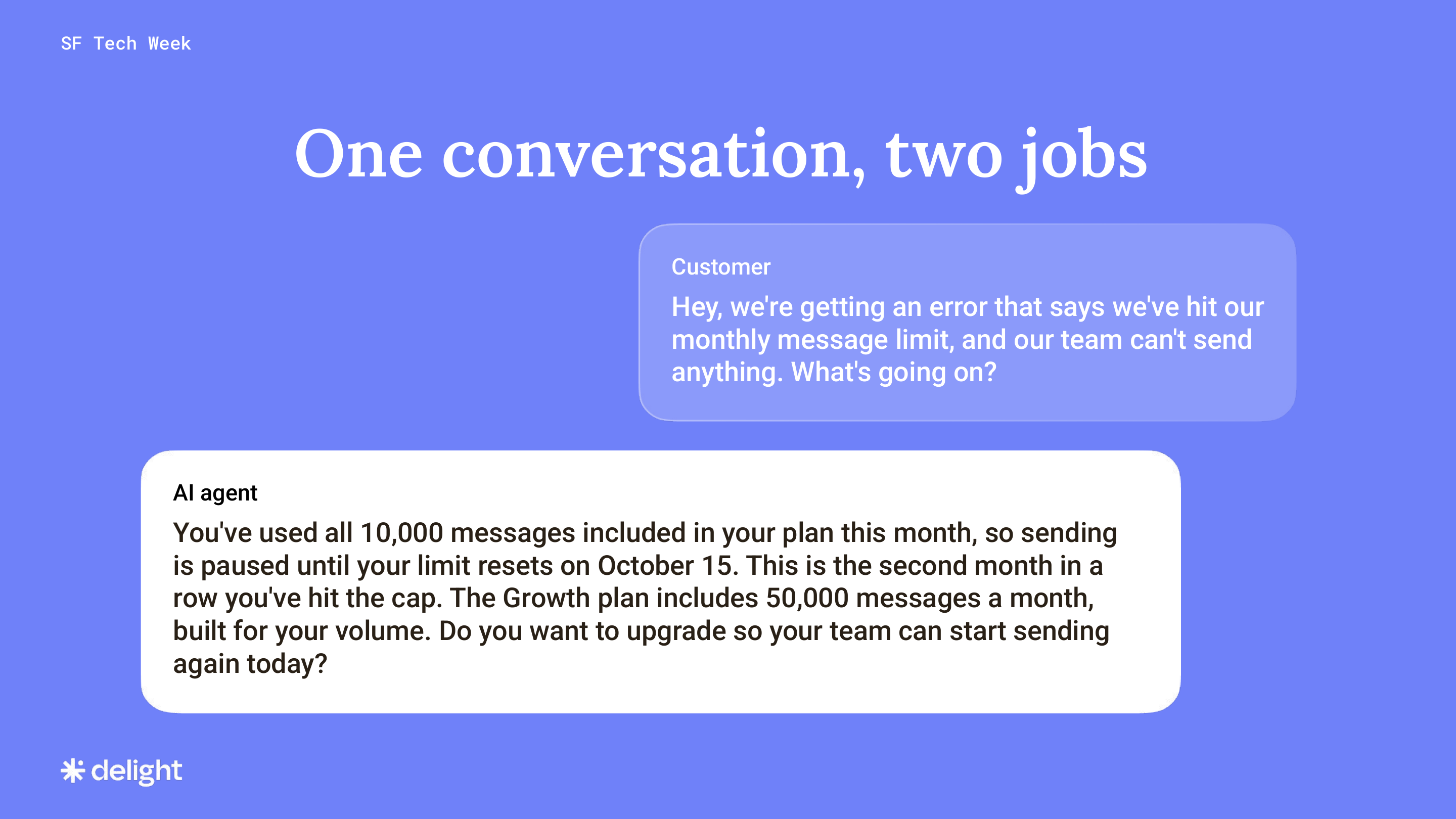
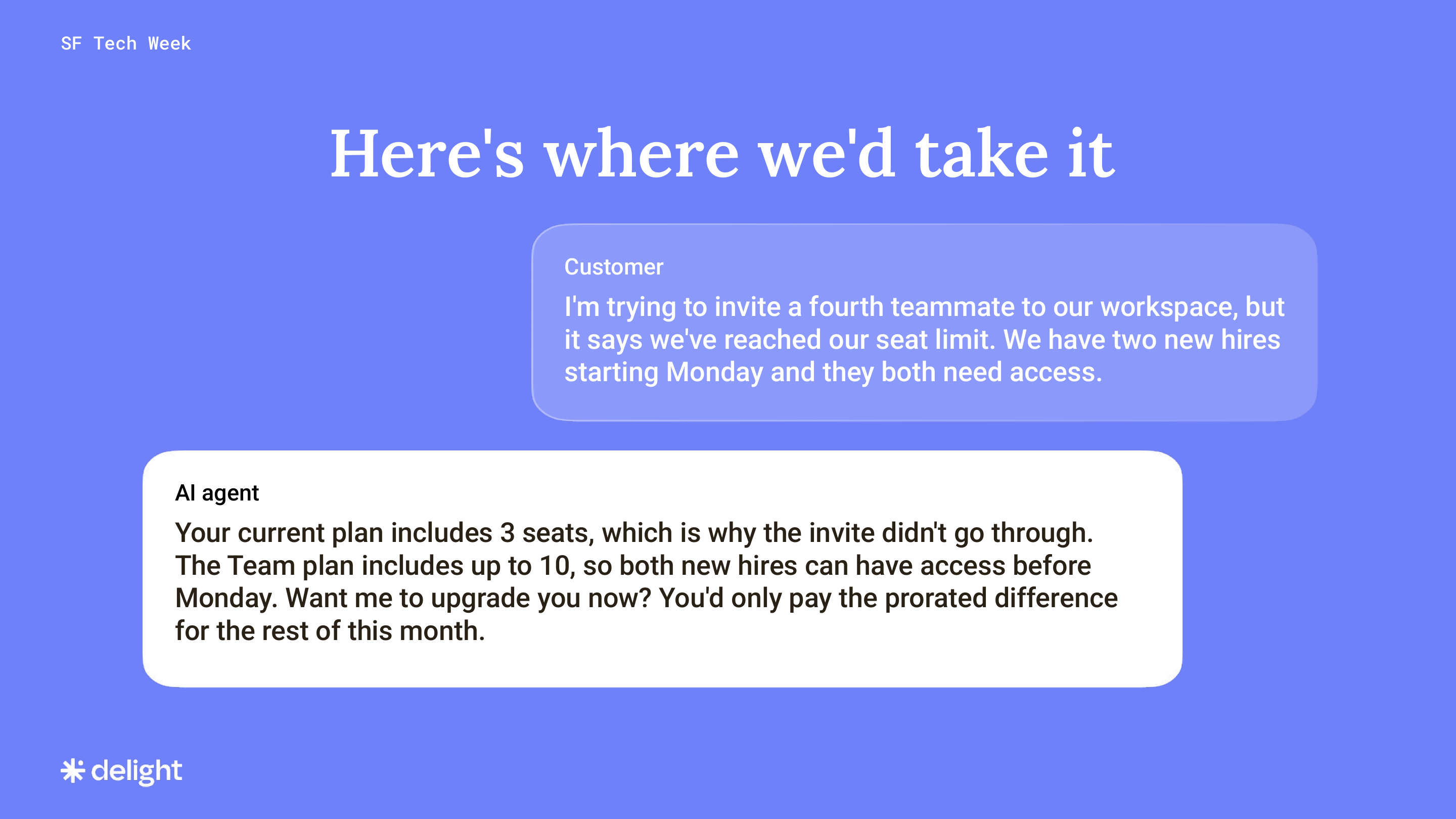
Here are three examples from my SF Tech Week talk, each starting as an ordinary support question:
When a team hits its monthly message limit
When a team runs out of seats
When someone rebuilds the same report every Friday
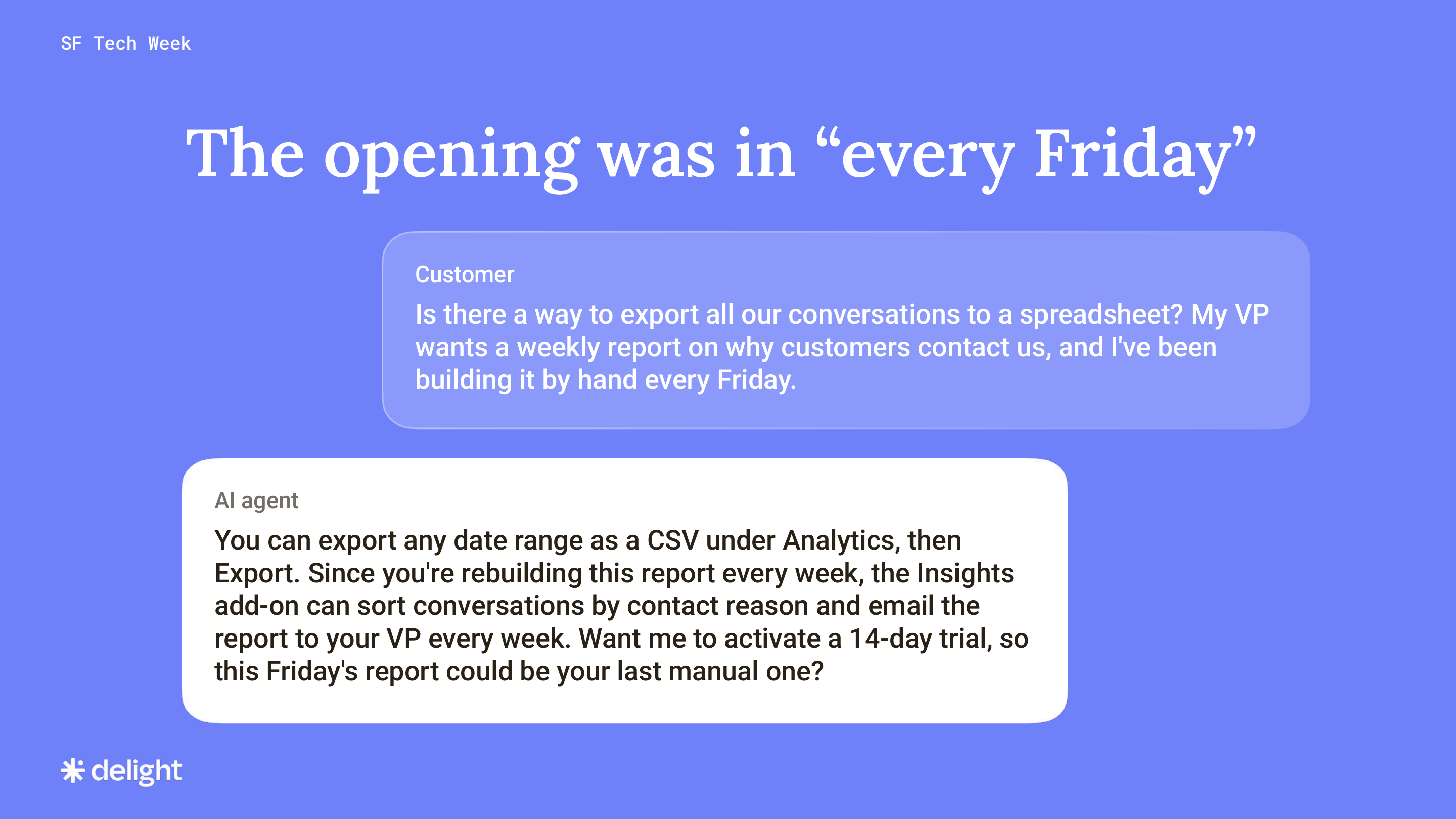
The third customer asked for a how-to, and the opening was hiding in two words, "every Friday." In all three, the offer comes straight out of the problem the agent just diagnosed, which is why it reads as help to the customer. An agent only behaves this way when someone builds it to, and that's the job.
Where do you find and evaluate CX engineer candidates?
You'll find CX engineer candidates in two places, inside your own support team or in technical AI roles, and the best way to evaluate them is on judgment more than any single skill. Here's how I'd think about each step of how to hire a CX engineer:
Should you promote from within or hire from outside?
There are two good paths into this role, and the right one depends on whether your bigger gap is customer judgment or technical depth.
The first is promoting from within. Someone on your support team is probably already doing pieces of this work informally, without a mandate, a budget, or a title. They're the person who keeps flagging that the agent gets the same billing question wrong, and with their customer instincts already in place, they can learn the technical side, like editing agent instructions and reading conversation logs.
The second is hiring someone with an AI or technical background and coaching them on the human side of support, like tone, escalation, and recognizing when a frustrated customer needs a person.
Where should the role report?
A CX engineer should report into CX leadership, with the authority to change the agent's instructions and knowledge without waiting on another team. Giving the work a name, a budget, and that authority is what turns scattered effort into a function that compounds. If every fix still needs sign-off from product and engineering, you've hired an analyst, and the agent will drift at the same pace it did before.
How do you test a candidate's judgment?
A short work sample tells you more about a candidate's judgment than a résumé does. Give them a realistic support conversation, and ask what the AI agent should say next and how they'd check that response before it reaches every customer.
The most revealing samples are ones where the opening isn't obvious. Say a shopper asks whether a jacket runs small and mentions she's already returned two jackets this year because of fit. A typical answer points her to the size chart, while a strong one also recommends a size based on what she kept and offers an exchange if this one doesn't fit either.
The strongest candidates then explain how they'd test that new behavior on a sample of past conversations before turning it on for everyone. Anyone who spots the opening without a hint already reads conversations the way this job requires.
Example CX engineer job description
Here's an example CX engineer job description you can adapt. It's written for a company whose AI agent is already live, so it's worth adjusting the first section if you're still launching.
CX Engineer
About the role. We're hiring our first CX engineer to own our AI customer agent after launch. You'll make sure it resolves more customer issues every month, stays accurate when our policies change, and recognizes when a support conversation is also a chance to help a customer get more from our product.
What you'll own
- Weekly reviews of resolution rate, containment rate, and cost per resolution, with a clear explanation of what moved and why
- A weekly read of real customer conversations, scored for accuracy, tone, and completeness
- The agent's knowledge and instructions, updated the same day a policy or product changes
- Tests for new edge cases before every release, plus a rollback plan for every change
- A ranked list of improvements, shared with support, product, and sales leaders
- Revenue moments inside support conversations, like plan limits, seat caps, and repeated manual work, and the agent behavior that acts on them
What you bring
- Experience in customer support, support operations, or a technical customer-facing role
- Comfort reading conversation logs and analytics, and writing clear, structured instructions for an AI agent
- Sound judgment about when an AI agent should hand a conversation to a person
- Curiosity about why customers ask what they ask
Where to start
Every conversation your AI agent closes this week holds the same question: containment or upsell? Someone on your team is probably already trying to answer it without the title, budget, or authority to act, and the next step is giving them the job. Before you post the role, our AI readiness assessment gives you a readiness score in about 7 minutes, with next steps for the gaps it finds.