If you want a new swimsuit this summer, you’re increasingly likely to skip Google or your favorite commerce platform in favor of ChatGPT. Instead of typing “green swimsuits” into multiple sites and clicking through links, you ask once: “trendy swimsuits for Italian vacation under $100.” The AI synthesizes a curated shortlist of personalized product recommendations from across the web that match your intent and context—then purchases for you.
This is agentic commerce: a new model of digital shopping in which AI agents autonomously handle product research, comparison, and purchasing on behalf of customers. In 2025, traffic to US retail sites from generative AI browsers surged 4,700% year-over-year. These users also spent 32% more time on-site and bounced 27% less than traditional visitors. The AI shopping experience is simply faster and better.
The impacts on customer experience (CX) are significant, but what's happening on the backend is seismic. AI agents don’t browse storefronts or respond to brand narratives. Instead, they query APIs, evaluate price and availability in real time, synthesize product reviews and comparisons, then complete purchases end-to-end. In agentic commerce, your backend is your storefront. To remain visible and competitive, retailers must adopt agent-ready infrastructure and new practices.
Agentic commerce is ushering in a new era in retail—a shift McKinsey estimates will generate $3–5 trillion in global retail value by 2030. This article explains the rise (and risks) of agentic commerce, and offers five steps retailers can take to prepare for a world in which AI agents, not retail interfaces, mediate the shopping experience.
The rise (and risk) of agentic commerce
Agentic AI—autonomous systems that can perceive, reason, and act autonomously on behalf of consumers and businesses—is fundamentally reshaping the shopping experience.
Traditionally, the retail funnel looked like this:
Customer → Website or App → Product → Purchase
Agentic commerce reshapes the funnel, making AI the new front door of ecommerce:
Customer → AI agent (AI search) → Retail APIs → Purchase
This marks a structural shift from consumers navigating retail interfaces to AI agents interacting directly with merchants on their behalf. More than a consumer trend, this is a restructuring of how commerce works that’s well underway.
A few examples:
- ChatGPT already drives more than 20% of referral traffic to Walmart and around 10% to eBay.
- Visa and Mastercard are building APIs that enable verified AI agents to spend within approved budgets using customers’ authorized payment methods.
- Google is piloting an “AI shopping mode” that tracks prices and buys automatically when a target is met.
- OpenAI and Perplexity have launched an in-conversation checkout feature.
The question retailers must answer is no longer "how do we rank on Google?" Instead, the question is: "Who owns the customer relationship when an AI agent makes the purchase?"
In the short term, retailers without machine-readable catalogs, real-time inventory APIs, and transactional infrastructure won't appear in AI-led purchasing flows at all. They'll be bypassed entirely, invisible to AI agents that rely on structured data to evaluate and recommend the ideal products to shoppers.
In the long term, retailers risk losing ownership of the customer entirely. According to McKinsey, retailers without their own agentic layer will be reduced from brand destinations to mere inventory suppliers for someone else's platform. Those lacking agent-ready infrastructure will lose not only customer intelligence—such as behavioral data, preference signals, and loyalty moments—but also the downstream revenue from personalization, retention, and lifetime value.
Agentic commerce relies on agentic architecture
Retailers can combat the disruption of agentic commerce through two key initiatives:
- Be discoverable wherever shoppers search: Ensure products, attributes, and value propositions are accurately represented and machine-readable by third-party AI platforms. This enables shopping agents to find, parse, and surface products, creating awareness.
- Build owned agentic experiences: Deploy AI agents on your own properties to capture the context behind every customer decision and win transactions. This intelligence informs pricing, inventory, merchandising, and personalization, but also enriches product catalogs with attributes and language that improve AI discoverability over time. This creates an advantage.
Both require the same foundation: agentic architecture. This is the agent-ready infrastructure layer that shifts legacy retail systems from solely human-facing interfaces to machine-readable, API-driven engines. It makes a retailer visible, transactable, and competitive in the agentic era.
For retailers, investing early in agentic infrastructure offers overlapping benefits. First, it ensures presence in autonomous commerce flows. It also creates a unified customer data layer that eliminates the siloed legacy architectures that have long constrained retailers, unlocking hyper-personalization, AI-powered customer service, real-time optimization, and many other high-value AI use cases in retail from a single, scalable foundation.
5 steps to succeed with agentic commerce
With 30-45% of consumers already shopping using generative AI tools, the question for retailers isn’t whether to participate—but how to own the customer intelligence and win the transaction.
When looking for the “perfect” option for shoppers, third-party AI agents favor products that offer the highest reliability and best "mathematical" value for their decision matrix. Retailers who present themselves as the cheapest, safest, and most contextually relevant option will be the go-to choice, winning the transaction and customer intelligence because they offer the path of least resistance and of greatest value.
The following five actions will help you appear in third-party recommendation engines, own customer intelligence, and win transactions from a foundation of agent-ready architecture—retaining a durable advantage in pricing, customer loyalty, and lifetime value.
1. Optimize for AI discoverability
Most product data was built for search filters, not AI agents. This requires a shift from human-centric SEO to structured, machine-readable data—known as Generative Engine Optimization (GEO) or AI engine optimization (AEO).
By ‘making data the product’, retailers enable agents to find, parse, compare, and surface products to customers when they ask across traditional search, AI assistants, and conversational AI platforms.
Retailers can focus on:
- Real-time inventory/pricing APIs: Exposing open, real-time APIs enables agents to query live data directly, making products retrievable in AI-led search.
- Structured data: Agents prioritize structured data over prose. Implementing Schema.org markup makes product details (price, size, color, materials) instantly machine-readable. Optimize product titles and attributes to avoid confusion.
- Provide fact-rich product content: GEO optimization requires more than branded descriptions. Focus on precise, detailed, unique specifications—material sourcing, dimensions, use cases—to provide a context-rich picture that makes products stand out.
2. Retain customers with your own agent
Even when the interaction starts on a third-party platform, brands can capture customer intelligence and transactions. Research from Bain & Company shows that, while consumers increasingly use AI for research, they currently trust brands’ on-site agents three times more than third-party agents.
Essentially, your branded AI agent is a functional API gateway that protects brand equity. To ensure priority and success, your agent must prove its value through extreme data accuracy, personalized autonomy (acting on behalf of the user), and secure, verifiable identity protocols.
This involves:
- Branded agents: Lowe’s branded AI concierge, MyLow, represents the brand’s logic, inventory, and loyalty. When a user’s personal agent (ChatPT) asks: “Do you have ⅝” copper pipe,” MyLow offers owned contextual intelligence—“Yes, at a store 2 miles from you with 10% off for loyalty members”—forcing the transaction through its superior branded logic, not ChatGPT’s.
- Standardize data exchanges: Standardized handshakes between referring and branded agents, using protocols like the Agentic Commerce Protocol (ACP), enable structured purchase intent to flow to your system. If a customer uses ChatGPT ("I need to fix a leaky faucet"), it acts as a "concierge," interacting with the branded agent Mylow to finalize product details or availability.
3. Enable autonomous transactions
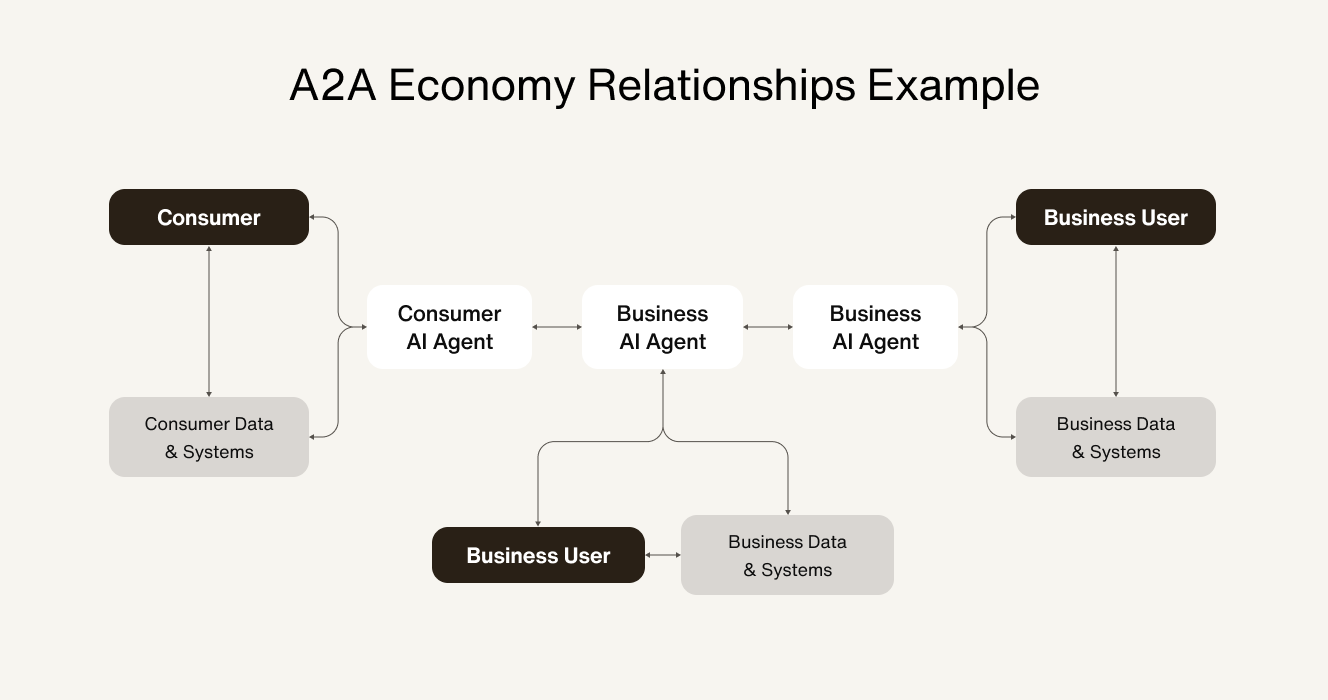
A key aspect of avoiding “disintermediation”—becoming a mere supplier for other AI—is to become an active partners in the agent-to-agent (A2A) economy. When your branded AI concierge interacts with consumers’ agents or other retailers' agents to source products and services through agent-to-agent relationships, it transforms competitors into collaborators.
Customer → Personal Agent → Branded Agent
Retailers must focus on:
- Transactional agents: Emerging standards like ACP enable AI agents to programmatically create carts, check inventory, and initiate payments, turning AI from a chatbot interface into a transactional engine.
- Embedded payments & security: Trust in this marketplace is measured by how reliably your agent handles transactions and protects data. Using tools like Shared Payment Tokens (SPTs) or Agent Payments Protocol (AP2), retailers can securely process payments from third-party agents, reducing cart abandonment and fraud.
4. Design the autonomous backend
To reliably win the transaction, your backend must be as agentic as your storefront. If your branded AI concierge sits atop a legacy, siloed supply chain, it won’t be able to compete effectively.
By transitioning to agent-integrated architecture, retailers move from reactive logistics to a self-healing ecosystem that protects margins and ensures A2A reliability. This enables:
- Self-optimizing supply chains: Deploy inventory agents that monitor real-time sales velocity alongside third-party signals (weather, local events, or social trends) and autonomously trigger reorders or stock shifts between stores—preventing the out-of-stock signals that instantly make third-party agents bounce to competitors.
- Dynamic, logic-based pricing: Pricing is a real-time negotiation in agentic commerce. Through agentic price discovery, you can offer a bundle price or a loyalty-match price to a querying agent. This makes you the "mathematical winner" in the agent’s decision matrix, without eroding margins in the broader market.
5. Secure data sovereignty
In agentic commerce, the platform that owns the interaction owns the intelligence. By using your branded agent to capture zero-party data and intent signals that third-party AI can’t see, you establish a data moat, securing the customer relationship for a durable advantage. This involves:
- Ethical guardrails & governance: Differentiate your agent as the most trustworthy to be the preferred choice. Implementing robust AI governance ensures it never compromises a user’s data privacy or hallucinates. Transparent data manifests can build brand-specific trust that other AI can’t match.
- Proactive personalization & re-engagement: Use captured data to anticipate customer needs. If your AI agent knows a customer bought a lawnmower last summer, it can nudge the user’s personal agent with a maintenance reminder coupon—creating a loyalty loop that doesn’t even require a new search.
How to prepare for agentic commerce
Agentic commerce is a seismic shift, but it’s not unprecedented. Like the arrival of digital commerce and search, brands that structured their data for SEO first didn't just get more traffic; they defined category authority on the web for a decade. Agentic commerce raises the stakes. Shopping agents don't return ten blue links and let shoppers choose. Instead, they select a single winner based on technical compatibility. First-mover advantage here isn't incremental, but structural.
In 2026, the difference between leaders and laggards isn’t urgency—it’s AI readiness: a true preparedness to adopt AI across technology, operations, and culture. According to the Cisco AI Readiness Index, only 13% of organizations are fully prepared to realize AI's potential. By contrast, the most AI-ready organizations are 4x more likely to move pilots into production and 50% more likely to see measurable returns.
The retailers pulling ahead have made readiness a cross-functional, repeatable process—one built on agentic infrastructure, high-quality data, and deep integration across technology, operations, and culture. This foundation lets them avoid the technical debt, governance risk, and fragmented deployments that commonly sideline those who are less prepared today, and less agile in the future.
Importantly, these investments compound. The same agentic architecture that makes your products discoverable to AI agents also powers a 360-degree customer view, AI customer service, hyper-personalization at scale, plus the highest-value AI use cases in retail of tomorrow.
How delight.ai helps retailers with agentic commerce
At delight.ai, we offer both the technical capabilities and proven experience in agentic commerce—serving as a trusted partner to enterprises through our:
- Branded AI concierge: Your owned agentic layer. Handles order tracking, returns, product discovery, and purchasing end-to-end across channels. Deeply integrated with ecommerce platform, OMS, and inventory data, capturing every customer interaction as proprietary intelligence that compounds over time and safeguards your customer relationship.
- Agent Memory Platform (AMP): AMP turns isolated transactions into a persistent, evolving customer profile. AI memory is core to hyper-personalization, proactive engagement, and what's next.
- Agentic architecture: Unified data layer that eliminates silos, enables real-time personalization, and creates the 360-degree customer view that agents rely on.
- Forward-deployed teams. Our AI experts work alongside your team to implement and scale a sustainable solution, equipped with proprietary AI readiness and AI governance frameworks built from successful real-world deployments with retail leaders.
To learn more about how delight.ai can help you lead in agentic commerce, contact sales.