Imagine a customer contacts support asking where her order is. The AI agent checks the CRM, spots a carrier delay, and resolves the issue proactively—but not before issuing a next-purchase discount that turns her frustration into appreciation.
The next day, she returns to browse the website, and the same AI agent switches roles instantly. Now a shopping assistant, it offers personalized product recommendations based on her history, session context, and the local forecast. When she purchases, it triggers a swarm of activity behind the scenes: an inventory agent flags the item as trending, a pricing agent adjusts positioning, and a logistics agent reroutes stock from the nearest warehouse.
This is artificial intelligence (AI ) in retail in 2026. No longer a fragmented set of tools, but a coordinated ecosystem of specialist AI agents, each simulating human roles to meet rising customer expectations and optimize retail operations in real time.
According to KPMG, AI adoption in the retail industry will grow from 33% to 85% by 2027. It’s a new era—so where do you start?
Read on to learn the 13 top AI use cases in retail with examples that are redefining how organizations sell, operate, and support customers in 2026.
The new frontier of retail: Agentic AI
Before we highlight key use cases, it’s important to understand how agentic AI is reshaping retail at every level. What began with predictive analytics and generative AI tools has evolved into agentic AI—autonomous AI agent systems that perceive, reason, and act on behalf of customers and retail processes without human intervention.
AI agents mark a shift from reactive automation to proactive intelligent orchestration—replacing disjointed platforms with a scalable, system-level solution to retailers’ biggest challenges. Reports show that between 80-95% of retailers are piloting or experimenting with agentic AI use cases.
Three aspects to consider:
- Agentic architecture is the foundation. It replaces siloed systems with a single ecosystem that runs on unified customer data. This evolving, 360-degree customer view powers continuous improvement over time.
- Agentic experiences are the expectation. A unified customer view enables retailers to scale delivery of consistent, hyper-personalized, omnichannel experiences that increase customer loyalty and conversion.
- Agentic commerce is the frontier. Instead of customers browsing storefronts, AI agents increasingly handle product research, comparison, and purchasing on their behalf. McKinsey estimates agentic commerce will generate $3–5 trillion in global value by 2030. Retailers who don't optimize their systems for AI agents risk becoming invisible, bypassed by platforms that do.
In short, as adoption surges, AI is becoming a competitive necessity in retail. By offering a new operating system to power truly unified omnichannel personalization, agentic AI is ushering in an AI-first future of retail operations that simultaneously improves the customer experience (CX) and operational efficiency.
Here are some top ways retailers are investing in AI capabilities.
13 AI use cases in retail that will define 2026
1. Autonomous 24/7 customer support
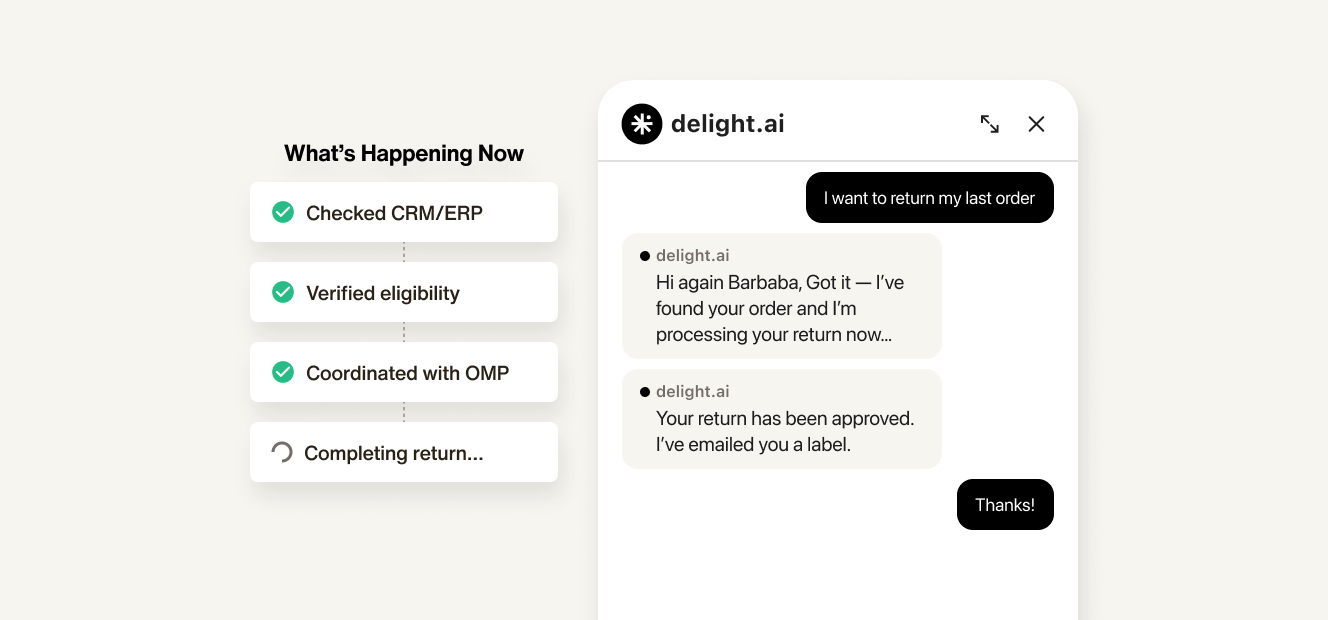
AI can automate the high-volume, repetitive tasks that overwhelm retail customer service teams (order tracking, returns, product FAQs) and eat into margins. Predicted by Gartner to handle 80% of frontline interactions by 2029, AI agents free retail staff to focus on high-sensitivity interactions and maintaining customer loyalty.
Say a customer requests a refund on Black Friday. Unlike traditional chatbots that just retrieve answers, delight.ai's AI Concierge remembers the customer, queries the CRM, validates the status with logistics, executes the refund via API call, and then updates the customer record. If the case exceeds its scope, the AI agent escalates with full context. Given its scalability across service channels, retailers using agentic AI in customer-facing roles report 66% productivity gains and 57% cost savings.
Key AI technology: AI agent platforms, agentic frameworks, AI-ready APIs for CRM/ERP integration.
2. AI search and product discovery
AI search is transforming how shoppers find and buy products, shifting from keyword matching into intent-based discovery. Using natural language understanding (NLU), AI interprets the query’s intent and context to synthesize a unique set of personalized product recommendations. For instance, instead of typing "blue dress," a customer enters "elegant attire for a garden wedding in June”—and receives a curated set of results based on their history, preferences, and live browsing context.
The same AI agent that powers support can drive this experience, evolving search boxes and shopping assistants into conversational discovery engines that reduce friction and improve conversion significantly. According to McKinsey, 40–55% of consumers now use AI search to make buying decisions, a clear signal that the shift to agentic commerce is already underway.

Key AI technology: Vector databases for semantic search, multi-modal embeddings (searching via images + text), and neural re-ranking algorithms.
3. Agentic commerce
After AI search finds the perfect product for a customer, agentic commerce comes next. On the customer’s behalf, AI agents autonomously verify stock via retailer APIs, compare options, and complete the purchase using the customer's authorized payment method. This shifts the retail journey from a shopper interacting with a website to a brand's AI agent interacting with a customer's AI agent, also known as the agent-to-agent (A2A) economy.
This is both an opportunity and a risk. Traffic to US retail sites from generative AI browsers surged 4,700% year-over-year in 2025, and these visitors spent 32% more time on site, browsed 10% more pages, and bounced 27% less. But retailers who don't build their own agentic layer (agent-ready architecture) risk losing ownership of customers, becoming mere inventory suppliers to someone else's platform.
Key AI technology: Autonomous transaction protocols, secure digital wallets for AI Agents, "headless" commerce APIs for machine-to-machine checkout.
4. Conversational commerce and voice AI shopping
Conversational commerce is the crossroads of messaging apps, AI assistants, and faster shopping experiences. It enables customers and brands to interact through text or voice-based conversations across channels like WhatsApp, smart assistants (e.g, Alexa), or AI embedded in branded apps. Conversational commerce is becoming a norm in retail due to its increased convenience, personalization, and accessibility, with 22% of consumers already preferring voice-enabled AI to typing.
Say a customer asks a retail AI chatbot: "Need a gift for a runner. Under $100. Arrives by Friday." The AI interprets the query, checks inventory and delivery windows, and completes the purchase. Voice AI enhances this, enabling hands-free interaction for mobile users, and helping retailers scale peak-season support without extra hiring.
Key AI technology: Latency-optimized small language models (SLMs) for edge devices, natural language understanding (NLU), WebSocket-based real-time voice streaming.
5. Hyper-personalization and predictive engagement
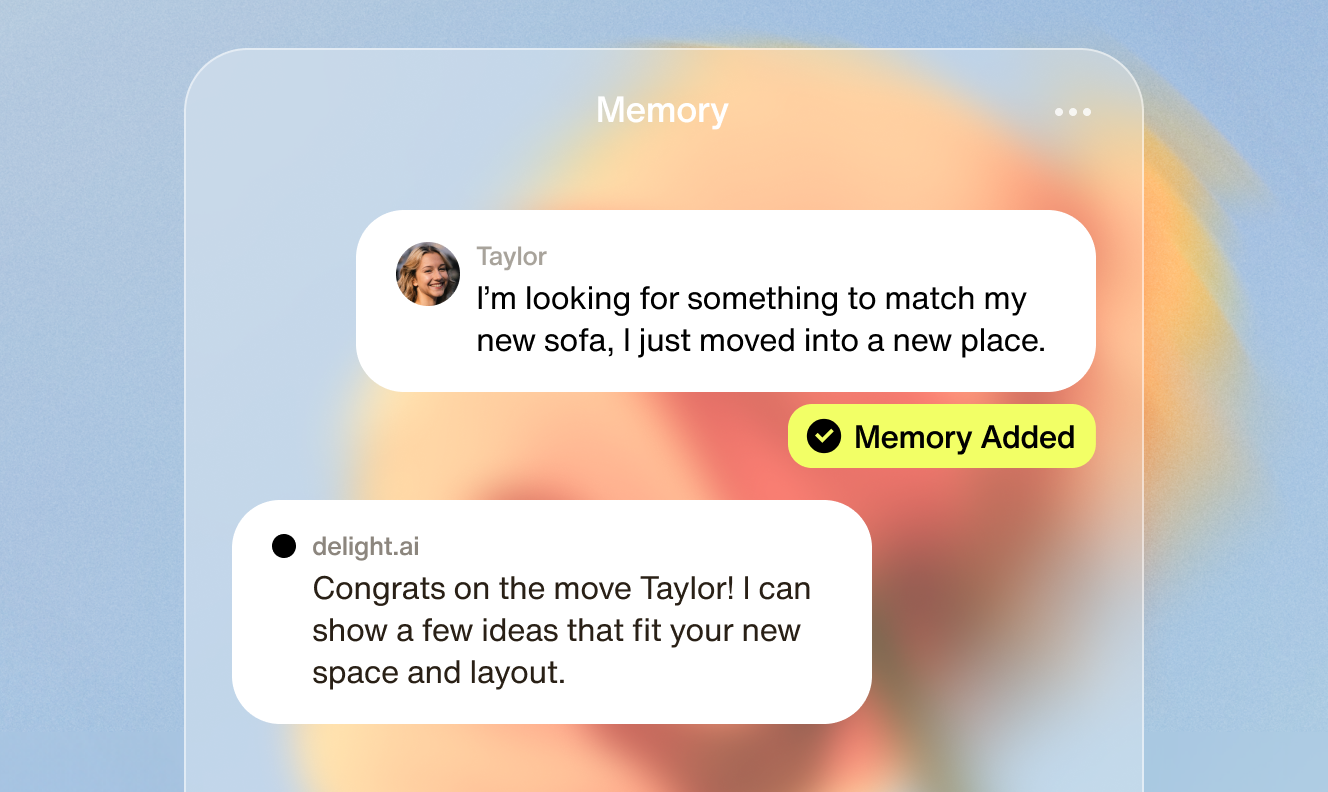
Hyper-personalization uses machine learning (ML) to target a "segment of one"—delivering the most contextually relevant recommendation or offer for that customer on that specific channel in that moment. Powered by a unified data layer and AI memory, it identifies the “next best action” for each individual based on their historical data and live context. More precise targeting and more relevant interactions at scale can drive a 10–15% revenue lift and up to 30% improvement in marketing efficiency.
Predictive engagement goes further by anticipating behavior. Target tracks subtle shifts in purchases of unscented lotion and supplements to identify second-trimester pregnancies among customers, then delivers personalized offers for strollers and diapers before customers even modify their purchasing. This level of foresight is now table stakes for personalization leaders.
Key AI technology: Real-time feature stores, transformer-based sequence models (for predicting the "next best action"), and federated learning for privacy-compliant data processing.
6. AI-enhanced omnichannel experiences
Today's consumers move fluidly between digital and in-store experiences, and agentic AI moves with them. By unifying customer data into one evolving source of truth, AI agents bridge formerly fragmented channels and platforms—enabling consistent, real-time personalization across mobile, desktop, in-store, and post-sale touchpoints without losing context between sessions.
For example, BJ's Wholesale Club deployed an AI agent across its mobile app, website, and in-store kiosks to streamline online and in-store shopping. As it guides shoppers to the right aisles and product pages, the agent delivers location- and context-aware promotions and loyalty program offers—boosting membership signups and digital engagement while improving CX.
Key AI technology: Unified customer data platform (CDP), cross-channel orchestrators, edge computing.
7. Generative AI content and experiences
Generative AI allows retailers to create product descriptions, marketing copy, personalized emails, and social assets in real time—all tailored to specific segments without adding to headcount. It enables a retailer with 50,000 SKUs to instantly convert its manufacturer specs into compelling, platform-optimized product descriptions. Or, marketing teams can iterate 10x more campaign variations—feeding these “just in time” generative outputs directly into AI-agent-optimized advertising to improve ROI.
Virtual try-ons, AI-generated product visualization, and dynamically generated landing pages can place these generative outputs directly in conversion points. Retailers using generative AI report up to 40% reductions in content production time alongside measurable improvements in engagement.
Key AI technology: Multi-agent content orchestrators, retrieval augmented generation (RAG), latent diffusion models (LDMs).
8. Cart abandonment recovery
Roughly 70% of online shopping carts get abandoned in checkout, costing retailers an estimated $18 billion annually. By detecting hesitation signals like mouse movement and slow scrolling in real-time, AI systems can intervene with tailored incentives via retail chatbots, offering free shipping or payment plans to close the sale.
Beyond proactive engagement, generative AI can draft “just in time” follow-ups tailored to individual shoppers. Predictive analytics also scores and segments carts to determine the best course of action to reduce abandonment rates and increase AOV.

Key AI technology: Generative dynamic creative (that builds unique offers in real-time), intent-based exit prediction ML models, and identify resolution graphs.
9. Dynamic pricing and competitive intelligence
Dynamic pricing uses AI algorithms to adjust product prices in real time based on demand signals, competitor pricing, inventory levels, and customer behavior. This more effectively optimizes prices over static methods, helping retailers stay competitive and maximize profits with comprehensive data analytics.
For example, Amazon's pricing algorithm updates millions of prices every 10 minutes, using a multi-agent system of specialized AI agents that track numerous factors to optimize its “Buy Box” price.
Key AI technology: Reinforcement learning (RL) for price elasticity modeling, high-frequency web scrapers, and Bayesian inference models for demand forecasting.
10. Demand forecasting and inventory management
Inaccurate demand forecasting is one of retail's most expensive problems; too much of this, not enough of that. Machine learning models analyze historical sales alongside real-time signals—weather, local events, global trade conditions—to predict what to stock, in what quantity, and where with a precision humans can’t match. McKinsey estimates AI reduces forecasting errors by 20–50% and cuts excess inventory costs by a similar margin.
The result is proactive replenishment that prevents stockouts, reduces overstock, and improves vendor relationships. For instance, Amazon's Supply Chain Optimization Technology (SCOT) AI processes 400 million+ items across 270 time spans, repositioning inventory autonomously when demand shifts to improve long-term forecasts by 20% regionally.
Key AI technology: Digital twin simulation of supply chain, causal AI, transformer-based time series models.
11. Supply chain optimization and last-mile delivery
In a world where demand shifts overnight and trade conditions change by the week, AI replaces reactive supply chain management with continuously self-optimizing operations. Predictive analytics anticipate disruptions before they occur. Multi-agent systems reroute inventory automatically. Generative AI solves last-mile precision problems that traditional mapping tools struggle with.
Amazon optimizes the last mile with three specialized AI agents. SCOT handles demand forecasting, Wellspring's generative AI shows drivers' exact drop-off points, while a third agentic framework enables warehouse robots to project visual cues to human workers, sorting packages to the correct vehicle faster.
Key AI technology: Digital twins simulation, graph neural networks (GNNs) for route optimization, and computer vision for automated warehouse auditing.
12. Visual search and image recognition
AI visual search lets shoppers upload a photo to find matching items. Powered by computer vision and ML, this enhances discovery for products that customers see and want, but struggle to describe. It also shortens the path from inspiration to purchase in categories like fashion, home décor, and accessories. For example, Nordstrom offers a “shop the look” feature in its mobile app, which identifies items in an image by texture, color, or fabric, then suggests complementary items or complete outfits to reduce search abandonment.
Computer vision also extends into physical stores—using image recognition to enable AI-powered shelf monitoring, automatic out-of-stock detection, and grab-and-go checkout that drive operational efficiency.
Key AI technology: Visual transformers (ViT), vector embeddings, fine-grained attribute recognition.
13. Sustainability and waste reduction
AI helps retailers reduce waste across the entire operation. Demand forecasting prevents overproduction. Route optimization cuts fuel consumption. Packaging AI recommends right-sized materials per order. In-store computer vision triggers automated markdowns on perishables before they expire rather than after. Retailers integrating AI into sustainability operations report 15–20% reductions in waste-related costs, turning operational efficiency into environmental performance.
Key AI technology: Product lifecycle analytics, AI-optimized reverse logistics (returns management), transparency tracking.
Benefits of AI in retail
When effectively integrated, these AI use cases offer retailers a suite of benefits in the near-term while positioning them to lead in the AI-driven future:
- Better customer experience: AI scales personalized interactions using real-time data, delivering 24/7 support and better product recommendations that can boost customer satisfaction by up to 25%.
- Improved retention and loyalty: AI makes loyalty feel more personal and sticky, from hyper-personalized loyalty offers to proactive outreach that catches at-risk customers.
- Greater operational efficiency: Retailers integrating AI into retail operations report an average 25% increase in operational efficiency from in-store to the warehouse.
- Enhanced decision-making: AI turns first- and third-party data into actionable intelligence for human and AI system decision-making.
- Cost savings: From support automation to employee agent assist to operational efficiency, 57% of retailers adopting AI agents report significant cost savings from lower cost-to-serve.
- Stronger fraud prevention: Retailers using AI for fraud detection reduce fraud losses by up to 30%, without the false positives that disrupt legitimate customers.
- Higher conversion rates: From hyper-personalization to AI shopping assistants like Amazon Rufus that drive 5–25% more revenue, AI’s faster, intent-driven journeys drive growth.
- Margin improvement: Smarter inventory management, optimized pricing strategies, reduced waste, and lower support costs all directly improve the bottom line.
Challenges of AI in retail
While 66% of retailers say they are piloting or have already implemented agentic AI, most are stumbling along the path to value. Critical challenges include:
The readiness gap. According to the Cisco AI Readiness Index, 98% of organizations report increased pressure to deploy AI, but only 14% are truly prepared to realize its potential. The lesson: urgency and readiness aren't the same thing.
Most retailers are accumulating technical debt through fragmented deployments, incurring risk from lacking governance, and getting bogged down in inefficiencies from a lack of cultural and operational alignment around technical investments. Those pulling ahead have made readiness a cross-functional, repeatable process that sidesteps the pitfalls of failed AI deployments.
The agentic architecture investment. For retailers to both capture the immediate value of agentic AI and position themselves for an AI-first future, they must make a significant investment in data infrastructure, system integration, and AI governance from the jump.
In the age of agentic commerce, deep product catalog integration, real-time inventory awareness, unified customer history, and embedded guardrails are prerequisites. Retailers who skip this foundational work face a compounding risk of stalled deployments as well as potential loss of customer ownership as agentic commerce shifts purchasing decisions away from retail interfaces toward AI agents that don't favor unprepared brands.