AI agents for ecommerce—autonomous systems that act on behalf of shoppers and retail systems—are fundamentally reshaping how consumers shop and businesses operate.
Unlike reactive chatbots of old, AI agents are goal-oriented digital workers that leverage large language models (LLMs) and unified customer data to perform complex tasks in real time. Increasingly, they power everything from 24/7 AI-powered customer engagement to hyper-personalized product recommendations to agentic commerce—the new frontier of digital retail.
Are they impactful? Data shows that shoppers using Amazon's Rufus AI assistant are roughly 60% more likely to make a purchase.
Read on to learn the top use cases for ecommerce AI agents in 2026, with real-life examples to guide you. By the end, you’ll understand why agentic AI is becoming the new operating system for ecommerce—and how you can use agents to enhance customer experience (CX), operational efficiency, and profitability as we enter the agentic commerce era.
AI agents for ecommerce: 10 use cases & examples in the agentic commerce era
AI agents represent a sea change in the ecommerce—moving retailers from reactive automation to proactive orchestration. According to Deloitte's 2026 Retail Outlook Report, agents are increasingly embedded in ecommerce platforms, and 68% of retailers plan to adopt agentic AI in the next 12-14 months.
Here are the 10 highest-value best use cases with real-life examples to inspire your investments in AI capabilities:
1. Agentic commerce
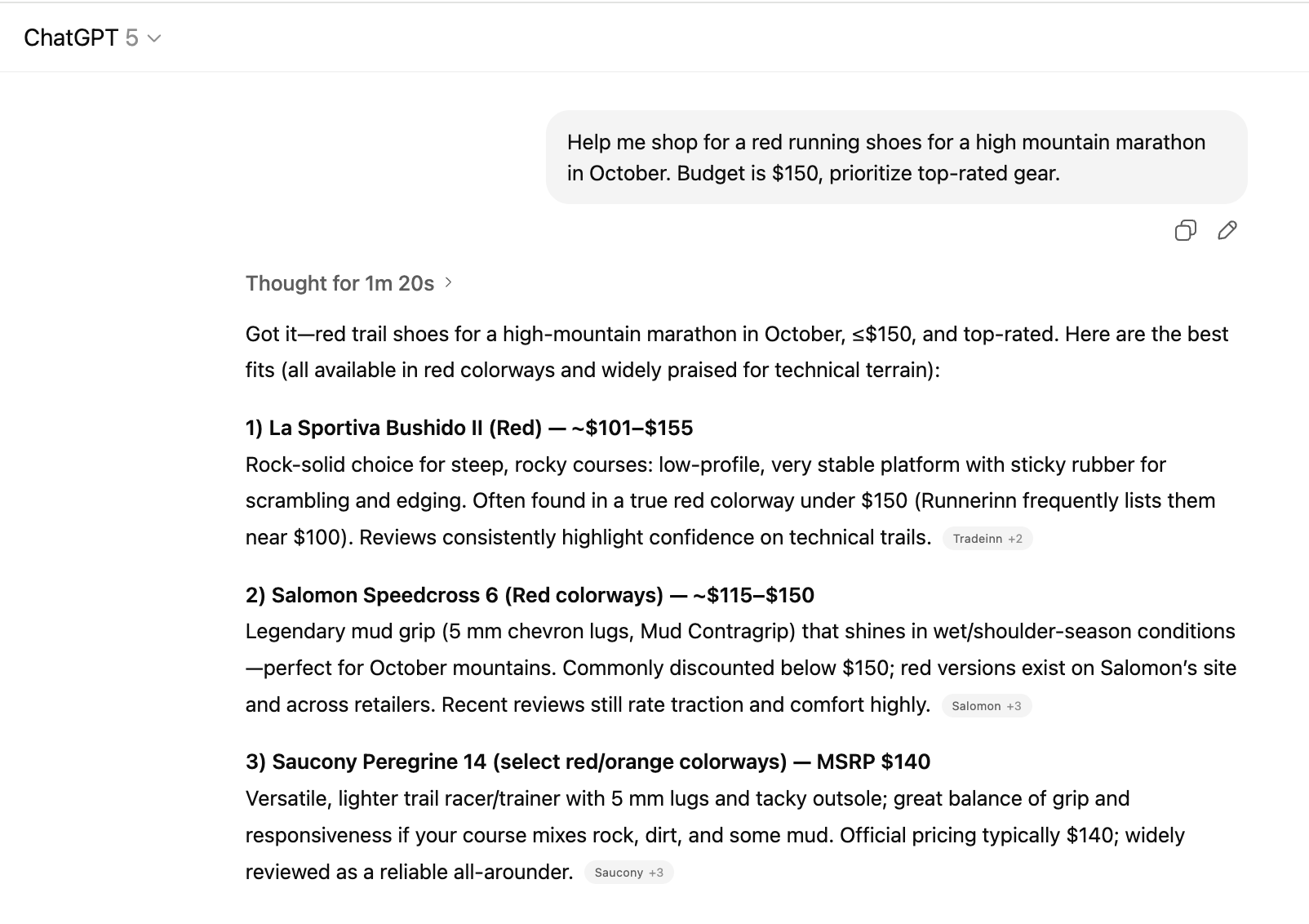
AI agents introduce a new model for ecommerce—agentic commerce—where shopping agents act autonomously on behalf of customers to find, compare, and purchase products. Rather than searching Google or directly navigating websites, consumers prompt AI agents on conversational platforms like ChatGPT. In return, they get a personalized shortlist of product recommendations in a fraction of the time.
This transformative trend toward AI shopping is already underway. Nearly 60% of consumers already use AI to shop, and 20% of Walmart's total referral traffic now comes from ChatGPT.
For retailers, this presents a challenge: When AI agents mediate the retail journey, they bypass retail interfaces. Instead, they query APIs and scan real-time inventory, product, and fulfillment data to identify the ideal product to recommend. To remain competitive, retailers must optimize for AI discoverability by ensuring product data is highly accurate and machine-readable. Deploying branded ecommerce AI agents is also key, enabling retailers to retain customer intelligence and win transactions over third-party agents.
Key AI technology: Generative engine optimization (GEO), standardized AI-action APIs, agent-specific identity protocols
2. Agentic architecture
AI agents also provide a new infrastructure for ecommerce, allowing merchants to both improve customer satisfaction and operational efficiency. By implementing agentic architecture, retailers can evolve from fragmented data and tools into one cohesive ecosystem that runs on unified customer data. This enables multi-agent systems, or teams of specialized agents, to collaborate in real time across formerly-siloed ecommerce platforms—using a 360-degree customer view to optimize operations and enhance CX at scale by dynamically adapting to each customer.
Beyond enabling autonomous agentic workflows, this structure also addresses a core risk of agentic commerce—disintermediation—where brand sites become mere inventory suppliers to third-party agents that determine what consumers see and buy. McKinsey warns that those lacking an agentic layer risk losing transactions and the customer data that compound into a durable advantage.
Key AI technology: Multi-agent AI frameworks, agent-to-agent (A2A) connectivity protocols, universal data layer (semantic data layer)
3. Proactive fraud prevention
AI agents move fraud prevention in ecommerce from reactive to proactive. By continuously monitoring transactions, evaluating purchase data, and identifying subtle irregularities that static systems may overlook, backend agents detect and act in real time to stop threats before they escalate.
Consider a multi-agent system with a fraud prevention agent. When a customer asks, "Where's my order?", the customer-facing agent queries the logistics, CRM, and carrier systems to verify delivery status, which triggers the fraud-detection agent. This agent assesses risk factors and queries verification systems, perhaps identifying issues such as a new card registered in a foreign country, or repeated refund requests. It can then pause the transaction, trigger step-up verification, and alert the fraud team, reducing chargebacks and preventing account takeovers without disrupting the experience for typical shoppers.
Key AI technology: Machine learning, adaptive authentication orchestration, graph neural networks
4. Hyper-personalized shopping
By embedding agents in websites, branded apps, messaging apps, SMS, and email—merchants can scale tailored shopping and support experiences across the customer journey. Critically, AI agents don’t personalize; they hyper-personalize. Rather than solely considering purchases and preferences, AI shopping concierges also analyze the customer’s immediate browsing context, dynamically adapting product recommendations, experiences, and offers to that exact moment and channel.
For example, delight.ai’s AI ecommerce agent analyzes real-time behavior alongside customer details stored in AI memory to tailor interactions to a “segment of one” instead of broad audience buckets, then suggests the “next best action” for that user on that specific channel to drive higher engagement and conversion rates than traditional methods. The result is more precise, targeted offers that significantly boost conversion rates among the 71% of consumers who expect consistently tailored interactions.
Key AI technology: Headless commerce APIs for recommendations, reinforcement learning, and session embeddings for dynamic adaptation
5. Autonomous support & post-purchase
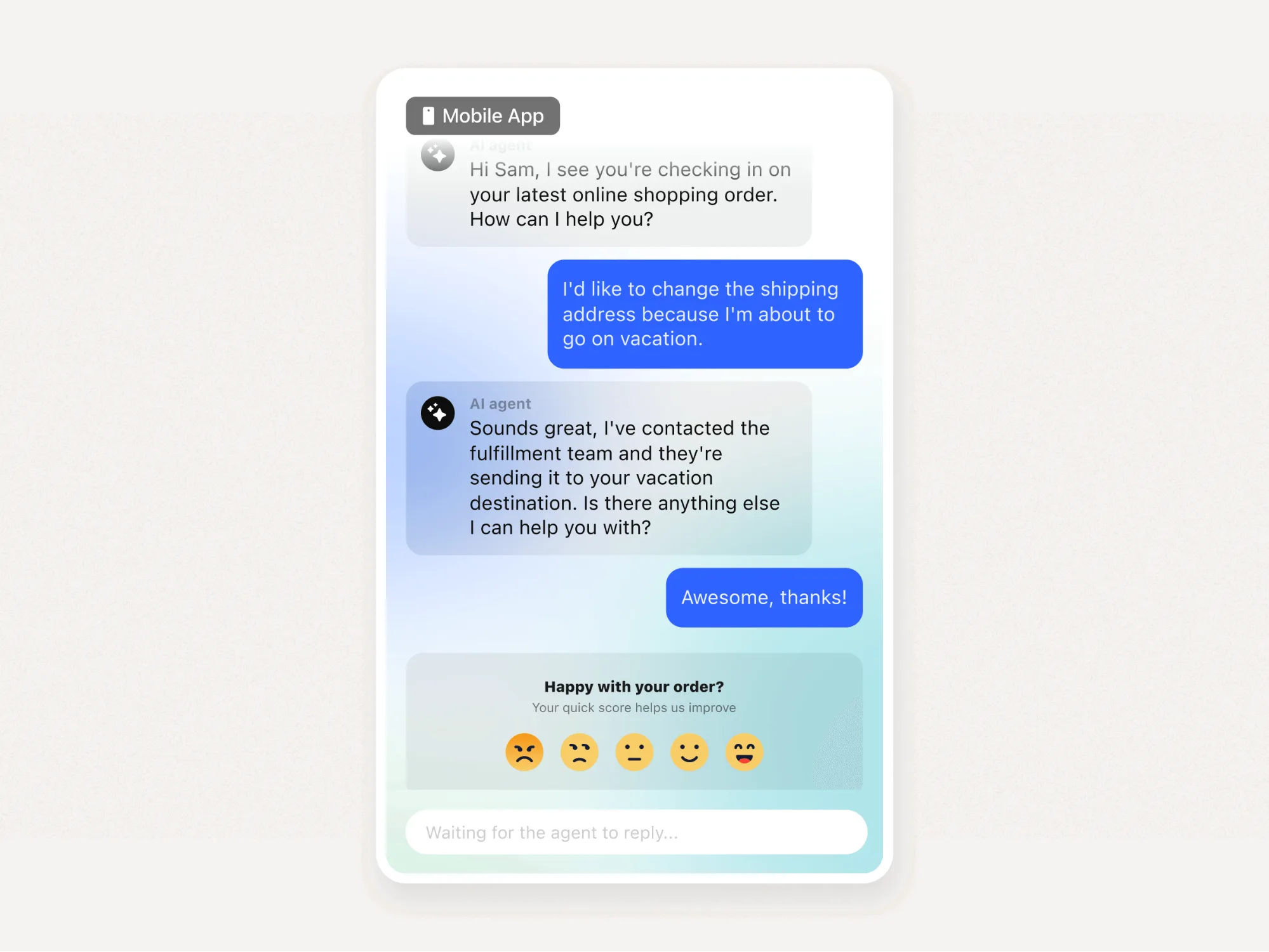
Unlike traditional ecommerce chatbots, AI agents can automate 80-90% of “Where is my order?” (WISMO) queries—and even execute complex tasks like return requests end-to-end. This level of autonomy changes the economics of support. AI-powered customer service can manage thousands of conversations at once, and it costs roughly the same to handle a product FAQ as a multi-step refund. By decoupling ticket volume from costs, AI enables support teams to improve operational efficiency as they also deliver a more seamless, satisfying experience.
Consider a peak-season scenario: a customer initiates a return on Black Friday via chat, then follows up later via email. With delight.ai’s AI concierge, the system retains context across channels and instantly picks up where the conversation left off. This eliminates both the friction of repeating information and the creation of duplicate tickets. At a time when 90% of consumers say the post-purchase experience is as important as the product, merchants are using AI to meet customer expectations for fast, consistent, personalized service across channels—without adding headcount.
Key AI technology: Agent memory platform for state management, AI agent governance for guardrails, NLU-based intent classifiers for intelligent routing
6. Proactive cart recovery
Cart abandonment is the scourge of ecommerce, representing a $18 billion issue for the industry—but AI agents can help. Using real-time behavioral analysis and large language models (LLMs), they engage customers in real-time using personalized two-way communication across WhatsApp, SMS, or phone calls with voice AI, often within minutes of abandonment.
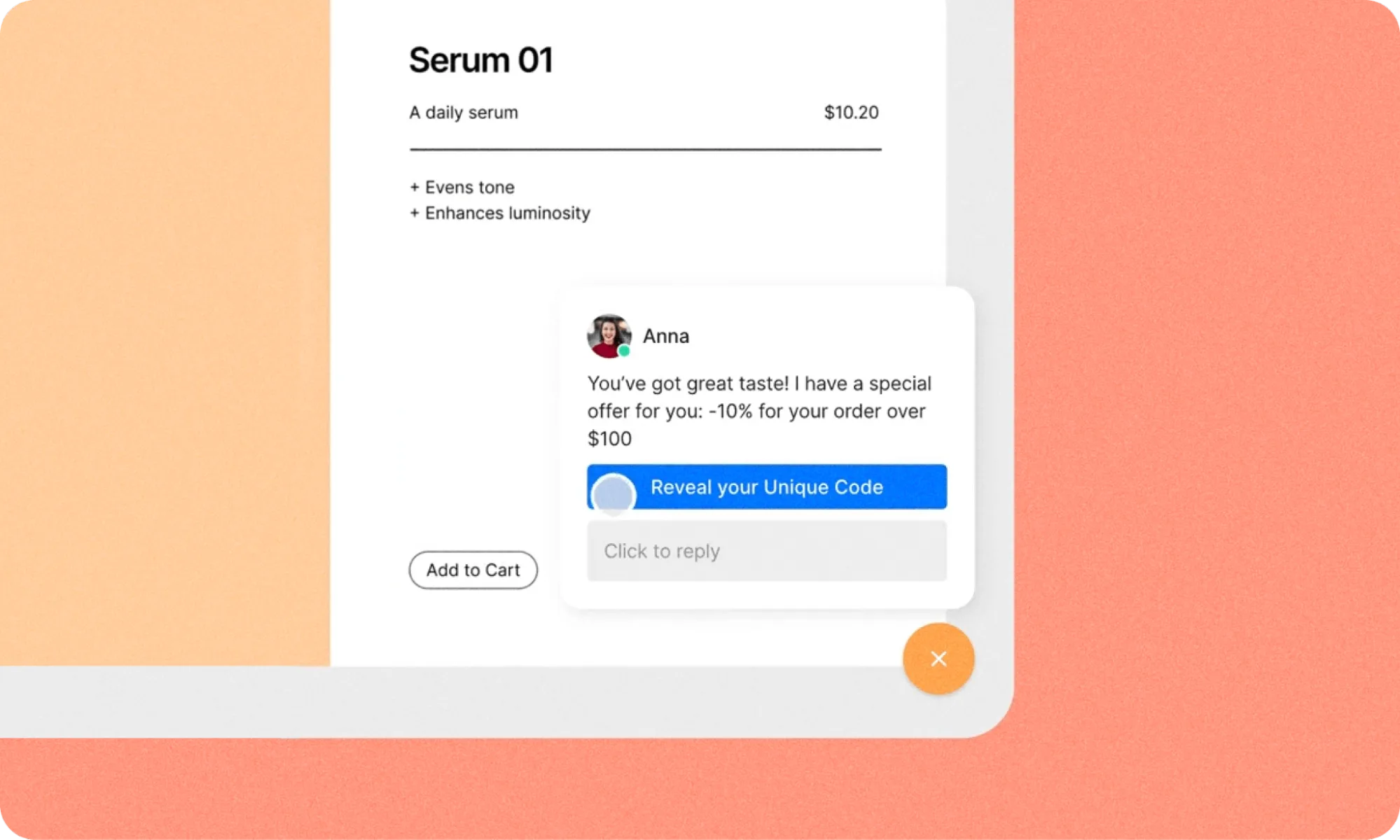
Proactive cart recovery takes this a step further by engaging customers directly in checkout. When it detects a shopper has stalled on the cart page, the agent instantly offers a coupon for free shipping or a discount before they bounce to close the sale. Using dynamic discounting, the agent evaluates whether a coupon is necessary in the moment, aiming to stay within the merchant's margin-safe limits.
Key AI technology: Conversational AI orchestrators, behavioral intent engines, prescriptive discount models
7. Conversational commerce & support
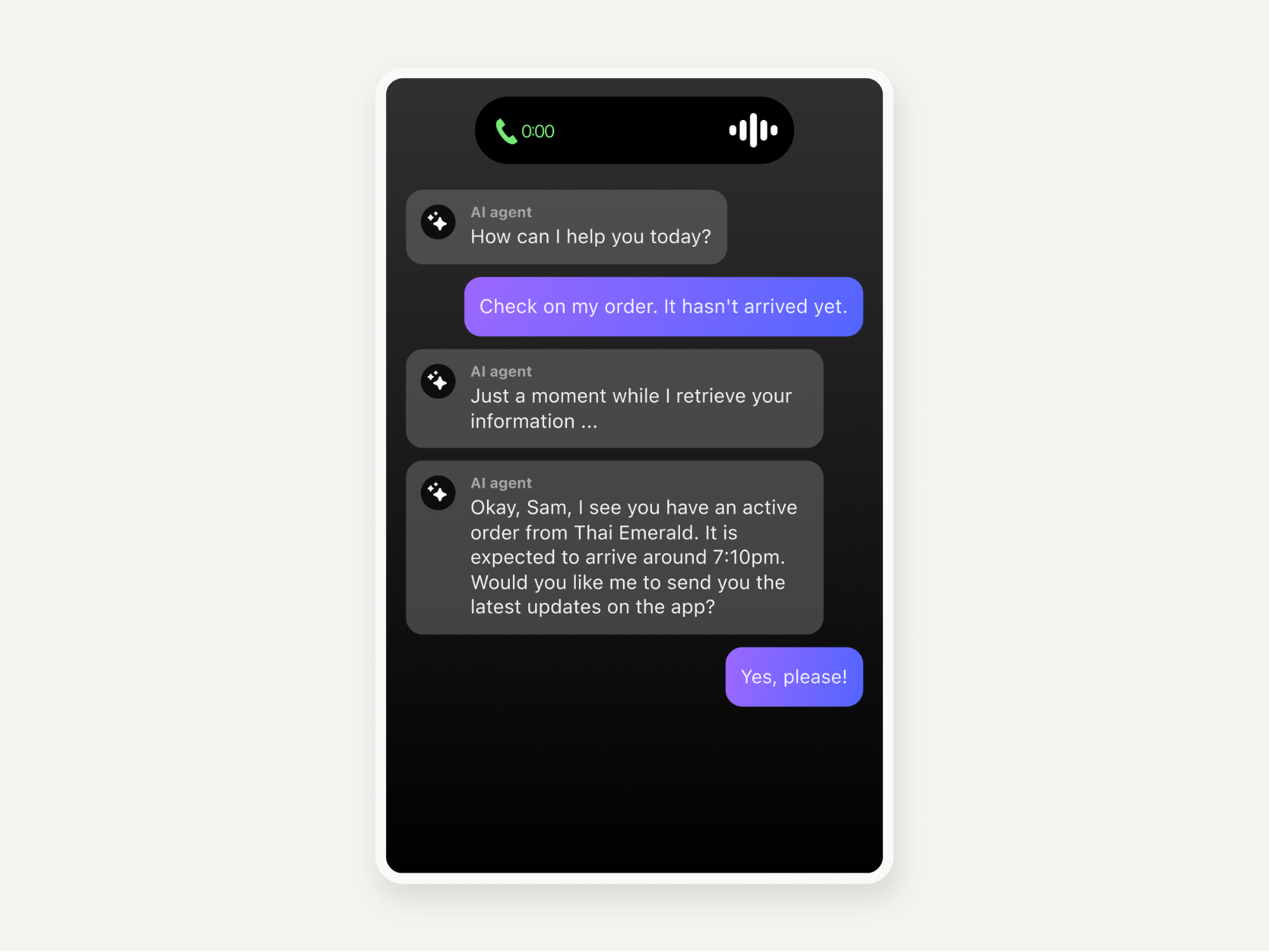
AI agents are turning conversational commerce into one of retail’s highest-ROI channels. Nearly 60% of consumers use voice-enabled AI assistants like Alexa to research products and make purchases. Meanwhile, shoppers who interact with agents like Amazon’s Rufus convert at nearly 4x the rate of those who don't. Conversational AI agents are becoming a primary interface for discovery, purchasing, and support.
Using natural language processing (NLP) and voice recognition, agents with voice AI can engage customers in real-time conversations across chat, voice, and messaging apps—offering seamless guidance from discovery to purchase to post-purchase. For example, Stitch Fix’s voice AI agent facilitates live conversations with human stylists who offer curated outfit suggestions. The same agent that acts as a shopping assistant can instantly pivot into support mode, offering 24/7 phone support for refunds or returns while gathering customer feedback to inform improvements.
Key AI technology: Natural language understanding (NLU), retrieval augmented generation (RAG), AI sentiment analysis
8. Optimized operations
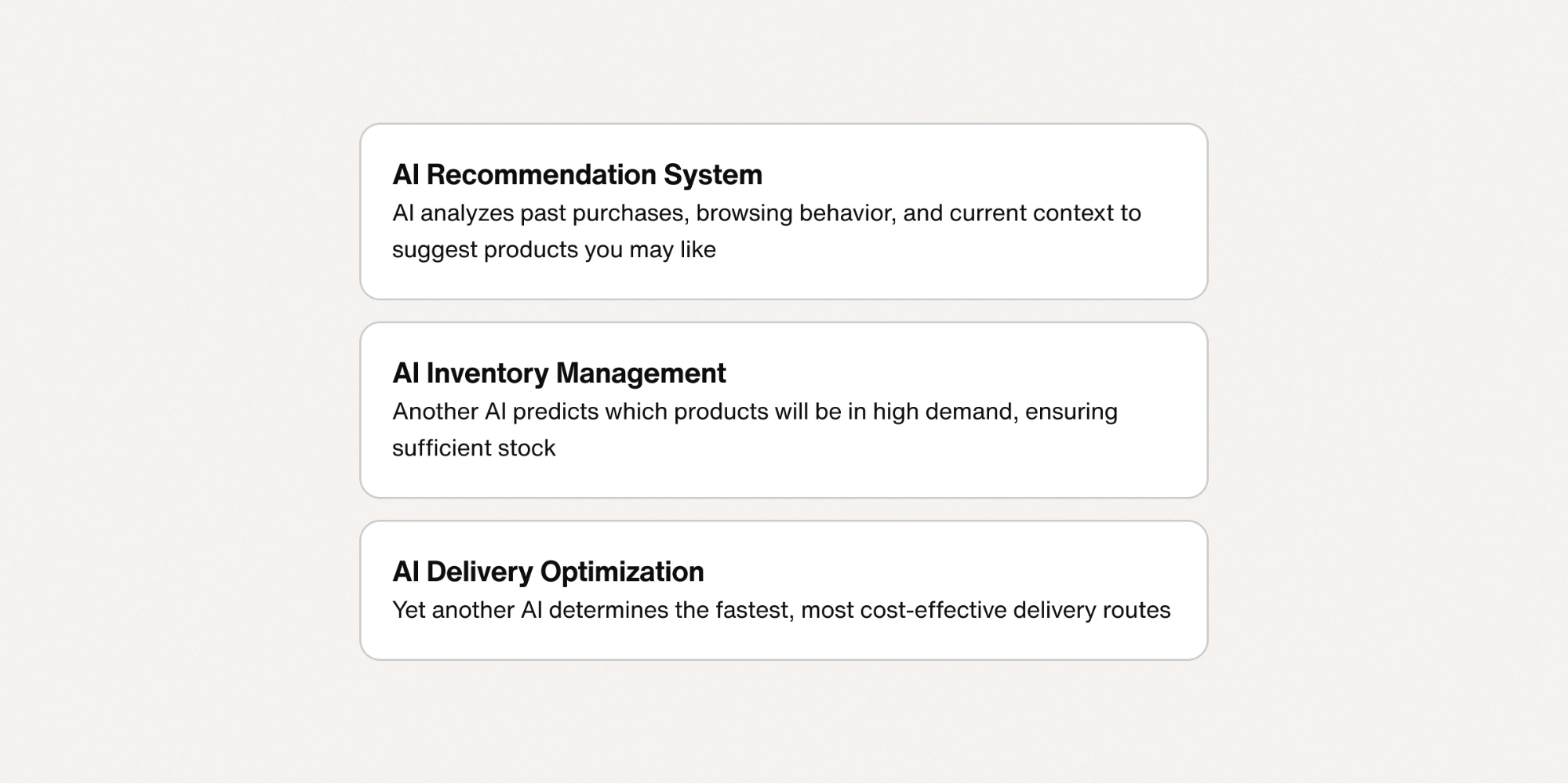
Multi-agent systems are reshaping how ecommerce businesses manage logistics, inventory, and fulfillment to increase profitability. By replacing workflows that once required manual coordination with networks of specialized AI agents that collaborate autonomously across systems, merchants can better predict demand, optimize inventory, and ensure timely delivery in ways no human team can match.
Amazon offers a clear example of this multi-agent orchestration: one agent forecasts demand, another manages inventory, and a third optimizes delivery routing. Critically, a manager agent—Amazon Q—acts as the reasoning layer across these verticalized agents, acting as an orchestrator by analyzing supply chain data, surfacing insights, and answering urgent operational questions in real time. Using this multi-agent system, Amazon increased its same-day deliveries by 30% in 2025, while lowering its cost-to-serve for the third consecutive year.
Key AI technology: Agentic frameworks for the orchestration layer, digital twin simulation for analysis, API-first tool use (function calling)
9. Loyalty program engagement
Loyalty programs drive strong revenue for brands, but only when customers choose to engage with their programs over competitors'. With AI agents for ecommerce, merchants can make their programs feel more tailored and unique to customers so they stand out from the rest.
Instead of sending the same offers to each member tailored by historical activity, AI agents use real-time behavioral signals—browsing patterns, churn propensity scores, redemption likelihood—to deliver the right incentive to each customer at the right time. For example, a customer with a high likelihood of churning gets a proactive retention offer, while a loyal member approaching a tier threshold gets a personalized nudge to close the gap.
Key AI technology: Uplift modeling (causal AI), next-best-action decision engines, generative AI for hyper-personalized asset creation
10. Dynamic pricing & inventory management
When powered by ML AI models, AI agents can replace manual pricing and reactive stock management with continuous autonomous optimization. Pricing agents monitor competitor feeds in real time, adjust prices based on demand and inventory levels, and apply personalized discounts at the cart level—predicting price elasticity with far greater accuracy to maximize both conversion and margin.
Meanwhile, inventory agents forecast demand at the SKU-and-location level, automatically trigger replenishment orders, and rebalance stock across warehouses and channels without human input. The result is a retail operation that responds to market conditions in minutes rather than days, helping merchants to reduce stockouts, clear slow-moving inventory, and protect margins at scale. Both of these dynamic approaches require guardrails, or minimum margin thresholds, to prevent AI algorithms from making mistakes that erode rather than protect margins and inventory balance.
Key AI technology: Reinforcement learning for autonomous pricing, deep learning for demand forecasting, agentic workflow orchestration for execution and guardrails
Bonus: Customer insights and optimization
By embedding AI agents across the retail funnel, merchants can gather the precise insights needed for continuous optimization. At the core of this approach is AI memory, a persistent system storing cross-channel behavioral signals, issues, and preferences. These insights feed into ecommerce systems to power everything from hyper-personalized marketing and dynamic pricing. The outcomes are then fed back into ML models, creating a cycle of continuous improvement that elevates decision-making for both human teams and AI systems.
This is also where the moat for agentic commerce is built. As third-party AI shopping agents increasingly mediate purchase decisions for consumers, the retailers with the richest, most structured customer intelligence are the ones whose products get recommended, whose personalized offers get surfaced, and whose loyalty programs factor into the agent's evaluation.
Key AI technology: Vector databases for AI memory systems, predictive analytics, customer knowledge graphs
Benefits of AI agents for ecommerce
AI agents offer a variety of advantages to both consumers and businesses compared to traditional automation and previous AI tools. Some of the major advantages include:
Hyper-personalization at scale
By using real-time context, memory, and data spanning systems and customer history, AI agents deliver a new level of tailored experiences to each customer to enhance brand loyalty and drive growth.
Seamless omnichannel engagement
Because agents operate across platforms using live data, they can provide a consistent CX across channels, for a smoother customer journey, fewer support queries, and better engagement.
Operational efficiency and cost reduction
By automating routine tasks like inventory checks and handling support queries instantly, agents free human teams to focus on high-value work, reducing costs and errors.
Data-driven decisions and insights
By tapping into live data from internal systems, third-party platforms, and market activity, AI agents bring real-time insights to drive analysis and decision-making, giving retailers a competitive advantage.
Scalability for all seasons and regions
When support tickets or customer queries surge, localized, multilingual AI agents can scale seamlessly to support product launches, seasonal traffic spikes, and global operations.
The future with AI agents for ecommerce
As the industry continues to evolve alongside agent capabilities, AI agents enable ecommerce merchants to pursue the highest-value use cases today, plus position themselves for leadership tomorrow.
By harnessing predictive analytics, generative AI, and customer-facing AI tools into a single harmonious, agentic ecosystem, AI agents are becoming essential to competitive operations in today's agentic commerce era—and whatever comes next.
To learn how delight.ai can help you build AI agents for ecommerce and retail, request and demo or contact sales.